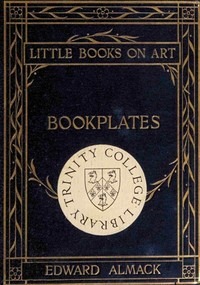
Bookplates by Edward Almack

(15 User reviews)   5058
Almack, Edward, 1852-1917 Almack, Edward, 1852-1917
English
Ever wonder about those little decorative labels inside old books? Edward Almack's 'Bookplates' isn't about a mystery you solve, but one you discover. It's a quiet journey into the forgotten art of the bookplate—those personalized stamps of ownership. Almack acts as your guide, showing how these tiny pieces of paper and ink tell big stories about who owned a book, what they valued, and the secret social codes of bibliophiles from centuries past. If you love old books, history, or just beautiful, curious things, this is a fascinating peek into a world most of us walk right past.
Share

Read "Bookplates by Edward Almack" Online

This book is available in the public domain. Start reading the digital edition below.

START READING FULL BOOK
Instant Access    Mobile Friendly

Book Preview

A short preview of the book’s content is shown below to give you an idea of its style and themes.

General remarks--Various modes of engraving--Styles in bookplates. Of course some people have exaggerated the importance of bookplates, and on the other hand some have affected to ignore them. Now the simple fact is that bookplates belong to books, and anything that has to do with books will assuredly charm cultivated minds until time shall be no more. If this essential point were oftener remembered, the exaggerations of both sides would be avoided. In Germany, a country where bookplates very early found a home, the word _bibliothekzeichen_, or library label, is used. Germans also use the name _ex libris_, and in France the Latin expression _ex libris_ is the only term in use. Naturally the owner’s name in the genitive case is always understood. In France manuscript inscriptions of ownership are very fittingly included as _ex libris_. It is too late to change now; but, at all events, whether included or not under any special word, manuscript inscriptions in books by their owners will always be a very interesting study. What, as explained above, are in France included under _ex libris_, were known long before the days of printing, as personal inscriptions with or without the delineation of armorial bearings are often to be found forming part of the text of books in manuscript. In fact the various relationships of wealthy patron, learned scribe, and skilled illuminator, gave much scope for these. To come to what may be said to be known everywhere as _ex libris_, is to treat of those wonderful days when the earliest printed books were still a novelty. Directly several people or institutions each had copies of a certain printed book, each copy being a duplicate of the other, a wish arose to distinguish ownership. Before treating further of bookplates, it will be well to clearly point out the different kinds of blocks or plates. The woodcut block, known in some manner to the Chinese 400 years before, was first cut in Europe early in the fifteenth century. The St. Christopher engraved in Germany in 1423, is probably the earliest. The piece of wood to be engraved was cut longwise with the grain, as a plank is cut to-day. A thin piece of some soft wood, such as pear, apple, or lime, was chosen, the design drawn upon it, and then with a knife the engraver cut away to a certain depth everything except the drawn design. In modern times--about 1785--a revolution took place in wood engraving, when Bewick began to engrave on a piece of wood cut endwise, and with a graver instead of a knife. Bewick chose some very hard wood, usually box. This manner has been continued to this day; and sometimes to distinguish the old art from the new, as the one is so different from the other, the former is called a woodcut and the latter wood-engraving. Next as to etchings. To produce an etching a copper plate is covered with wax, then with an etching-needle the design is drawn through the wax to the copper. Acid is then applied, which, of course, only eats out the copper where the design has been etched. Now as to copper-plate line engravings. The engraver first traces on the plate the outline of his design, and then with the triangular-pointed graver he furrows out the lines, inclining his graver deeper or shallower according as he wishes to produce varying effects. Copper-plate engraving has been practised ever since early in the fifteenth century. About 1820 engraving on steel came into vogue. More impressions can be taken from a steel than from a copper plate; but steel...

This is a limited preview. Download the book to read the full content.

This isn't a novel with a plot in the traditional sense. Think of it more as a guided tour through a museum you never knew existed. Edward Almack's Bookplates introduces you to the history and artistry of these small labels pasted inside books to mark ownership.

The Story

Almack walks you through the origins of bookplates, starting centuries ago when books were rare treasures. He shows how their designs evolved from simple coats of arms to intricate works of art, reflecting everything from a person's family history to their hobbies or professions. The 'story' is really the collective tale of the book lovers, nobles, and scholars who used these plates, leaving their personal stamp on the pages of history.

Why You Should Read It

I picked this up out of mild curiosity and ended up completely charmed. Almack's passion is contagious. The best part is how it changes the way you look at old books. Now, when I find a vintage book, I immediately check for a bookplate. That little label transforms it from just an old object into something with a past life and a previous owner. It makes history feel personal and tangible.

Final Verdict

Perfect for history buffs, antique book collectors, or anyone with a soft spot for niche, beautifully detailed subjects. It's a calm, informative read that feels like having a conversation with a deeply knowledgeable friend. You won't get thrilling twists, but you might get a wonderful new hobby—or at least, a new appreciation for the hidden stories waiting inside old bindings.


🟢 No Rights Reserved

You are viewing a work that belongs to the global public domain. Share knowledge freely with the world.

Amanda Miller
2 months ago

To be perfectly clear, it challenges the reader's perspective in an intellectual way. I couldn't put it down.

Sandra Wilson
1 year ago

Text is crisp, making it easy to focus.

Joshua Allen
6 months ago

Thanks for the recommendation.

Lisa Thomas
1 year ago

I was skeptical at first, but the author's voice is distinct and makes complex topics easy to digest. Exceeded all my expectations.

Dorothy Miller
1 year ago

The index links actually work, which is rare!

5
5 out of 5 (15 User reviews )

Add a Review

Your Rating *
There are no comments for this eBook.
You must log in to post a comment.
Log in


Related eBooks