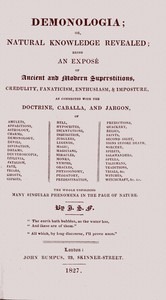
Demonologia : or, natural knowledge revealed; being an exposé of ancient and…

(19 User reviews)   5287
Forsyth, J. S. Forsyth, J. S.
English
Hey, have you heard about this wild old book I found? It's called 'Demonologia' by J.S. Forsyth, and it's not your typical spooky story. It’s a book from the 1800s that tries to explain all those ancient tales of demons, spirits, and possession... using pure science. The main hook is the author's bold claim: every supernatural event in history, from haunted houses to biblical miracles, can be broken down with logic, medicine, and psychology. It’s the ultimate historical skeptic's manifesto, arguing that our ancestors just didn't have the right tools to understand what was really happening. The conflict is right there in the title—it's a full-on 'exposé' against centuries of belief.
Share

Read "Demonologia : or, natural knowledge revealed; being an exposé of ancient and…" Online

This book is available in the public domain. Start reading the digital edition below.

START READING FULL BOOK
Instant Access    Mobile Friendly

Book Preview

A short preview of the book’s content is shown below to give you an idea of its style and themes.

Legends, miracles, prophecies, &c. are relics of superstitious ages. What also is extraordinary, is, that few species of superstition, if any, originated with the _populace_. They were the inventions of barbarous ages before the dawn of reason—afterwards the fabrications of men actuated by ambition, and a desire to servilize the human mind. As regards the Romans only, a people whom we are taught from our infancy to respect, and who, indeed, in their better days, were truly venerable for their virtue and valour, what is there in their history more astonishing than their implicit belief in augury[1]? Their belief in omens or preternatural appearances of the heavenly bodies, in eclipses, comets, and dreadful thunder-storms, may be forgiven. They had made small progress in astronomy; they had not learnt that an eclipse is a matter of common calculation; and that storms are, in most cases, highly beneficial to the earth, and nowise connected with past or future events. But when we find them giving implicit credit to their priests, who thought proper to predict good or evil, merely from the appearance of the entrails of sacrificed animals, from the flight of birds, from chickens, foxes, &c. we are at a loss to conceive how a deception of this kind could have prevailed, without being detected and exposed by the good sense of the people. The mob alone, or the common soldiers and sailors, were not merely influenced by the reports of the augurs[2]; their kings or commanders undertook no expedition without consulting these oracles, and were always unsuccessful, if they confided so much in themselves as to disregard their opinions. In some cases, it is easy to suppose that they might have been in concert with the augurs, to promote some favourite point, to raise an enthusiasm in the people in their favour, or to inspire the soldiers with fortitude in some dangerous enterprise. But it is not so easy to suppose that this was always the case, because, upon the evidence of their historians, it appears that there was generally but little connexion between them; and that, although the people looked to the commander for _orders_, they regarded the augurs as superior beings who were to grant _success_. The art of augury the Romans had from the Tuscans, and the Tuscans from the Greeks, who probably derived it from the Chaldeans; but the progress of the art is as absurd as the origin of it is obscure. The only wonder is, that it had so much influence upon a people, in the whole of whose history we find so many brilliant examples of solid sense, of learning, and of eloquence. Their historians, who rank among the most learned of their writers, and of whose abilities we can even now be judges, gravely relate the process of consulting augury, and the success of it. Yet the augurs were men following one another in regular succession. Was there none to betray the secret? Was the art of juggling an hereditary secret without one interruption? Tyranny first broke the chain. When Rome was governed by tyrants, these despised augury, and prosecuted their wicked purposes, whatever might be the appearance of the entrails of an ox; and as they, no doubt, often succeeded in their enterprises, augury would naturally fall into disrepute. These circumstances, in the great chain of causes and events, would naturally pave the way for a more rational religion. We are indebted to Henry VIII. for the commencement of the reformation; but, if the pope would have sanctioned his lust and his extortion, that advantage would have probably been derived from...

This is a limited preview. Download the book to read the full content.

J.S. Forsyth's 'Demonologia' is a fascinating time capsule. Written in the 19th century, it sets out on a single-minded mission: to dismantle the entire concept of the supernatural by applying the period's understanding of science and reason.

The Story

There isn't a plot in the traditional sense. Instead, the book is a systematic argument. Forsyth marches through history, from ancient myths to more recent cases of 'demonic possession.' He takes each story—the whispers in the dark, the reports of levitation, the speaking in tongues—and proposes a natural cause. Was it a hallucination from fever? A clever trick? A misunderstood mental illness? He acts like a detective for the rational mind, offering alternative explanations for what people once called magic or miracles.

Why You Should Read It

What grabbed me wasn't whether Forsyth was right or wrong by today's standards. It was watching a human mind from the past so confidently try to clean up the messy, frightening parts of history with the broom of science. You can feel his passion to make the world make sense. It's less about ghosts and more about us—about how every generation uses the best tools it has to explain the unexplained. The book itself becomes a historical artifact, showing what 'logic' looked like 200 years ago.

Final Verdict

Perfect for history buffs, skeptics, or anyone who loves a good intellectual puzzle. If you enjoy seeing how people in the past wrestled with big questions, or if you like the idea of a Victorian-era author doing a 'mythbusters' on demonology, you'll find this incredibly engaging. It's not a scary book; it's a confident, almost brazen, attempt to explain away the scary.


ℹ️ Copyright Status

This digital edition is based on a public domain text. Use this text in your own projects freely.

Kenneth Hill
2 years ago

Five stars!

Edward Thomas
6 months ago

Enjoyed every page.

Paul Scott
7 months ago

I stumbled upon this title and it provides a comprehensive overview perfect for everyone. A valuable addition to my collection.

Ava Smith
1 year ago

The layout is very easy on the eyes.

Ethan Williams
6 months ago

I was skeptical at first, but the arguments are well-supported by credible references. Exactly what I needed.

5
5 out of 5 (19 User reviews )

Add a Review

Your Rating *
There are no comments for this eBook.
You must log in to post a comment.
Log in


Related eBooks