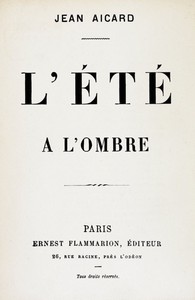
L'Été à l'ombre by Jean Aicard

(11 User reviews)   1772
Aicard, Jean, 1848-1921 Aicard, Jean, 1848-1921
French
Okay, so picture this: a quiet French village in the late 1800s, where everyone knows everyone's business. Into this world walks a mysterious stranger. He's handsome, seems decent enough, but he carries this heavy secret that nobody can quite figure out. The locals are buzzing with gossip. Is he a nobleman hiding from his past? A criminal? Or just a man looking for a fresh start? The whole village gets pulled into the puzzle, especially the young women who find him intriguing. 'L'Été à l'ombre' is less about a big, dramatic event and more about the slow, simmering tension of a secret in a small town. It's about how curiosity can turn into obsession, and how a single outsider can make a whole community question itself. If you love character-driven stories where the real action is in the whispers and sideways glances, this is your summer read. It’s a quiet, moody little book that sticks with you.
Share

Read "L'Été à l'ombre by Jean Aicard" Online

This book is available in the public domain. Start reading the digital edition below.

START READING FULL BOOK
Instant Access    Mobile Friendly

Book Preview

A short preview of the book’s content is shown below to give you an idea of its style and themes.

songe du lecteur satisfait achève et embellit les rêves du conteur... * * * * * Lis mon livre l’été, à l’ombre. J. A. La Garde-près-Toulon, 10 juillet 1895. LA VIERGE PALE A Gaston Bonnier. I Il mettait au-dessus de sa tête angélique deux petites ailes courtes, légères et blanches, le bonnet d’Yvonne. Yvonne était blonde, avec des yeux très bleus et un visage pâle, pâle comme le visage de ces madones en cire qu’on voit dans les églises de village, enfantines et anciennes, sous des globes de verre. Oui, elle avait l’air d’une sainte mystique, la douce et blanche Yvonne, et c’est pour cela que Jacques l’avait aimée. II Jacques Kardec, lieutenant de vaisseau, avait vingt-huit ans. Avec un bon esprit très droit, net, ferme, il avait un cœur excellent. Il était sorti en bon rang de l’École navale. De taille moyenne, mais très fort, il se vantait de sa force avec un joli rire jeune, plein de mépris pour les faibles, et qui cependant n’avait pour eux rien d’offensant. On ne pardonne pas «un plus fort»; on pardonne «un trop fort», contrairement à ce qui arrive dans l’ordre intellectuel, où l’on prend moins ombrage du simple talent que du génie, jusqu’à l’heure du moins où le génie s’est imposé... Quand la conversation «s’amenait» sur la force physique, Jacques tirait en silence de sa poche une pièce de dix francs en or--et, doucement, doucement, entre ses doigts, il la ployait comme du plomb. Ou bien il faisait apporter un jeu de cartes, et les trente-deux cartes étaient déchirées à la fois, tout doucement... C’était l’amusement des carrés d’officiers, cette manie de Jacques. Tout le monde essayait de l’imiter, au milieu des rires. Un tel ne parvenait à déchirer que douze cartes à la fois; un autre en déchirait vingt. Personne ne ployait la pièce de dix francs. Il avait une volonté qui était d’acier, comme ses doigts. Un cou de taureau, des épaules d’hercule. Pas très grand, je l’ai dit. Avec cela, marqué pour devenir le type du «marin énergique»... Le contraire d’un poète fade... Et pourtant l’amour prit le cœur de Jacques entre ses petits doigts et le ploya, le ploya... comme la pièce de dix francs... le déchira, le déchira... comme le jeu de trente-deux cartes. III --Jacques, mon fils, à quoi te mènera cet amour? Cette Yvonne n’est pas du tout ce qu’il te faut. C’est une demi-bourgeoise qui n’a qu’une demi-éducation. Je ne te dirai pas qu’elle n’a point de fortune; cela n’est pas grave, puisque tu en as, mais le fils de l’amiral Kardec ne peut pas, ne doit pas épouser cette fille. Réfléchis, mon doux Jacques. Si ton père vivait, tu l’écouterais, lui! Il te ferait comprendre. Jacques secouait la tête et, à toute objection, répondait simplement, obstinément, patiemment: --Je l’aime! Sa mère se sentait vaincue. Elle connaissait l’entêtement des Kardec: «Jacques est butté», se disait-elle, comme au temps où l’amiral opposait à la sienne une de ces volontés inflexibles qui avaient fait de lui un chef de premier ordre. Alors, la pauvre mère, avec timidité, essaya de dire, pour finir: --Tu sais, une fois, avec Jean Lepic, le matelot, cette fille a fait parler d’elle... --Je connais cette histoire, dit Jacques, ne m’en parlez plus jamais, je vous en prie, ma mère... Et il serait fâcheux qu’une autre personne que vous m’en parlât!... Vous conviendrez bien qu’avant de me connaître, Yvonne a pu sentir son cœur battre, sans qu’on ait le droit de lui en faire un crime. Elle a souri à ce Jean Lepic, peut-être... Nous avons tous eu de ces...

This is a limited preview. Download the book to read the full content.

Jean Aicard's L'Été à l'ombre (which translates to 'Summer in the Shade') is a classic French novel that feels surprisingly modern in its focus on psychology and social observation. Published in 1878, it captures a specific time and place, but the human emotions at its core are timeless.

The Story

The plot is elegantly simple. A stranger arrives in a Provençal village. He rents a house, keeps to himself, and politely avoids answering too many questions about his life before. His presence acts like a stone thrown into a still pond. The ripples touch everyone: the young women who are drawn to his melancholy charm, the men who are suspicious of his refined manners, and the busybodies who weave elaborate theories about his past. The entire novel builds on the suspense of his unknown history. We follow the villagers as they watch, speculate, and project their own hopes and fears onto this enigmatic figure. The 'conflict' isn't a sword fight or a chase; it's the quiet, relentless pressure of a community trying to solve a human mystery.

Why You Should Read It

I fell for this book because of its atmosphere. Aicard paints the South of France so vividly you can almost feel the heat and smell the lavender. But more than that, he is a master of quiet tension. You read not for a shocking twist, but for the delicate unraveling of social facades. The stranger is a mirror, and each villager sees something different in him. It’s a fascinating study in how gossip works, how quickly we judge others, and the universal longing to understand what is hidden. The characters feel real—flawed, curious, and often a little foolish in their assumptions.

Final Verdict

This book is perfect for readers who love slow-burn, atmospheric stories. If you enjoy authors who explore the complexities of small-town dynamics or the weight of personal history, you'll find a lot to love here. It’s not a fast-paced thriller; it's a thoughtful, simmering portrait of a community under the spell of a secret. Think of it as a literary version of people-watching at a café, where the most ordinary interactions hint at deeper dramas. A true hidden gem for a lazy afternoon.


🟢 No Rights Reserved

This work has been identified as being free of known copyright restrictions. Thank you for supporting open literature.

Oliver Davis
5 months ago

Amazing book.

Ava Thompson
2 months ago

I didn't expect much, but the author's voice is distinct and makes complex topics easy to digest. I couldn't put it down.

Jessica Hernandez
3 months ago

Solid story.

Emily Johnson
1 year ago

I started reading out of curiosity and the content flows smoothly from one chapter to the next. Worth every second.

Oliver Robinson
6 months ago

Read this on my tablet, looks great.

5
5 out of 5 (11 User reviews )

Add a Review

Your Rating *
There are no comments for this eBook.
You must log in to post a comment.
Log in


Related eBooks