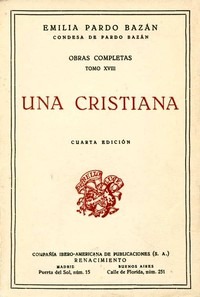
Una Cristiana by condesa de Emilia Pardo Bazán

(17 User reviews)   5174
Pardo Bazán, Emilia, condesa de, 1852-1921 Pardo Bazán, Emilia, condesa de, 1852-1921
Spanish
Hey, have you ever felt trapped by what everyone expects of you? That's exactly where we find our heroine in 'Una Cristiana.' Imagine this: a young, devout woman named Carmen is about to become a nun. It's what her family wants, and it's what she's always thought she wanted. But then she meets a skeptical, free-thinking man named Salustio, who starts asking her the big questions about life, faith, and freedom. The whole book is this intense, quiet battle between duty and desire, between unquestioning faith and the terrifying, exciting possibility of choosing your own path. It's less about dramatic action and more about the earthquake happening inside one person's soul. If you like stories about internal conflict and society's pressure, you'll be hooked.
Share

Read "Una Cristiana by condesa de Emilia Pardo Bazán" Online

This book is available in the public domain. Start reading the digital edition below.

START READING FULL BOOK
Instant Access    Mobile Friendly

Book Preview

A short preview of the book’s content is shown below to give you an idea of its style and themes.

cuerpo con objeto de prepararme a ingresar en la Escuela de Caminos. Por supuesto, Aritmética y Álgebra; sobra decir que Geometría. A más, Trigonometría y Analítica; y por contera Descriptiva y Cálculo diferencial. Luego (prendidito con alfileres, si he de ser franco) idioma francés; y cosido a hilván, muy deprisa, el inglés, porque al señor de alemán no quise meterle el diente ni en broma: me inspiraban profundo respeto los caracteres góticos. A continuación, los infinitos «dibujos»: el lineal, el topográfico y también el de paisaje, que supongo tendrá por objeto el que al manejar el teodolito y la mira, pueda un ingeniero de caminos distraerse inocentemente rasguñando en su álbum alguna vista pintoresca, ni más ni menos que las _mises_ cuando viajan. Siguió al ingreso el cursillo, llamado así en diminutivo para que no nos asustemos. En él no entran sino cuatro asignaturas para hacer boca: Cálculo integral, Mecánica racional, Física y Química. Durante el año del cursillo no nos metimos en más dibujos; pero al siguiente (que es el primero de la carrera propiamente dicha) nos tocaban --aparte de profundizar los Materiales de construcción, la Mecánica aplicada, la Geología y la Estereotomía-- dos dibujitos nuevos: el dibujo a pluma, «de sólidos», y el «lavado». Yo no fuí de los alumnos más exageradamente _empollones_, pero como tampoco era de los más lerdos (aunque me esté mal el decirlo), supe machacar el hierro según convenía que se machacase, y acudir a la paciencia y a la tenacidad en asignaturas donde no bastando el ejercicio del entendimiento hay que forzar el automatismo de la memoria. Tuve algún tropiezo, pues no es fácil evitarlos al seguir una carrera en que deliberadamente se aprietan las clavijas a los alumnos, con el fin de sacar el número justo para cubrir las plazas vacantes. Año arriba o abajo, era seguro el éxito, y mi madre, que costeaba mi carrera ayudada por su único hermano, llevaba con relativa resignación, cuanta permitía su carácter, mis fracasos, por constarle que no eran muchos, y que al salir ingeniero hecho y derecho, tenían en el bolsillo los nueve mil... y dietas. Ni todos los tropiezos fueron de los que pueden evitarse, aun desplegando la mayor asiduidad del mundo. Un año estuve enfermo de anemia, complicada después con viruelas locas; y este incidente y otros que no hacen al caso, explicarán cómo, gozando fama de joven estudioso y persona medianamente culta, hube de encontrarme a los ventiún años cursando el segundo de la carrera; es decir, faltándome tres para terminarla. El año anterior, o sea el primero de la carrera propiamente dicha, me ví precisado a dejar alguna asignatura para los exámenes de Septiembre. Atribuyo este incidente, siempre desagradable, a la influencia maléfica de cierta posada donde me alojé por tentación del diablo. El tiempo pasado allí me dejó indelebles recuerdos que me traen risa a los labios y vislumbres de indiscreto júbilo al alma cuando los evoco. Algo referiré de esta posada, y ustedes dirán si Arquímedes en persona sería capaz de estudiar en semejante madriguera. Hay todavía en Madrid tres o cuatro casas --verbigracia, la de los Corralillos, la de los Cuartelillos, la de Tócame Roque-- muy semejantes a la que voy a describir. En su recinto se apiñaba el vecindario de un mediano poblachón; tenía sus tres patios con balconada, sobre la cual se abrían las puertas de los cuchitriles o tabucos, numeradas en los dinteles; y no faltaban sus inquilinas desvergonzadas y reñidoras, sus ciegos entonando coplejas al son de destemplado guitarrillo, sus gatos atacados de neurosis correteando de bohardilla a bohardilla y de baranda a...

This is a limited preview. Download the book to read the full content.

Published in 1890, Emilia Pardo Bazán's Una Cristiana (A Christian Woman) throws us into a world where personal choice is a radical act. The author, a fierce advocate for women's rights, uses this novel to explore the cages—both religious and social—that confined women of her time.

The Story

Carmen is a young woman raised in a strict, traditional Catholic family. Her path seems set: she is devout and preparing to enter a convent, fulfilling her family's pious expectations. Her life takes a sharp turn when she meets Salustio, her brother's intellectual friend. He's a man of science and reason, skeptical of blind faith. Through their conversations, he challenges everything Carmen has ever believed. He doesn't just question religion; he questions her lack of freedom to choose. The core of the story is Carmen's internal struggle as these new ideas clash with a lifetime of conditioning, forcing her to decide who she really is.

Why You Should Read It

What makes this book so powerful is how real Carmen's conflict feels. It's not a simple 'good vs. evil' story. Pardo Bazán shows us the genuine comfort and security Carmen finds in her faith, which makes her potential rebellion all the more painful and courageous. You're right there with her, feeling the weight of every doubt. The debates between Carmen and Salustio are like watching two different worlds collide, and it makes you think about your own beliefs and assumptions.

Final Verdict

This is a perfect pick for readers who love character-driven stories and historical fiction that tackles big ideas. If you enjoyed the internal conflicts in novels like Madame Bovary or The Age of Innocence, you'll find a kindred spirit in Carmen. It's a slow-burn, thoughtful novel that proves the most intense battles are often the ones fought in silence, within our own hearts and minds.


🟢 Open Access

No rights are reserved for this publication. Distribute this work to help spread literacy.

Elijah Walker
1 year ago

Honestly, the depth of research presented here is truly commendable. Highly recommended.

Jackson Johnson
1 year ago

A must-have for anyone studying this subject.

Betty Robinson
11 months ago

Five stars!

Margaret Robinson
1 year ago

Simply put, the depth of research presented here is truly commendable. Highly recommended.

Nancy Wilson
5 months ago

Helped me clear up some confusion on the topic.

4.5
4.5 out of 5 (17 User reviews )

Add a Review

Your Rating *
There are no comments for this eBook.
You must log in to post a comment.
Log in


Related eBooks