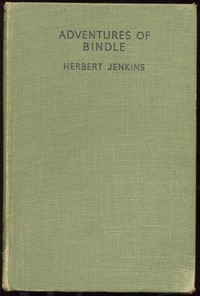
Adventures of Bindle — A Reader’s Guide
Edition facts
For Adventures of Bindle — A Reader’s Guide, the stored edition analysis reports 67,733 words, 4 hr 55 min estimated reading time, and 7 detected text sections.
The text analysis averages about 12.2 words per sentence, while the detected sections provide another way to judge how the source is divided.
Project Gutenberg metadata also associates the work with “Humorous stories,” connecting these edition facts with the source record’s subject description.
Calculated from edition completeness, EPUB availability, text structure and catalogue metadata. Not a user rating.
How this score is calculated
- Description quality20 pts
- Title & short description10 pts
- Source metadata20 pts
- Text length15 pts
- Chapters / structure15 pts
- EPUB file integrity20 pts
Total of 100 points, scaled to a 2.5-5.0 range. Editions with an empty description or a missing EPUB file are not scored.
Read the Text
Bindle looked up from the paper at Mrs. Bindle.
"Well?" she challenged.
He turned once more to the paper and re-read the advertisement with great deliberation, forgetful of his fast-cooling plate.
"Well," remarked Bindle judicially, "this is a Christian 'ome right enough, plenty of soap an' water, with an 'ymn or two thrown in so as you won't notice the smell. Cookin's good likewise, an' as for 'ome-comforts, if we ain't got 'em, who 'as? There's sweepin' an' scrubbin' an' mats everywhere, mustn't smoke in the parlour unless you 'appen to be the chimney, and of course there's you, the biggest 'ome-comfort of all. Yes! Mrs. B.," he concluded, shaking his head with gloomy conviction, "we got enough 'ome comforts to start a colony, I'm always trippin' over 'em."
"Eat your pie," snapped Mrs. Bindle, "perhaps it'll stop your mouth."
Bindle applied himself to the apple-pie with obvious relish, glancing from time to time at _The Gospel Sentinel_.
"Well?" demanded Mrs. Bindle once more.
"I was jest wonderin'," said Bindle.
"I was jest wonderin'," continued Bindle, "why we want a lodger, us like two love-birds a-singin' an' a-cooin' all day long."
"What about the housekeeping?" demanded Mrs. Bindle aggressively.
"The 'ousekeepin'?" enquired Bindle innocently.
"Yes, the housekeeping," repeated Mrs. Bindle with rising wrath, as if Bindle were directly responsible, "the housekeeping, I said, and food going up like--like----"
"'Ell," suggested Bindle helpfully.
"How am I to make both ends meet?" she demanded.
"I suppose they must meet?" he enquired tentatively.
"Don't be a fool, Bindle!" was the response.
"I ain't goin' to be a fool with that there lodger 'angin' about," retorted Bindle. "If 'e starts a-playin' about wi' my 'Ome Comfort, 'e'll find 'is jaw closed for alterations. I'm a desperate feller where my 'eart's concerned. There was poor 'ole 'Orace only the other day. Jest back from the front 'e was."
Bindle paused and shook his head mournfully.
"Horace who?" demanded Mrs. Bindle.
"'Orace Gaze," replied Bindle. "Nice cove too, 'e is.
"''Ullo! 'Orace,' I calls out, when I see 'im jest a-comin' from the station with all 'is kit.
"'The missis'll be glad to see you,' I says.
"'She don't know I'm 'ere yet,' 'e says.
"'Didn't you send 'er a telegram?' I asks.
"'Telegram!' says 'e, 'not 'arf.'
"'Lord! ain't you a mug, Joe!' says 'e; 'you don't catch me a-trustin' women, I got my own way, I 'ave,' says 'e, mysterious like.
"'What is it?' I asks 'im.
"'Well, I goes 'ome,' says 'e, ''er thinkin' me at the front, rattles my key in the front door, then I nips round to the back, an' catches the blighter every time!'"
"I won't listen to your disgusting stories," said Mrs. Bindle angrily.
"Disgustin'?" said Bindle incredulously.
"You've a lewd mind, Bindle."
"Well, well!" remarked Bindle, "it's somethink to 'ave a mind at all, it's about the only thing they don't tax as war profits."
"You'll have to be careful when the lodger comes." There was a note of grim warning in Mrs. Bindle's voice.
"Lodgers ain't to be trusted," said Bindle oracularly. "If you expects 'em to pinch your money-box, orf they goes with your missis; an' if you're 'opin' it'll be your missis, blowed if they don't pouch the canary. No!" he concluded with conviction, "lodgers ain't to be depended on."
"That's right, go on; but you're not hurting me," snapped Mrs. Bindle, rising to clear away. "You always oppose me, perhaps you'll tell me how I'm to feed you on your wages." She stood, her hands on her hips, looking down upon Bindle with challenge in her eye.
"My wages! why, I'm gettin'----"
"Never mind what you're getting," interrupted Mrs. Bindle. "You eat all you get and more, and you know it. Look at the price of food, and me waiting in queues half the day to get it for you. You're not worth it," she concluded with conviction.
"I ain't, Mrs. B.," replied Bindle good-humouredly, "I ain't worth 'alf the love wot women 'ave 'ad for me."
Mrs. Bindle sniffed. "You always was fond of your food," she continued, as if reluctant to let slip a topic so incontrovertible.
"I was, Mrs. B.," agreed Bindle; "an' wot is more I probably always shall be as long as you go on cookin' it. Wot I shall do when you go orf with the lodger, I don't know," and Bindle wagged his head from side to side in utter despondency.
Mrs. Bindle made an unprovoked attack upon the kitchen fire.
"Well," said Bindle after a pause, "if it's rations or a lodger, I suppose it's got to be a lodger," and he drew a deep sigh of resignation. He turned once more to _The Gospel Sentinel_. "Musical, too, ain't 'e," he continued. "I wonder wot 'e plays, the jews' 'arp or a drum? Seems a rare sport 'e does, chapel-goer, temperance, quiet, musical, fond of 'ome-comforts, good cookin'; an' don't want to pay much; regular blood I should call 'im."
"He's coming to-night to see the place," Mrs. Bindle announced, "and don't you go and make me feel ashamed. You'd better keep out of the room."
"'Ow could you!" cried Bindle reproachfully, as he proceeded to light his pipe. "Me----"
"Don't do that!" snapped Mrs. Bindle.
Bindle regarded her over the flaming match with eyebrows raised interrogatingly.
"Perhaps he doesn't smoke," she explained.
"But I ain't goin' to give up tobacco," said Bindle with decision. "'Oly Angels! me with a wife an a lodger an' no pipe!"
He looked about him as if in search of sympathy. Then turning to Mrs. Bindle, he demanded:
"You mean to say I got to give up smokin' for a lodger!" Indignation had smoothed out the wrinkles round his eyes and stilled the twitchings at the corners of his mouth.
"It doesn't matter after he's here," Mrs. Bindle responded sagely.
Slowly the set-expression vanished from Bindle's face; the wrinkles and twitches returned, and he breathed a sigh of elaborate relief.
"Mrs. B.," he said admiringly, "you 'aven't lived for nineteen years with your awful wedded 'usband, lovin', 'onourin' an' obeyin' 'im--I don't think--without learnin' a thing or two." He winked knowingly.
"Yes," he continued, apparently addressing a fly upon the ceiling, "we'll catch our lodger first an' smoke 'im afterwards, all of which is good business. Funny 'ow religion never seems to make you too simple to----"
Bindle was interrupted by a knocking at the outer-door. Mrs. Bindle performed a series of movements with amazing celerity. She removed and folded her kitchen-apron, placing it swiftly in the dresser-drawer, gave a hasty glance in the looking-glass over the mantelpiece to assure herself that all was well with her personal appearance and, finally, slipped into the parlour to light the gas. She was out again in a second and, as she passed into the passage leading to the outer-door, she threw back at Bindle the one word "Remember," pregnant with as much meaning as that uttered two and a half centuries before in Whitehall.
"Nippy on 'er feet is Mrs. B.," muttered Bindle admiringly, as he listened intently to the murmur of voices and the sound of footsteps in the passage. Presently the parlour-door closed and then--silence.
Bindle fidgeted about the kitchen. He was curious as to what was taking place in the parlour and, above all, what manner of man the prospective lodger would turn out to be. He picked up the evening paper, endeavouring to read what the Austrian Prime Minister thought of the prospects of peace, what Berlin thought of the Austrian Prime Minister, what the Kaiser thought of the Almighty, and what the Almighty was permitted to think of the Kaiser. But international politics and the War had lost their interest. Bindle was conscious that he was on the eve of a crisis in his home life.
"'Ow the injiarubber ostridge can a cove read when 'e ain't smokin'?" he muttered discontentedly as he paused to listen. He had detected a movement in the parlour.
Yes; the door had been opened. There was again the murmur of voices, steps along the passage and, finally, the sound of the outer-door closing. A moment later Mrs. Bindle entered.
Bindle looked up expectantly; but remembering that curiosity was the last thing calculated to open Mrs. Bindle's set lips, he became engrossed in his paper.
Mrs. Bindle seated herself opposite to him and, smoothing her skirt, "folded 'er 'ands on 'er supper," as Bindle had once expressed it.
"He's coming Monday," she proclaimed with the air of one announcing an event of grave national importance.
"Does 'e smoke?" enquired Bindle anxiously.
"He does not," replied Mrs. Bindle with undisguised satisfaction; "but," she added, as if claiming for some hero the virtue of self-abnegation, "he doesn't object to it--in moderation," she added significantly.
"Well, that's somethink," admitted Bindle as he proceeded to light his long-neglected pipe. "There was pore 'ole Alf Gorley wot beer made sick; but 'e used to like to see other coves with a skinful."
"Don't be disgusting, Bindle," snapped Mrs. Bindle, piqued that his apparent lack of interest in the lodger gave her no opportunity of imparting the information she was bursting to divulge.
"Wot's disgustin'?" demanded Bindle.
"Him, watching men making beasts of themselves," retorted Mrs. Bindle.
"Them makin' beasts o' themselves!" Bindle exclaimed. "If you'd ever seen Alf after 'alf a pint o' beer, you wouldn't 'ave said it was them wot was makin' beasts o'----"
"Mr. Hearty will like him," interrupted Mrs. Bindle, unable longer to keep off the subject of the lodger. Mr. Hearty had married Mrs. Bindle's sister, and had become a prosperous greengrocer.
"'Earty like Alf! 'Old me, 'Orace!" cried Bindle.
"I meant Mr. Gupperduck," said Mrs. Bindle with dignity.
"Mr. Wot-a-duck!" Bindle cried, his interest too evident for concealment.
"Mr. Josiah Gupperduck," repeated Mrs. Bindle with unction. "That is his name."
Bindle whistled, a long low sound of joy and wonder. "Well, I'm damned!" he exclaimed.
"Don't you swear before me, Joseph Bindle," cried Mrs. Bindle angrily; "for I won't stand it."
"Gupperduck!" repeated Bindle with obvious enjoyment. "Sounds like a patent mackintosh."
"Oh! you may laugh," said Mrs. Bindle, drawing her lips, "you may laugh; but he'll be company for me. He plays too." She could no longer restrain her desire to tell all she knew about Mr. Gupperduck.
"Is it the jew's 'arp, or the drum wot 'e plays?" enquired Bindle presently.
"It's neither," replied Mrs. Bindle, "it's the accordion."
Bindle groaned. Mentally he visualised Mr. Hearty's hymn-singing Sunday evenings, plus Mr. Gupperduck and his accordion.
"Well, well!" he remarked philosophically, "I suppose we're none of us perfect."
"He's a very good man, an' he's goin' to join our chapel," announced Mrs. Bindle with satisfaction.
Bindle groaned again. "'Earty, an' Mrs. B., an' Ole Buttercup," he muttered. "Joe Bindle, you'll be on the saved-bench before you know where you are"; and rising he went out, much to the disappointment of Mrs. Bindle, who was prepared to talk "lodger" until bed-time.
To Bindle the lodger was something between a convention and an institution. He was a being around whom a vast tradition had accumulated. In conjunction with the mother-in-law he was, "on the halls," the source from which all humour flowed. His red nose, umbrella and bloater were ageless.
He was a sower of discord in other men's houses, waxing fat on the produce of a stranger's labour. He would as cheerfully go off with his landlord's wife for ever, as with the unfortunate man's shirt or trousers for a few hours, thus losing him a day's work.
Nemesis seemed powerless to dog the footsteps of the lodger, retribution was incapable of tracking him down. He was voracious of appetite, prolific of explanation, eternally on the brink of affluence, for ever in the slough of debt.
He was a prince of parasites, a master of optimism, a model of obtuseness, he could achieve more, and at less cost to himself, than a Gypsy. He was as ancient as the hills, as genial as the sunshine, as cheerful as an expectant relative at the death-bedside of wealth. He was unthinkable, unforgettable, unejectable, living on all men for all time.
Nations rose and declined, kings came and went, emperors soared and fell; but the lodger stayed on.
Bindle looked forward to the coming of Mr. Gupperduck with keen interest. Since the evening of his call, Mrs. Bindle had become uncommunicative.
"Wot's 'e do?" Bindle had enquired.
"He's engaged upon the Lord's work," she had replied, and proved unamenable to all further interrogation.
On the Monday Bindle was home from work early, only to be informed that Mr. Gupperduck would not arrive until eight o'clock.
"Now you just be careful what you say, Bindle," Mrs. Bindle had admonished him as she busied herself with innumerable saucepans upon the stove.
"Don't you be nervous, Mrs. B.," he reassured her, sniffing the savoury air with keen anticipation, "there ain't nothink wrong with my conversation once I gets goin'. Wot about drink?" he demanded as he unhooked from the dresser the blue and white jug with the crimson butterfly just beneath the spout.
"He's temperance," replied Mrs. Bindle with unction.
"Well, I 'ope 'e looks it," was Bindle's comment as he went out.
When time permitted, Bindle's method of fetching the supper-beer was what he described as "'alf inside and 'alf in the jug," which meant that he spent half an hour in pleasant converse with congenial spirits at The Yellow Ostrich.
When he returned to Fenton Street, Mr. Gupperduck had arrived. Depositing the jug upon the table with deliberation, Bindle turned to welcome the guest.
"Pleased to see you, Mr. Gutter----" He paused, the name had momentarily escaped him.
"Gupperduck, Mr. Josiah Gupperduck," volunteered the lodger.
"It ain't easy, is it?" said Bindle cheerfully. "Must 'ave caused you a rare lot o' trouble, a name like that."
Mr. Gupperduck eyed him disapprovingly. He was a small, thin man, with a humourless cast of face, large round spectacles, three distinct wisps of overworked hair that failed to conceal his baldness, a short brown beard that seemed to stand out straight from his chin, and a red nose. His upper lip was bare, save for a three days' growth of bristles.
"Looks like a owl wot's been on the drink," was Bindle's mental comment. "You can read 'is 'ole 'istory in the end of 'is nose."
"Been a pleasant day," remarked Bindle conversationally, quite forgetful that it had rained continuously since early morning.
"Pleasant!" interrogated Mr. Gupperduck.
Bindle suddenly remembered. "For the ducks, I mean," he said; then with inspiration added, "not for Gupperducks."
"Bindle!" admonished Mrs. Bindle. "You forget yourself."
"Oh, don't mind me, Mr. G.," said Bindle; "there ain't no real 'arm in me."
Bindle proceeded to put "an 'ead on the beer." This he did by pouring it into the glass from a distance of fully a yard and with astonishing accuracy. Catching Mr. Gupperduck's eye, he winked.
"Can't get an 'ead like that on lemonade," he remarked cheerfully.
The atmosphere was constrained. Mr. Gupperduck was tired and hungry, Bindle was hungry without being tired, and Mrs. Bindle was grimly prepared for the worst.
"Well, 'ere's long legs to the baby!" cried Bindle, raising his glass and drinking thirstily.
Mrs. Bindle cast a swift glance at Mr. Gupperduck, who gazed at Bindle wonderingly over the top of the spoon he was raising to his mouth.
The meal continued in silence. Bindle was hypnotised by Mr. Gupperduck's ears. They stood out from each side of his head like sign-boards, as if determined that nothing should escape them.
After a time Mr. Gupperduck began to show signs that the first ardour of his appetite had been appeased.
"If it ain't a rude question, mister," began Bindle, "might I ask wot's your job?"
"I'm in the service of the Lord," replied Mr. Gupperduck in a harsh tone.
"Trade union wages?" queried Bindle with assumed innocence.
"Bindle!" admonished Mrs. Bindle, "behave yourself."
"I am a sower of the seed," said Mr. Gupperduck pompously and with evident self-satisfaction.
"Well, personally myself," said Bindle, "I ain't much belief in them allotments. You spend all your time in diggin', gettin' yourself in an 'ell of a mess, an' then somebody comes along an' pinches your bloomin' vegetables."
"I refer to the spiritual seed," said Mr. Gupperduck. "I preach the word of God, the peace that passeth all understanding."
Bindle groaned inwardly, and silence fell once more over the board.
"Mrs. Bindle," said Mr. Gupperduck at length, "you have given me a most excellent supper."
Mrs. Bindle's lips became slightly visible.
"The Lord shall feed his flock," remarked Mr. Gupperduck apropos of nothing in particular, "and----"
"'E keeps a few little pickin's for 'Is Gupperducks," flashed Bindle.
"Bindle!" Mrs. Bindle glanced across at Mr. Gupperduck. The two then entered into a conversation upon the ways of the Lord, about which they both seemed to possess vast stores of the most intimate information. From their conversation Bindle gathered that Mr. Gupperduck was a lecturer in the parks, mission-halls and the like, being connected with the Society for the Suppression of Atheism.
"And what are the tenets of your spiritual faith, Mr. Bindle?" Mr. Gupperduck suddenly turned and addressed himself to Bindle.
"Wot's my wot?" enquired Bindle with corrugated forehead.
"He's a blasphemer, Mr. Gupperduck, I'm sorry to say," volunteered Mrs. Bindle.
Mr. Gupperduck regarded Bindle as if Mrs. Bindle had said he was the "Missing Link."
"Mr. Bindle," he said earnestly, "have you ever thought of the other world?"
"Thought of the other world!" Bindle exclaimed. "If you lived with Mrs. B., you wouldn't 'ave much time for thinkin' of anythink else. She's as dotty about 'eaven as an 'en over a 'shop-egg,' an' as for 'Earty, that's my brother-in-law, well, 'Earty gets my goat when 'e starts about 'eaven an' angels."
"I fear you speak lightly of serious things, Mr. Bindle," said Mr. Gupperduck harshly. "Think of when the trumpet shall sound incorruptible and----!"
"Think o' when the all-clear bugle sounds in Fulham," responded Bindle.
Mr. Gupperduck looked at Mrs. Bindle in horror.
"I'm a special, you know," explained Bindle. "I got to be on the listen for that bugle after the air-raids. My! don't they jest nip back into their little beds again, feelin' 'ow brave they've all been."
Mr. Gupperduck seemed to come to the conclusion that Bindle was hopeless. For the next half-hour he devoted himself to conversing with Mrs. Bindle about "the message" he was engaged in delivering.
"You plays, don't you?" enquired Bindle, as Mr. Gupperduck rose.
"I am very fond of my accordion," replied Mr. Gupperduck.
"I suppose you couldn't give us a tune?" ventured Bindle.
"Not to-night, Mr. Bindle," said Mr. Gupperduck. "I have a lot to do to-morrow." Then, as if suddenly remembering his pose, he added, "There is the Lord's work to be done on the morrow, and His servant hath need of rest."
Bindle stared. Mrs. Bindle regarded her lodger with admiration tinctured with awe. When Mr. Gupperduck could not call to mind an appropriate passage from the Scriptures, he invented one.
"I'm sorry," remarked Bindle, as Mr. Gupperduck moved towards the door. "I wanted you to play a thing I picked up at The Granville the other night. It was a rare good song, 'If You Squeeze Me Tighter, Jimmie, I Shall Scream.' I can whistle it if----" but Mr. Gupperduck was gone.
Then the storm burst.
"You're a disgrace to any respectable 'ome, Joseph Bindle, that you are," Mrs. Bindle broke out as soon as Mr. Gupperduck's bedroom door was heard to close.
"Me?" enquired Bindle in obvious surprise.
"What must he think of us?" demanded Mrs. Bindle. "You with your lewd and blasphemous talk."
"Wot 'ave I done now?" enquired Bindle in an injured tone.
"Talkin' about babies' legs, and--and--oh! you make me ashamed, you do." Mrs. Bindle proceeded to bang away the supper things.
"Steady on," admonished Bindle, "or you'll 'ave the Duck out o' bed."
"What must 'e think of me with such an 'usband?" Mrs. Bindle's aitches were dropping from her under the stress of her pent-up feelings.
"Well! speakin' for myself," said Bindle, relighting his pipe, which had gone out, "he most likely thinks you're an uncommon lucky woman. You see, Lizzie," Bindle continued evenly, "you're fickle, that's wot's the matter with you."
Mrs. Bindle paused in the act of pouring water over the piled-up dishes in the sink.
"As soon as you sees another cove wot takes your fancy, you sort o' loses your taste for your own 'usband."
Bindle seated himself at the table and spread out the evening paper.
The first chapter, “The Coming of the Lodger,” opens with a domestic explosion: Mrs. Bindle slams a pie-dish on the table, and Bindle responds with studied cheerfulness. The dialogue immediately establishes their dynamic—her righteous fury, his evasive wit—and introduces the war setting through Mrs. Bindle’s fear of air-raids. Bindle’s temporary job as porter at Fulham Square Mansions, covering for a friend, is the springboard for the ensuing farce. The author’s comic method relies on brisk, colloquial exchanges and Bindle’s strategic retreats, a pattern that recurs throughout the excerpts.
A Marriage of Bangs and Banter
The opening pages present a marital battle conducted through noise and one-liners. Mrs. Bindle “banged a plate of stew,” “bang away the breakfast things,” and attacked the stove with a poker—her emotions expressed through percussion. Bindle, by contrast, deploys verbal deflection: “Well, there’s always Gawd an’ Mr. Gupperduck, Mrs. B.” His habit of retreating when she threatens hysterics is described as a “master of strategical retreat.” This physical and verbal choreography is the engine of the comedy. The reader quickly learns that Bindle’s apparent insouciance masks a sharp awareness of his wife’s moods, and that her tirades are partly performance. The dialogue is dense with period slang and working-class idiom, giving the exchanges a specific, lived-in texture.
Wartime London as a Comic Arena
The story is set during World War I, and the conflict intrudes in specific, often absurd ways. Mrs. Bindle fears air-raids; Bindle jokes about “the boys wot’s fightin’.” His job as a porter arises because a friend’s wife is ill and needs a change of air—a mundane wartime disruption. The chapter titles hint at further wartime entanglements: “The Air-Raid,” “A Billeting Adventure.” Yet the war is backdrop rather than subject. Jenkins uses it to generate comic situations—soldiers billeted in a lady’s drawing-room, a flat let twice—rather than to comment on conflict. The humor depends on the collision of domestic pettiness with larger historical forces, a technique that keeps the tone light and the stakes personal.
Bindle’s Voice and the Rhythm of Dialogue
Bindle’s speech is the book’s central comic instrument. He uses dropped h’s, contractions (“ain’t,” “lorst”), and a habit of reducing his wife’s complaints to absurd alternatives: “You can go round an’ ‘old ‘Earty’s ‘and.” His remarks are often punctuated by his wife’s physical reactions, creating a call-and-response pattern. The narrator occasionally steps in to gloss Bindle’s tactics, as when noting that “without an audience dogs will not fight and women will never have hysterics.” This narrative voice is dry and economical, letting the dialogue carry the humor. Readers should attend to the rhythm of these exchanges—the way Bindle’s pauses, his deliberate emptying of a coffee-cup, or his lighting of a pipe become tactical moves in a domestic skirmish.
Recurring Characters and the Promise of Farce
The “What This Book Is About” preface lists a cast of returning characters: the gloomy Ginger, Mr. Hearty, Lady Knob-Kerrick, and others. The first chapter introduces only the Bindles, but the preface promises a series of set-pieces—a shop advertisement, a bil letting, a duplicated flat. The chapter titles confirm a picaresque structure: each chapter likely presents a new scrape. The excerpts show Bindle as a catalyst for chaos, not a victim. His willingness to “take any ole job” and his eye for “a diversion” suggest that the comedy will arise from his opportunistic interventions. Readers familiar with earlier Bindle books will recognize the formula; newcomers can expect a chain of loosely connected episodes driven by Bindle’s resourceful mischief.
The excerpts reveal a comic method rooted in precise dialogue and physical comedy. Bindle’s voice—cheerful, evasive, and irreverent—is the constant. The war setting provides occasions for farce rather than pathos. Readers should listen for the rhythm of the Bindles’ exchanges and watch for the way small domestic objects (pie-dishes, irons, pipes) become props in their ongoing performance. The book’s episodic structure rewards dipping in; each chapter is a self-contained comic situation.
Reading about Mrs. Bindle’s explosive piety, I remembered my aunt’s similar fury over unstuffed cushions. That same stifled domestic heat lived in Country Lodgings — Text and Context, where every quiet room felt like a held breath. I think we both found comfort in chaos then—her in livid disorder, me in laughter. Some books simply let you sit still inside that memory.
Michael Campbell
3 weeks agoLucas Lewis
3 weeks ago-
Wesley Flores - 2 weeks ago
This book offers a pleasant escape with its humorous and well-observed stories. The character of Bindle is engaging, and the writing is witty. However, some stories feel a bit dated, and the humor might not appeal to everyone. Still, it's a decent read for fans of classic British comedy. -
John Kyle Wilson - 1 week ago
The humor in these stories is too reliant on period-specific jokes and stereotypes that haven't aged well. The plotlines are repetitive, and Bindle's antics become predictable. While it might have been amusing in its time, it feels stale and unoriginal today. Not recommended for modern readers seeking fresh comedy. -
Jennifer Kelly Collins - 6 days ago
A delightful collection of humorous tales featuring the charming and witty Bindle. The stories are light-hearted and filled with clever observations about everyday life. The characters are vividly drawn, and the comedy is timeless. Perfect for a lazy afternoon when you need a good laugh and a dose of British charm.
Your personal reading reflection
Build a private reading journal entry for this title.
Sofia Thomas
3 weeks ago