Comment on devient écrivain by Antoine Albalat

(14 User reviews)   1987
Albalat, Antoine, 1856-1935 Albalat, Antoine, 1856-1935
French
Ever wondered how writers like Flaubert or Zola actually worked? Not the romantic myth, but the real, messy, frustrating process? That's exactly what Antoine Albalat's 'Comment on devient écrivain' (How to Become a Writer) tackles. Forget the idea of waiting for divine inspiration. This book is the opposite of that. Albalat, a 19th-century critic and teacher, rips the curtain back on literary genius. He shows you the endless drafts, the obsessive word choices, and the brutal self-criticism that went into creating the French classics we admire. The real mystery here isn't a plot twist—it's the answer to a burning question: is great writing born from talent alone, or is it something you can actually learn through hard, specific work? If you've ever stared at a blank page and felt lost, this century-old French guide might just be the most practical and surprising pep talk you'll ever read.
Share

Read "Comment on devient écrivain by Antoine Albalat" Online

This book is available in the public domain. Start reading the digital edition below.

START READING FULL BOOK
Instant Access    Mobile Friendly

Book Preview

A short preview of the book’s content is shown below to give you an idea of its style and themes.

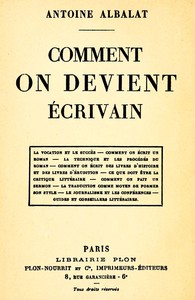
JOURNALISME ET LES CONFÉRENCES--GUIDES ET CONSEILLERS LITTÉRAIRES. PARIS LIBRAIRIE PLON PLON-NOURRIT et Cie, IMPRIMEURS-ÉDITEURS 8, RUE GARANCIÈRE--6e Tous droits réservés DU MÊME AUTEUR: L’Art d’écrire enseigné en vingt leçons. Un vol. in-18, broché. 50e mille. (COLIN, édit.). La Formation du style par l’assimilation des auteurs. Un vol. in-18. 19e mille, broché. (COLIN, édit.). Le Travail du style enseigné par les corrections manuscrites des grands écrivains. Un vol. in-18. 17e mille. Ouvrage couronné par l’_Académie française_. (COLIN, édit.). Comment il faut lire les auteurs classiques français. Un vol. in-18. 10e mille. Ouvrage couronné par l’_Académie française_. Comment il ne faut pas écrire. Un vol. in-18. 10e mille. (PLON, édit.). Souvenirs de la vie littéraire. Un vol. in-18. 3e mille. (CRÈS, édit.). Les Ennemis de l’art d’écrire. Un vol. in-18. (LIBRAIRIE UNIVERSELLE). (_Épuisé_). Ouvriers et procédés (critique littéraire). Un vol. in-18. (HAVARD, édit.). (_Épuisé_). Le Mal d’écrire et le roman contemporain. Un vol. in-18. (FLAMMARION, édit.). (_Épuisé_). Marie, roman. Un vol. (COLIN, édit.). (_Épuisé_). L’Amour chez Alphonse Daudet. Un vol. (_Épuisé_). (OLLENDORFF, édit.). Une Fleur des tombes, roman. (HAVARD, édit). (_Épuisé_). L’Impossible pardon, roman. Un vol. (_Épuisé_). Lacordaire. Un vol. (VITTE, édit.). Joseph de Maistre. Un vol. (VITTE, édit.). Pages choisies de Louis Veuillot. Avec une introduction critique. Un vol. in-18. (VITTE, édit.). Frédéric Mistral. Son génie et son œuvre. (SANSOT, édit.). Ce volume a été déposé au ministère de l’intérieur en 1925. Copyright 1925 by Plon-Nourrit et Cie. Droits de reproduction et de traduction réservés pour tous pays. A MONSIEUR ET MADAME LOUIS PETERS Hommage de fidèle et respectueuse amitié. PRÉFACE La vocation littéraire est une disposition générale pour l’art d’écrire, qui se développe par la lecture et qui peut s’appliquer à tous les genres de productions, romans, histoire, érudition, critique... On se trompe très souvent sur sa propre tournure d’esprit; tel débute par des essais philosophiques qui excelle plus tard dans la peinture des réalités vivantes. Il est difficile de bien connaître les premières raisons de nos goûts, et de démêler les influences qui déterminent le choix d’un sujet ou d’un livre. La plupart du temps, au lieu de se recueillir et de mûrir son talent, on est pressé d’écrire, on publie à la hâte, au hasard, sans réflexion et sans but. Pour éviter les fâcheuses conséquences qu’entraîne cette précipitation, il m’a paru utile de donner quelques conseils de conduite et de travail à ceux qu’un goût invincible pousse vers la carrière littéraire. On nous dira: «Vous voulez nous enseigner à faire du roman et de l’histoire? Quelle est votre compétence? Quels sont vos titres? Voyons vos œuvres.» L’objection est nulle. Si je dénonce dans ces pages la médiocrité du roman contemporain, je ne conserve personnellement aucune illusion sur la valeur des quelques romans que j’aie pu écrire. Je crois voir nettement ce qui m’a manqué, et non moins clairement ce qui manque aux autres; et voilà pourquoi je suis persuadé que mes conseils peuvent être profitables, n’eussent-ils pour résultat que de mettre mes lecteurs en garde contre les défauts que je n’ai pas su ou pas eu le temps d’éviter. Trente ans de labeur et de lectures me semblent une expérience suffisante pour guider et conseiller ceux qui sont aux prises avec la difficulté d’écrire. La plupart des Cours et des Manuels ont été rédigés par des professeurs qui ne passent pas pour des prosateurs de génie, et je ne sache pas qu’on leur en ait fait un reproche. Qu’on ait publié des livres passables, qu’on en ait publié d’excellents, qu’on n’en ait point publié du tout, chacun peut enseigner la littérature et le style, s’il a du jugement,...

This is a limited preview. Download the book to read the full content.

First published in 1905, Comment on devient écrivain isn't a novel. Think of it as a masterclass in a book, written by a critic who had unprecedented access to the notebooks and early drafts of France's literary giants.

The Story

There's no traditional plot. Instead, Albalat structures his book like a series of frank, no-nonsense lessons. He starts by dismantling the biggest myth: that writers are born, not made. Using examples from Flaubert, Balzac, and others, he shows their first attempts were often clumsy. The real story is in the revisions. He presents their original sentences side-by-side with the final, polished versions from published novels. You see Flaubert change a single word twenty times. You watch as a bland description is transformed into a vivid, unforgettable image through sheer effort. Albalat walks you through their techniques for observation, building characters, finding the right style, and developing that critical editorial eye. The 'narrative' is the journey from a rough idea to a finished work of art.

Why You Should Read It

What's incredible is how modern this feels. It's a massive relief. Reading this, you realize even the greats struggled. They had bad days, wrote terrible drafts, and doubted themselves. Albalat's advice is shockingly direct: copy the masters to understand their rhythm, write every single day even if it's bad, and be merciless when you edit. It turns the mystical act of writing into a concrete craft. For anyone who writes—blogs, stories, even emails—this perspective is liberating. It shifts the focus from having a 'brilliant idea' to the dignity and power of hard work. It makes genius feel accessible, not god-given.

Final Verdict

This is not for the casual beach reader. It's a workshop in book form. It's perfect for aspiring writers, literature students, or anyone fascinated by the creative process. If you love seeing how the sausage is made, especially literary sausage from the pantheon of French classics, you'll be glued to the page. It's a timeless, encouraging, and brutally honest guide that proves the best writing isn't about inspiration striking—it's about showing up and doing the work.


📚 Free to Use

This publication is available for unrestricted use. Access is open to everyone around the world.

Michelle Rodriguez
4 months ago

Compatible with my e-reader, thanks.

James King
5 months ago

The layout is very easy on the eyes.

Elijah Ramirez
11 months ago

A bit long but worth it.

Amanda Moore
1 year ago

Helped me clear up some confusion on the topic.

Emily Flores
3 months ago

Very interesting perspective.

4.5
4.5 out of 5 (14 User reviews )

Add a Review

Your Rating *
There are no comments for this eBook.
You must log in to post a comment.
Log in


Related eBooks