
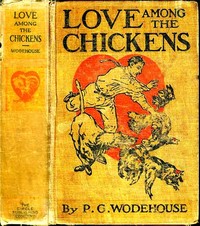
Love Among the Chickens A Story of the Haps and Mishaps on an English Chicken Farm — Themes and Context

(2 User reviews)   358
Wodehouse, P. G. (Pelham Grenville), 1881-1975, Both, Armand, 1881-1922 [Illustrator] Project Gutenberg 2007
Humorous stories; England -- Fiction; Farm life -- Fiction; Chicken breeders -- Fiction; Ukridge, Stanley Featherstonehaugh (Fictitious character) -- Fiction Readers of public-domain and historical texts
Project Gutenberg digital edition en

Edition facts

Words 52,883
Reading time 230 min
Text sections 8

The source record for Love Among the Chickens A Story of the Haps and Mishaps on an English Chicken Farm — Themes and Context measures this digital text at 52,883 words, 3 hr 50 min estimated reading time, and 8 detected text sections.

The text analysis averages about 11.9 words per sentence, while the detected sections provide another way to judge how the source is divided.

Project Gutenberg metadata also associates the work with “Humorous stories,” connecting these edition facts with the source record’s subject description.

P. G. Wodehouse's early comic novel follows narrator Jeremy Garnet as he recounts his misadventures on a chicken farm run by the irrepressible Stanley Featherstonehaugh Ukridge. The excerpts reveal a first-person narrative voice, a romance plot involving a girl with brown hair, and a satirical view of rural enterprise.
Share
Editorial Edition Score 4.7/5

Calculated from edition completeness, EPUB availability, text structure and catalogue metadata. Not a user rating.

How this score is calculated
  • Description quality20 pts
  • Title & short description10 pts
  • Source metadata20 pts
  • Text length15 pts
  • Chapters / structure15 pts
  • EPUB file integrity20 pts

Total of 100 points, scaled to a 2.5-5.0 range. Editions with an empty description or a missing EPUB file are not scored.

Edition quality

Read the Text

They had a momentary vision of an excited dog, framed in the doorway

"I've only bin and drove 'im further up," said Mrs. Beale

Things were not going very well on our model chicken farm

"Mr. Garnet," he said, "we parted recently in anger. I hope that bygones will be bygones"

"I did think Mr. Garnet would have fainted when the best man said, 'I can't find it, old horse'"

_A LETTER with a POSTSCRIPT_

Mr. Jeremy Garnet stood with his back to the empty grate--for the time was summer--watching with a jaundiced eye the removal of his breakfast things.

"Mrs. Medley," he said.

"Would it bore you if I became auto-biographical?"

"Never mind. I merely wish to sketch for your benefit a portion of my life's history. At eleven o'clock last night I went to bed, and at once sank into a dreamless sleep. About four hours later there was a clattering on the stairs which shook the house like a jelly. It was the gentleman in the top room--I forget his name--returning to roost. He was humming a patriotic song. A little while later there were a couple of loud crashes. He had removed his boots. All this while snatches of the patriotic song came to me through the ceiling of my bedroom. At about four-thirty there was a lull, and I managed to get to sleep again. I wish when you see that gentleman, Mrs. Medley, you would give him my compliments, and ask him if he could shorten his program another night. He might cut out the song, for a start."

"He's a very young gentleman, sir," said Mrs. Medley, in vague defense of her top room.

"And it's highly improbable," said Garnet, "that he will ever grow old, if he repeats his last night's performance. I have no wish to shed blood wantonly, but there are moments when one must lay aside one's personal prejudices, and act for the good of the race. A man who hums patriotic songs at four o'clock in the morning doesn't seem to me to fit into the scheme of universal happiness. So you will mention it to him, won't you?"

"Very well, sir," said Mrs. Medley, placidly.

On the strength of the fact that he wrote for the newspapers and had published two novels, Mrs. Medley regarded Mr. Garnet as an eccentric individual who had to be humored. Whatever he did or said filled her with a mild amusement. She received his daily harangues in the same spirit as that in which a nurse listens to the outpourings of the family baby. She was surprised when he said anything sensible enough for her to understand.

His table being clear of breakfast and his room free from disturbing influences, the exhilaration caused by his chat with his landlady left Mr. Garnet. Life seemed very gray to him. He was a conscientious young man, and he knew that he ought to sit down and do some work. On the other hand, his brain felt like a cauliflower, and he could not think what to write about. This is one of the things which sour the young author even more than do those long envelopes which so tastefully decorate his table of a morning.

He felt particularly unfitted for writing at that moment. The morning is not the time for inventive work. An article may be polished then, or a half-finished story completed, but 11 A.M. is not the hour at which to invent.

Jerry Garnet wandered restlessly about his sitting room. Rarely had it seemed so dull and depressing to him as it did then. The photographs on the mantelpiece irritated him. There was no change in them. They struck him as the concrete expression of monotony. His eye was caught by a picture hanging out of the straight. He jerked it to one side, and the effect became worse. He jerked it back again, and the thing looked as if it had been hung in a dim light by an astigmatic drunkard. Five minutes' pulling and hauling brought it back to a position only a shade less crooked than that in which he had found it, and by that time his restlessness had grown like a mushroom.

He looked out of the window. The sunlight was playing on the house opposite. He looked at his boots. At this point conscience prodded him sharply.

"I won't," he muttered fiercely, "I will work. I'll turn out something, even if it's the worst rot ever written."

With which admirable sentiment he tracked his blotting pad to its hiding place (Mrs. Medley found a fresh one every day), collected ink and pens, and sat down.

There was a distant thud from above, and shortly afterwards a thin tenor voice made itself heard above a vigorous splashing. The young gentleman on the top floor was starting another day.

"Oi'll--er--sing thee saw-ongs"--brief pause, then in a triumphant burst, as if the singer had just remembered the name--"ovarraby."

Mr. Garnet breathed a prayer and glared at the ceiling.

"Ahnd--er--ta-ales of fa-arr Cahsh-meerer."

Sudden and grewsome pause. The splashing ceased. The singer could hardly have been drowned in a hip bath, but Mr. Garnet hoped for the best.

His hopes were shattered.

"Come," resumed the young gentleman persuasively, "into the garden, Maud, for ther black batter nah-eet hath--er--florn."

Jerry Garnet sprang from his seat and paced the room.

"This is getting perfectly impossible," he said to himself. "I must get out of this. A fellow can't work in London. I'll go down to some farmhouse in the country. I can't think here. You might just as well try to work at a musical 'At Home.'"

Here followed certain remarks about the young man upstairs, who was now, in lighter vein, putting in a spell at a popular melody from the Gaiety Theater.

He resumed his seat and set himself resolutely to hammer out something which, though it might not be literature, would at least be capable of being printed. A search through his commonplace book brought no balm. A commonplace book is the author's rag bag. In it he places all the insane ideas that come to him, in the groundless hope that some day he will be able to convert them with magic touch into marketable plots.

This was the luminous item which first met Mr. Garnet's eye:

_Mem._ Dead body found in railway carriage under seat. Only one living occupant of carriage. He is suspected of being the murderer, but proves that he only entered carriage at twelve o'clock in the morning, while the body has been dead since the previous night.

To this bright scheme were appended the words:

This will want some working up.

"It will," thought Jerry Garnet grimly, "but it will have to go on wanting as far as I'm concerned."

The next entry he found was a perfectly inscrutable lyric outburst.

There are moments of annoyance, Void of every kind of joyance, In the complicated course of Man's affairs; But the very worst of any He experiences when he Meets a young, but active, lion on the stairs.

Sentiment unexceptionable. But as to the reason for the existence of the fragment, his mind was a blank. He shut the book impatiently. It was plain that no assistance was to be derived from it.

His thoughts wandered back to the idea of leaving London. London might have suited Dr. Johnson, but he had come to the conclusion that what he wanted to enable him to give the public of his best (as the reviewer of the _Academy_, dealing with his last work, had expressed a polite hope that he would continue to do) was country air. A farmhouse by the sea somewhere ... cows ... spreading boughs ... rooks ... brooks ... cream. In London the day stretches before a man, if he has no regular and appointed work to do, like a long, white, dusty road. It seems impossible to get to the end of it without vast effort. But in the country every hour has its amusements. Up with the lark. Morning dip. Cheery greetings. Local color. Huge breakfast. Long walks. Flannels. The ungirt loin. Good, steady spell of work from dinner till bedtime. The prospect fascinated him. His third novel was already in a nebulous state in his brain. A quiet week or two in the country would enable him to get it into shape.

He took from the pocket of his blazer a letter which had arrived some days before from an artist friend of his who was on a sketching tour in Devonshire and Somerset. There was a penciled memorandum on the envelope in his own handwriting:

_Mem._ Might work K. L.'s story about M. and the W--s's into comic yarn for one of the weeklies.

He gazed at this for a while, with a last hope that in it might be contained the germ of something which would enable him to turn out a morning's work; but having completely forgotten who K. L. was, and especially what was his (or her) story about M., whoever he (or she) might be, he abandoned this hope and turned to the letter in the envelope.

The earlier portions of the letter dealt tantalizingly with the scenery. "Bits," come upon by accident at the end of disused lanes and transferred with speed to canvas, were described concisely but with sufficient breadth to make Garnet long to see them for himself. There were brief _résumés_ of dialogues between Lickford (the writer) and weird rustics. The whole letter breathed of the country and the open air. The atmosphere of Garnet's sitting room seemed to him to become stuffier with every sentence he read.

The postscript interested him.

"... By the way, at Yeovil I came across an old friend of yours. Stanley Featherstonhaugh Ukridge, of all people. As large as life--quite six foot two, and tremendously filled out. I thought he was abroad. The last I heard of him was that he had started for Buenos Ayres in a cattle-ship. It seems he has been in England sometime. I met him in the refreshment room at Yeovil station. I was waiting for a down train; he had changed on his way to town. As I opened the door I heard a huge voice in a more or less violent altercation, and there was S. F. U., in a villainous old suit of gray flannels (I'll swear it was the same one that he had on last time I saw him), and a mackintosh, though it was a blazing hot day. His pince-nez were tacked onto his ears with wire as usual. He greeted me with effusive shouts, and drew me aside. Then after a few commonplaces of greeting, he fumbled in his pockets, looked pained and surprised.

"'Look here, Licky,' he said. 'You know I never borrow. It's against my principles. But I _must_ have a shilling, or I'm a ruined man. I seem to have had my pocket picked by some scoundrelly blackguard. Can you, my dear fellow, oblige me with a shilling until next Tuesday afternoon at three-thirty? I never borrow, so I'll tell you what I'll do. I'll let you have this (producing a beastly little three-penny-bit with a hole in it) until I can pay you back. This is of more value to me than I can well express, Licky, my boy. A very, very dear friend gave it to me when we parted, years ago. It's a wrench to part with it. But grim necessity ... I can hardly do it.... Still, no, no, ... you must take it, you must take it. Licky, old man, shake hands! Shake hands, my boy!'

"He then asked after you, and said you were the noblest man--except me--on earth. I gave him your address, not being able to get out of it, but if I were you I should fly while there is yet time."

"That," said Jerry Garnet, "is the soundest bit of advice I've heard. I will."

"Mrs. Medley," he said, when that lady made her appearance.

"I'm going away for a few weeks. You can let the rooms if you like. I'll drop you a line when I think of coming back."

"Yes, sir. And your letters. Where shall I send them, sir?"

"Till further notice," said Jerry Garnet, pulling out a giant portmanteau from a corner of the room and flinging it open, "care of the Dalai Lama, No. 3 Younghusband Terrace, Tibet."

"Yes, sir," said Mrs. Medley placidly.

"I'll write you my address to-night. I don't know where I'm going yet. Is that an A. B. C. over there? Good. Give my love to that bright young spirit on the top floor, and tell him that I hope my not being here to listen won't interfere in any way with his morning popular concerts."

"And, Mrs. Medley, if a man named ----"

Mrs. Medley had drifted silently away. During his last speech a thunderous knocking had begun on the front door.

Jerry Garnet stood and listened, transfixed. Something seemed to tell him who was at the business end of that knocker.

He heard Mrs. Medley's footsteps pass along the hall and pause at the door. Then there was the click of the latch. Then a volume of sound rushed up to him where he stood over his empty portmanteau.

Mrs. Medley's reply was inaudible, but apparently in the affirmative.

"Where is he?" boomed the voice. "Show me the old horse. First floor. Thank you. Where is the man of wrath?"

There followed a crashing on the stairs such as even the young gentleman of the top floor had been unable to produce in his nocturnal rovings. The house shook.

And with the tramping came the thunderous voice, as the visitor once more gave tongue.

"Garnet! GARNET!! GARNET!!!"

Mr. Stanley Featherstonhaugh Ukridge dashed into the room, uttering a roar of welcome as he caught sight of Garnet, still standing petrified athwart his portmanteau.

"My dear old man," he shouted, springing at him and seizing his hand in a clutch that effectually woke Garnet from his stupor. "How _are_ you, old chap? This is good. By Jove, this is good! This is fine, what?"

He dashed back to the door and looked out.

"Come on, Millie," he shouted.

Garnet was wondering who in the name of fortune Millie could possibly be, when there appeared on the further side of Mr. Ukridge the figure of a young woman. She paused in the doorway, and smiled pleasantly.

"Garnet, old horse," said Ukridge with some pride, "let me introduce you to my wife. Millie, this is old Garnet. You've heard me talk about him."

"Oh, yes," said Mrs. Ukridge.

Garnet bowed awkwardly. The idea of Ukridge married was something too overpowering to be assimilated on the instant. If ever there was a man designed by nature to be a bachelor, Stanley Ukridge was that man. Garnet could feel that he himself was not looking his best. He knew in a vague, impersonal way that his eyebrows were still somewhere in the middle of his forehead, whither they had sprung in the first moment of surprise, and that his jaw, which had dropped, had not yet resumed its normal posture. Before committing himself to speech he made a determined effort to revise his facial expression.

"Buck up, old horse," said Ukridge. He had a painful habit of addressing all and sundry by that title. In his school-master days he had made use of it while interviewing the parents of new pupils, and the latter had gone away, as a rule, with a feeling that this must be either the easy manner of genius or spirits, and hoping for the best. Later, he had used it to perfect strangers in the streets. On one occasion he had been heard to address a bishop by that title.

"Surprised to find me married, what? Garny, old boy"--sinking his voice to what was intended to be a whisper--"take my tip. You go and do the same. You feel another man. Give up this bachelor business. It's a mug's game. Go and get married, my boy, go and get married. By gad, I've forgotten to pay the cabby. Half a moment."

He was out of the door and on his way downstairs before the echoes of his last remark had ceased to shake the window of the sitting room. Garnet was left to entertain Mrs. Ukridge.

So far her share in the conversation had been small. Nobody talked very much when Ukridge was on the scene. She sat on the edge of Garnet's big basket chair, looking very small and quiet. She smiled pleasantly, as she had done during the whole of the preceding dialogue. It was apparently her chief form of expression.

Jerry Garnet felt very friendly toward her. He could not help pitying her. Ukridge, he thought, was a very good person to know casually, but a little of him, as his former headmaster had once said in a moody, reflective voice, went a very long way. To be bound to him for life was not the ideal state for a girl. If he had been a girl, he felt, he would as soon have married a volcano.

"And she's so young," he thought, as he looked across at the basket chair. "Quite a kid."

"You and Stanley have known each other a long time, haven't you?" said the object of his pity, breaking the silence.

"Yes. Oh, yes," said Garnet. "Several years. We were masters at the same school together."

Mrs. Ukridge leaned forward with round, shining eyes.

"Isn't he a _wonderful_ man, Mr. Garnet!" she said ecstatically.

Not yet, to judge from her expression and the tone of her voice, had she had experience of the disadvantages attached to the position of Mrs. Stanley Ukridge.

Garnet could agree with her there.

"Yes, he is certainly wonderful," he said.

"I believe he could do anything."

"Yes," said Garnet. He believed that Ukridge was at least capable of anything.

"He has done so many things. Have you ever kept fowls?" she broke off with apparent irrelevance.

"No," said Garnet. "You see, I spend so much of my time in town. I should find it difficult."

Mrs. Ukridge looked disappointed.

"I was hoping you might have had some experience. Stanley, of course, can turn his hand to anything, but I think experience is such a good thing, don't you?"

"It is," said Garnet, mystified. "But--"

"I have bought a shilling book called 'Fowls and All About Them,' but it is very hard to understand. You see, we--but here is Stanley. He will explain it all."

"Well, Garnet, old horse," said Ukridge, reëntering the room after another energetic passage of the stairs, "settle down and let's talk business. Found cabby gibbering on doorstep. Wouldn't believe I didn't want to bilk him. Had to give him an extra shilling. But now, about business. Lucky to find you in, because I've got a scheme for you, Garny, old boy. Yes, sir, the idea of a thousand years. Now listen to me for a moment."

He sat down on the table and dragged a chair up as a leg rest. Then he took off his pince-nez, wiped them, readjusted the wire behind his ears, and, having hit a brown patch on the knee of his gray flannel trousers several times in the apparent hope of removing it, began to speak.

"About fowls," he said.

"What about them?" asked Garnet. The subject was beginning to interest him. It showed a curious tendency to creep into the conversation.

"I want you to give me your undivided attention for a moment," said Ukridge. "I was saying to my wife only the other day: 'Garnet's the man. Clever man, Garnet. Full of ideas.' Didn't I, Millie?"

"Yes, dear," said Mrs. Ukridge, smiling.

"The fact is," said Ukridge, with a Micawber-like burst of candor, "we are going to keep fowls."

He stopped and looked at Garnet in order to see the effect of the information. Garnet bore it with fortitude.

Ukridge shifted himself farther on to the table and upset the inkpot.

"Never mind," he said, "it'll soak in. Don't you worry about that, you keep listening to me. When I said we meant to keep fowls, I didn't mean in a small sort of way--two cocks and a couple of hens and a ping-pong ball for a nest egg. We are going to do it on a large scale. We are going to keep," he concluded impressively, "a chicken farm!"

"A chicken farm," echoed Mrs. Ukridge with an affectionate and admiring glance at her husband.

"Ah," said Garnet, who felt his responsibilities as chorus.

The novel opens with a complaint about a noisy upstairs neighbor, establishing Jeremy Garnet's dry, irritable voice and his tendency to narrate domestic annoyances with mock-heroic exaggeration. The first chapter's title, 'A Letter with a Postscript,' hints at the epistolary framing that introduces the chaotic scheme of Stanley Featherstonehaugh Ukridge, whose entrance is described as interrupting Garnet's writing with a proposal to farm chickens in Lyme Regis. The frontispiece illustration caption—'Never mind the ink, old horse. It'll soak in'—captures Ukridge's breezy disregard for consequences, a tone that colors the entire enterprise.

A Narrator Who Watches and Wryly Comments

Jeremy Garnet is not the instigator but the observer, a role that allows Wodehouse to filter the farm's absurdities through a self-deprecating, ironic lens. In the opening, Garnet addresses his landlady with elaborate sarcasm about the top-floor tenant's late-night singing. Later, he describes Ukridge's visit as reminiscent of 'Mr. George Ade's fable of the author,' comparing his friend's intrusion to a literary trope. This self-awareness extends to Garnet's own writing: he mentions his novel The Maneuvers of Arthur and its heroine Pamela, whom the love interest Phyllis criticizes as unconvincing. The narrator's profession as a writer becomes a running joke, as he admits knowing 'less about chicken farming' than about society, which he satirized in an earlier book. Readers should watch how Garnet's commentary shapes the comedy, often undercutting Ukridge's grand pronouncements with quiet skepticism.

Ukridge's Scheme and the Farm's Comic Premise

The chicken farm is less a real agricultural venture than a stage for Ukridge's bluster and Garnet's reluctant participation. The chapter titles—'Ukridge's Scheme,' 'The Arrival,' 'Buckling To'—promise a sequence of optimistic plans meeting reality. In the excerpts, Garnet reflects that he has 'not regretted' joining the scheme, but the illustrations hint at disaster: one shows 'an excited dog, framed in the doorway,' another depicts Mrs. Beale complaining, and a third bears the caption 'Things were not going very well on our model chicken farm.' The humor derives from the gap between Ukridge's confidence and the farm's actual state. The epilogue's illustration, showing the best man saying 'I can't find it, old horse,' suggests a wedding ceremony gone awry, tying the farm's chaos to the romantic plot. Readers should note how the farm functions as a backdrop for social comedy rather than a realistic setting.

Romance and the Scent of Yellow Lubin

The romantic thread centers on Phyllis Derrick, introduced in Chapter III as 'a Girl with Brown Hair.' In the garden scene, Garnet's proposal is interrupted by Tom Chase, a rival whose cheerful 'tea is ready' deflates the tension. The narrative dwells on sensory details: the 'magic scent of the yellow lubin' that emboldens Garnet, and the bees humming in the flowers. Phyllis's literary criticism—she finds Garnet's heroines unconvincing and is 'so glad' they are not based on real people—adds a meta-fictional layer. The chapter 'Tea and Tennis' continues the social comedy, with Chase dissecting a chocolate cake while discussing a boatman's clumsiness. The romance proceeds through misadventures: a near-drowning, a council of war, and Ukridge's unsolicited advice. Readers should observe how Wodehouse balances the romantic plot with farcical incidents, never allowing sentiment to overwhelm the comedy.

Structure and the Unreliable Promise of Order

The novel's structure, with 23 chapters and an epilogue, suggests a conventional comic arc, but the excerpts reveal a deliberate looseness. The opening chapter's title promises a 'Letter with a Postscript,' yet the narrative quickly shifts to direct storytelling. The table of contents lists episodes like 'The Arrival of Nemesis' and 'Scientific Golf,' indicating set pieces rather than a tightly plotted progression. The epilogue's illustration—showing a wedding ceremony where the best man cannot find the ring—implies a resolution that is characteristically botched. Wodehouse uses chapter breaks to heighten anticipation: 'The Storm Breaks' and 'After the Storm' suggest climactic events, but the tone remains light. Readers should approach the novel as a series of comic vignettes held together by Garnet's wry narration and Ukridge's relentless optimism, rather than expecting a tightly woven plot.

First-time readers will enjoy the novel most by focusing on the interplay between Garnet's dry observations and Ukridge's grandiose failures. The chicken farm is a pretext for social satire, not a manual on poultry. Pay attention to the recurring motif of interrupted moments—proposals, meals, schemes—and the way Wodehouse uses minor characters like Mrs. Beale and Tom Chase to puncture pretension. The epilogue's wedding mishap is a fitting capstone to a story where nothing goes as planned, and the humor lies in the telling.

Reading about Jeremy’s tangle with Ukridge’s schemes, I remembered a summer at my aunt’s, tending hens that never laid. The same gentle absurdity hung in the air there, much as it does in Country Lodgings — Text and Context, where quiet rooms hold their own quiet chaos. That book felt like a warm hand on my shoulder, and this one stirs that feeling again.

Elijah Nelson
3 weeks ago

Anthony Miller
3 weeks ago

5
5 out of 5 (2 User reviews )

Add a Review

Your Rating *
There are no comments for this eBook.

Reader reflection

How did this book work for you?

Your answers remain private and are stored only in this browser.

Your progress 0 / 10
1

How far have you progressed with this book?

2

Was reading this book enjoyable?

3

Is this a title you would suggest to others?

4

How much effort did this book require?

Related eBooks