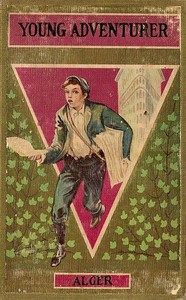
The Young Adventurer; or, Tom's Trip Across the Plains — Story, Setting & Ideas

(1 User reviews)   218
Alger, Horatio, Jr., 1832-1899 Project Gutenberg 2008
Conduct of life -- Fiction; Robbers and outlaws -- Fiction; Overland journeys to the Pacific -- Fiction; Indians of North America -- West (U.S.) -- Fiction; West (U.S.) -- History -- 1860-1890 -- Fiction Readers of public-domain and historical texts
Project Gutenberg digital edition en

Edition facts

Words 46,819
Reading time 204 min
Text sections 6

Before opening The Young Adventurer; or, Tom's Trip Across the Plains — Story, Setting & Ideas, the edition data offers a quick orientation: 46,819 words, 3 hr 24 min estimated reading time, and 6 detected text sections.

The text analysis averages about 11.3 words per sentence, while the detected sections provide another way to judge how the source is divided.

Project Gutenberg metadata also associates the work with “Conduct of life -- Fiction,” connecting these edition facts with the source record’s subject description.

Horatio Alger's 1868 western follows young Tom Nelson from a mortgaged farm to the Plains, where he faces outlaws, Indians, and false accusations. The excerpts reveal a pattern of moral tests, ironic reversals, and a hero who chooses innocence over escape.
Share
Editorial Edition Score 4.7/5

Calculated from edition completeness, EPUB availability, text structure and catalogue metadata. Not a user rating.

How this score is calculated
  • Description quality20 pts
  • Title & short description10 pts
  • Source metadata20 pts
  • Text length15 pts
  • Chapters / structure15 pts
  • EPUB file integrity20 pts

Total of 100 points, scaled to a 2.5-5.0 range. Editions with an empty description or a missing EPUB file are not scored.

Edition quality

Read the Text

MARK NELSON'S FAMILY.

"I wish I could pay off the mortgage on my farm," said Mark Nelson soberly, taking his seat on the left of the fireplace, in the room where his wife and family were assembled.

"Have you paid the interest, Mark?" asked his wife.

"Yes; I paid it this afternoon, and it has stripped me of money completely. I have less than five dollars in my pocketbook toward buying you and the children clothes for the winter."

"Never mind me," said his wife cheerfully. "I am pretty well provided for."

"Why, mother," said Sarah, the oldest daughter, a girl of fourteen; "you haven't had a new dress for a year."

"I have enough to last me till spring, at any rate," said the mother.

"You never buy anything for yourself."

"I don't go in rags, do I?" asked Mrs. Nelson, with a smile.

Mrs. Nelson had a happy disposition, which led her to accept uncomplainingly, and even cheerfully, the sacrifices which, as the wife of a farmer in poor circumstances, she was compelled to make.

"You are right, Sarah," said Mark Nelson. "Your mother never seems to think of herself. She might have been much better off if she had not married me."

The children did not understand this allusion. They had never been told that their mother had received an offer from Squire Hudson, the wealthiest man in the village, but had chosen instead to marry Mark Nelson, whose only property was a small farm, mortgaged for half its value. Her rejected admirer took the refusal hard, for, as much as it was possible for him, he loved the prettiest girl in the village, as Mary Dale was generally regarded. But Mary knew him to be cold and selfish, and could not make up her mind to marry him. If she had done so, she would now be living in the finest house in the village, with the chance of spending the winter in New York or Boston, instead of drudging in an humble home, where there was indeed enough to eat, but little money for even necessary purposes. She had never regretted her decision. Her husband, though poor, was generally respected and liked, while the squire, though his money procured him a certain degree of consideration, had no near or attached friends.

To Squire Hudson many in the village paid tribute; for he held mortgages on twenty farms and buildings, and was strict in exacting prompt payment of the interest semi-annually. It was he to whom Mark Nelson's farm was mortgaged for two thousand dollars. The mortgage had originally been for fifteen hundred dollars, but five years before it had been increased to two thousand, which represented more than half the sum which it would have fetched, if put up for sale. The interest on this sum amounted to a hundred and twenty dollars a year, which Mark Nelson always found it hard to raise. Could he have retained it in his hands, and devoted it to the use of his family, it would have helped them wonderfully, with Mrs. Nelson's good management.

Tom, the oldest boy, now approaching his sixteenth birthday, looked up from a book he was reading. He was a bright-looking boy, with brown hair, a ruddy complexion, and dark-blue eyes, who looked, and was, frank and manly.

"What is the amount of your interest?" he asked.

"Sixty dollars every half-year, Tom. That is what I paid to Squire Hudson this afternoon. It would have made us very comfortable, if I only could have kept it."

"It would have done you more good than the squire," said Sarah.

"He has more money than he knows what to do with," said her father, almost complainingly. "It seems hard that money should be so unevenly distributed."

"Money is not happiness," said Mrs. Nelson quietly.

"No; but it helps to buy happiness."

"I don't think Squire Hudson is as happy a man as you, Mark."

Mark Nelson's face softened as he surveyed his wife and children.

"I am happy at home," he said, "and I don't think the squire is."

"I am sure he isn't," said Tom. "Mrs. Hudson is sour and ill-tempered, and Sinclair--the only child--is a second edition of his mother. He is the most unpopular boy in the village."

"Still," said the farmer, not quite convinced, "money is an important element of happiness, and a farmer stands a very poor chance of acquiring it. Tom, I advise you not to be a farmer."

"I don't mean to be if I can help it," said Tom. "I am ready for any opening that offers. I hope some day to pay off the mortgage on the farm, and make you a free man, father."

"Thank you for your good intentions, Tom; but two thousand dollars is a large sum of money."

"I know it, father; but I was reading in a daily paper, not long since, of a boy, as poor as myself, who was worth twenty-five thousand dollars by the time he was thirty. Why shouldn't this happen to me?"

"Don't build castles in the air, Tom," said his mother sensibly.

"At least, mother, I may hope for good luck. I have been wanting to talk to you both about my future prospects. I shall be sixteen next week, and it is time I did something."

"You are doing something--working on the farm now, Tom."

"That don't count. Father advises me not to be a farmer, and I agree with him. I think I am capable of making my way in the world in some other way, where I can earn more money. There is Walter, who likes the country, to stay with you."

Walter, the third child, was now twelve years of age, with decided country tastes.

"I would like to be a farmer as well as anything," said Walter. "I like the fresh air. I shouldn't like to be cooped up in a store, or to live in the city. Let Tom go if he likes."

"I have no objection," said Mr. Nelson; "but I have neither money nor influence to help him. He will have to make his own way."

"I am not afraid to try," said Tom courageously. "From this day I will look out for a chance, if you and mother are willing."

"I shall not oppose your wishes, Tom," said Mrs. Nelson gravely, "though it will be a sad day for me when you leave your home."

"That isn't the way to look at it, mother," said Tom. "If gold pieces grew on currant bushes, it wouldn't be necessary for me to leave home to make a living."

"I wish they did," said Harry, a boy nine years of age.

"What would you do then, Harry?" asked his brother, smiling.

"I would buy a velocipede and a pair of skates."

"I heard of a boy once who found a penny in the field, right under a potato-vine," said Walter.

"I don't believe it," said Harry.

"It's true, for I was the boy."

"Where did it come from?"

"Tom put it there to fool me."

"Won't you put one there to fool me, Tom?" asked Harry.

"You are too smart, Harry," said Tom, laughing. "My pennies are too few to try such experiments. I hope, by the time you are as old as Walter, to give you something better."

The conversation drifted to other topics, with which we are not concerned. Tom, however, did not forget it. He felt that an important question had that evening been decided for him. He had only thought of making a start for himself hitherto. Now he had broached the subject, and received the permission of his father and mother. The world was all before him where to choose. His available capital was small, it is true, amounting only to thirty-seven cents and a jack-knife; but he had, besides, a stout heart, a pair of strong hands, an honest face, and plenty of perseverance--not a bad equipment for a young adventurer.

Since the time of which I am writing, over sixty years have passed, for it was in the year 1850 that Tom made up his mind to leave home and seek a fortune. The papers were full of the new gold discoveries in the new country which had recently been added to the great republic. Thousands were hurrying to the land of gold; men who had been unfortunate at home, or, though moderately well situated, were seized by the spirit of adventure. At considerable sacrifice many raised the means of reaching the new El Dorado, while others borrowed or appropriated the necessary sum. Some, able to do neither, set out on a venture, determined to get there in some way.

In the weekly paper, to which Mr. Nelson had for years been a subscriber, Tom had read a good deal about California. His youthful fancy had been wrought upon by the brilliant pictures of a land where a penniless man might, if favored by fortune, secure a competence in a twelvemonth, and he ardently wished that he, too, might have the chance of going there. It was a wish, but not an expectation. It would cost at least two hundred dollars to reach the Pacific coast, and there was no hope of getting a tithe of that sum.

"If I could only go to California," thought Tom, "I would make my way somehow; I would cheerfully work twelve hours a day. I don't see why a boy can't dig gold, as well as a man. If somebody would lend me money enough to get there, I could afford to pay high interest."

There was one man in Wilton who might lend him the money if he would. That man was Squire Hudson. He always had money on hand in considerable quantities, and two hundred dollars would be nothing to him. Tom would not have dreamed of applying to him, however, but for a service which just at this time he was able to render the squire.

Tom had been in search of huckleberries--for this was the season--when, in a narrow country road, not much frequented, his attention was drawn to an object lying in the road. His heart hounded with excitement when he saw that it was a well-filled pocketbook. He was not long in securing it.

Opening the wallet, he found it was absolutely stuffed with bank-bills, some of large denomination. There were, besides, several papers, to which he paid but little attention. They assured him, however, as he had already surmised, that the wallet was the property of Squire Hudson.

"I wonder how much money there is here," thought Tom, with natural curiosity.

He stepped into the woods to avoid notice, and carefully counted the bills. There were two hundred-dollar bills, and three fifties, and so many of smaller denominations that Tom found the whole to amount to five hundred and sixty-seven dollars.

"Almost six hundred dollars!" ejaculated Tom, in excitement, for he had never seen so much money before. "How happy should I be if I had as much money! How rich the squire is! He ought to be a happy man."

Then the thought stole into our hero's mind, that the wallet contained nearly three times as much as he would need to take him to California.

"If it were only mine!" he thought to himself.

Perhaps Tom ought to have been above temptation, but he was not. For one little instant he was tempted to take out two hundred dollars, and then drop the wallet where he had picked it up. No one would probably find out where the missing money was. But Tom had been too well brought up to yield to this temptation. Not even the thought that he might, perhaps within a year, return the money with interest, prevailed upon him.

"It wouldn't be honest," he decided, "and if I began in that way I could not expect that God would prosper me. If that is the only way by which I can go to California I must make up my mind to stay at home."

So the question was settled in Tom's mind. The money must be returned to the owner. His pail was nearly full of huckleberries, but he postponed going home, for he felt that Squire Hudson would be feeling anxious about his loss, and he thought it his duty to go and return the money first of all. Accordingly he made his way directly to the imposing residence of the rich man.

Passing up the walk which led to the front door, Tom rang the bell. This was answered by a cross-looking servant. She glanced at the pail of berries, and said quickly: "We don't want any berries, and if we did you ought to go round to the side door."

"I haven't asked you to buy any berries, have I?" said Tom, rather provoked by the rudeness of the girl, when he had come to do the squire a favor.

"No, but that's what you're after. We have bought all we want."

"I tell you I didn't come here to sell berries," said Tom independently; "I picked these for use at home."

"Then what do you come here for, anyway, takin' up my time wid comin' to the door, when I'm busy gettin' supper?"

"I want to see Squire Hudson."

"I don't know if he's at home."

"Then you'd better find out, and not keep me waiting."

"I never see such impudence," ejaculated the girl.

"I mean what I say," continued Tom stoutly. "I want to see the squire on important business."

"Much business you have wid him!" said the girl scornfully.

Tom by this time was out of patience.

"Go and tell your master that I wish to see him," he said firmly.

"I've a great mind to slam the door in your face," returned Bridget angrily.

"I wouldn't advise you to," said Tom calmly.

A stop was put to the contention by an irritable voice.

"What's all this, hey? Who's at the door, Bridget?"

"A boy wid berries, sir."

"Tell him I don't want any."

"I have told him, and he won't go."

"Won't go, hey?" and Squire Hudson came out into the hall. "What's all this, I say? Won't go?"

"I wish to see you, sir," said Tom, undaunted. "I have told the girl that I didn't come here to sell berries; but she objects to my seeing you."

Squire Hudson was far from an amiable man, and this explanation made him angry with the servant. He turned upon her fiercely.

"What do you mean, you trollop," he demanded, "by refusing to let the boy see me? What do you mean by your insolence, I say?"

Bridget was overwhelmed, for the squire's temper was like a tornado.

"I thought he wanted to sell berries," she faltered.

"That isn't true," said Tom. "I told you expressly that I picked the berries for use at home, and had none to sell."

"Go back to the kitchen, you trollop!" thundered the squire. "You deserve to go to jail for your outrageous conduct."

Bridget did not venture to answer a word, for it would only have raised a more violent storm, but retreated crestfallen to her own realm, and left our hero in possession of the field. She contented herself with muttering under her breath what she did not dare to speak aloud.

"You are Tom Nelson, are you not?" asked the squire, adjusting his spectacles, and looking more carefully at the boy.

"Have you any message from your father?"

"Then why did you come here to take up my time?" demanded the squire, frowning.

"I came to do you a service, Squire Hudson."

"You came--to--do--me--a--service?" repeated the squire slowly.

"You may as well come in," said the rich man, leading into the sitting-room.

Tom followed him into a handsomely furnished room, and the two sat down opposite each other.

"I don't know what service you can do me," said Squire Hudson incredulously.

His manner implied: "I am a rich man and you are a poor boy. How can you possibly serve me?"

"Have you lost anything lately?" inquired Tom, coming at once to business.

I suppose most men, when asked such a question, would first think of their pocket-books. It was so with Squire Hudson. He hastily thrust his hand into his pocket, and found--a large hole, through which, doubtless, the wallet had slipped.

"I have lost my wallet," he said anxiously. "Have you found it?"

In reply Tom produced the missing article. The squire took it hurriedly, and, at once opening it, counted the money. It was all there, and he heaved a sigh of relief, for he was a man who cared for money more than most people.

"Where did you find it?" he asked.

Tom answered the question.

"It is very fortunate you came along before anyone else saw it. I rode that way on horse-back this morning. I told Mrs. Hudson that my pocket needed repairing, but she put it off, according to her usual custom. If it had not been found, I would have kept her on short allowance for a year to come."

Tom felt rather embarrassed, for, of course, it would not do to join in with the squire in his complaints of his wife. Suddenly Squire Hudson said, eying him keenly: "Do you know how much money there is in this wallet?"

"Then you counted it?"

"I wanted to know how much there was, so that no one might blame me if any were missing."

"Didn't you want to take any?" asked the squire bluntly.

"Yes," answered Tom promptly.

"Why didn't you? For fear you would be found out?"

"That may have had something to do with it, but it was principally because it would have been stealing and stealing is wrong."

"What would you have done with the money if you had taken it?"

"Started for California next week," answered Tom directly.

"Eh?" ejaculated the squire, rather astonished. "Why do you want to go to California--a boy like you?"

"To dig gold. I suppose a boy can dig gold, as well as a man. There doesn't seem to be much chance for me here. There's nothing to do but to work on the farm, and father and Walter can do all there is to be done there."

"How is your father getting along?" asked the rich man, with an interest which rather surprised Tom.

"Poorly," said Tom. "He makes both ends meet; but we all have to do without a great many things that we need."

The squire looked thoughtful. He took half a dollar from his wallet and tendered it to Tom.

"You've done me a service," he said. "Take that."

"I would rather not take money for being honest," he said.

"That's all nonsense," said Squire Hudson sharply.

"That's the way I feel about it," said Tom stoutly.

"Then you're a fool."

"This would have been quite a large loss to me. I am perfectly willing to give you this money."

Then Tom gathered courage and said boldly, "You can do me a great favor, Squire Hudson, if you choose."

"Lend me enough money to go to California," said Tom nervously.

"Good gracious! Is the boy crazy?" ejaculated the astonished squire.

"No, sir, I am not crazy. I'll tell you what my plans are. I shall go to work directly I get there, and shall devote the first money I make to paying you. Of course, I shall expect to pay high interest. I am willing to pay you three hundred dollars for two; unless I am sick, I think I can do it inside of twelve months."

"How much money do you suppose you will need for this wild-goose expedition?"

"About two hundred dollars, sir; and, as I just said, I will give you my note for three."

"A boy's note is worth nothing."

"Perhaps it isn't in law; but I wouldn't rest till it was paid back."

"What security have you to offer?"

"None, sir, except my word."

"Do you know what I would be if I lent you this money?"

"You would be very kind."

"Pish! I should be a fool."

"I don't think you'd lose anything by it, sir; but, of course, I can't blame you for refusing," and Tom rose to go.

"Sit down again," said the squire; "I want to talk to you about this matter. How long have you been thinking of California?"

"Only two or three days, sir."

"What made you think of it?"

"I wanted to help father."

"Who has told you about California?"

"I have read about it in the papers."

"Have you spoken to your father about going there?"

"I have spoken to him about leaving home, and seeking my fortune; but I have not mentioned going to California, because I thought it impossible to raise the necessary money."

"Of course. That's sensible, at least."

The first chapter opens not with adventure but with a family counting pennies around a fireplace. Mark Nelson has just paid the mortgage interest and has less than five dollars left for winter clothes. His wife cheerfully insists she needs nothing new, while their daughter Sarah notes she hasn't had a dress in a year. This domestic pinch sets the economic pressure that will drive Tom westward—but Alger immediately establishes that the family's real wealth is mutual self-denial and good humor.

The Wallet and the Loan

Tom's first test comes when he finds a wallet. Instead of pocketing it, he seeks out the owner and asks for a loan—a request that could seem cheeky but is presented as honest enterprise. The scene establishes a recurring pattern: Tom's moral decisions are practical, not abstract. He doesn't just return the wallet; he leverages the act to fund his journey. This blend of rectitude and calculation runs through the excerpts, where Tom repeatedly chooses to stay and face trouble rather than flee, as when he refuses to escape arrest because 'I want my innocence proved.'

The Double Arrest and the Escape That Isn't

In a striking reversal, Tom and the villain Vincent are arrested together. Vincent sneers at the alderman and the local policeman, comparing them unfavorably to New York. The officer retorts sarcastically about New York being 'a model city.' When Vincent bolts, a bystander urges Tom to run too, but Tom stays. The officer returns, astonished to find him waiting. Alger uses this moment to invert expectations: the guilty man flees, the innocent one holds his ground. The officer's 'revulsion of sentiment' hints that Tom's steadfastness earns him allies even among those paid to suspect him.

Mr. Waterbury's Dry Humor and the Joke of Innocence

Tom's benefactor, Mr. Waterbury, greets his arrest with a teasing question: 'Was it in a fit of emotional insanity that you relieved the lady of her pocketbook?' The joke is pointed—Tom's innocence is so obvious that the accusation becomes absurd. Waterbury's remark that 'innocence is not always a protection' acknowledges the risk, but the scene resolves with Tom walking free. Alger uses this light tone to underscore a serious point: in this world, character is tested by adversity, but the narrative rewards those who refuse to compromise. The pattern is consistent: Tom's honesty is not naive; it is a deliberate strategy that pays off.

Readers should watch how Alger pairs each moral decision with a practical outcome. Tom's choices are never purely idealistic—they also work. The excerpts show a hero who calculates his integrity, and a world where villains overreach and trip themselves. The western setting is less a landscape than a stage for these moral dramas, and the real journey is not across the Plains but through a series of ethical tests that Tom passes by staying put.

Reading about Tom’s moral tests, I remembered my grandfather’s worn copy of The Son of his Father — Text and Context, which once gave me the same quiet ache when a boy chose honesty over an easy escape. That old book taught me that growing up isn’t about winning, but about keeping your word when no one is watching.

Harper Thompson
3 weeks ago

5
5 out of 5 (1 User reviews )

Add a Review

Your Rating *
There are no comments for this eBook.

Reader reflection

What did you think of this book?

Answer a few questions and save a private reflection on this device.

Your progress 0 / 10
1

Which reading stage best describes you?

2

What was your overall reaction to the book?

3

Would you recommend this book to another reader?

4

How demanding did the text feel?

Related eBooks