
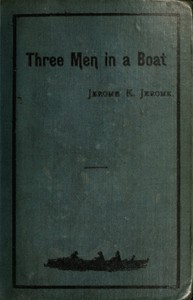
Three men in a boat (to say nothing of the dog) by Jerome K. Jerome

(4 User reviews)   921
By Ashley Gutierrez Posted on Jan 14, 2026
In Category - Environment
Jerome, Jerome K. (Jerome Klapka), 1859-1927 Jerome, Jerome K. (Jerome Klapka), 1859-1927
English
Imagine your three most dramatic friends—the kind who think a splinter is a medical emergency—deciding to take a two-week boating trip on the Thames. That's the glorious setup for Jerome K. Jerome's 1889 classic, 'Three Men in a Boat (To Say Nothing of the Dog).' There's no grand mystery or villain here. The main conflict is simply life itself: the absurd battle between their grandiose plans and hilarious reality. They pack enough supplies for a polar expedition, argue over maps they can't read, and attempt to open a can of pineapple for what feels like three days. Their trusty (and food-obsessed) fox terrier, Montmorency, mostly judges them from the sidelines. Reading this book feels like overhearing the funniest, most relatable pub story ever told. It's about friendship tested by minor inconveniences and the universal truth that the best adventures are the ones where everything goes slightly, wonderfully wrong. If you've ever tried to put up a tent in the rain or had a picnic ruined by ants, you'll see yourself in these pages.
Share

Read "Three men in a boat (to say nothing of the dog) by Jerome K. Jerome" Online

This book is available in the public domain. Start reading the digital edition below.

START READING FULL BOOK
Instant Access    Mobile Friendly

Book Preview

A short preview of the book’s content is shown below to give you an idea of its style and themes.

and incurable veracity_, _nothing yet discovered can surpass it_. _This_, _more than all its other charms_, _will_, _it is felt_, _make the volume precious in the eye of the earnest reader_; _and will lend additional weight to the lesson that the story teaches_. LONDON, _August_, 1889. [Picture: Graphic of three men in a rowing boat] CHAPTER I. Three invalids.—Sufferings of George and Harris.—A victim to one hundred and seven fatal maladies.—Useful prescriptions.—Cure for liver complaint in children.—We agree that we are overworked, and need rest.—A week on the rolling deep?—George suggests the River.—Montmorency lodges an objection.—Original motion carried by majority of three to one. There were four of us—George, and William Samuel Harris, and myself, and Montmorency. We were sitting in my room, smoking, and talking about how bad we were—bad from a medical point of view I mean, of course. We were all feeling seedy, and we were getting quite nervous about it. Harris said he felt such extraordinary fits of giddiness come over him at times, that he hardly knew what he was doing; and then George said that _he_ had fits of giddiness too, and hardly knew what _he_ was doing. With me, it was my liver that was out of order. I knew it was my liver that was out of order, because I had just been reading a patent liver-pill circular, in which were detailed the various symptoms by which a man could tell when his liver was out of order. I had them all. It is a most extraordinary thing, but I never read a patent medicine advertisement without being impelled to the conclusion that I am suffering from the particular disease therein dealt with in its most virulent form. The diagnosis seems in every case to correspond exactly with all the sensations that I have ever felt. [Picture: Man reading book] I remember going to the British Museum one day to read up the treatment for some slight ailment of which I had a touch—hay fever, I fancy it was. I got down the book, and read all I came to read; and then, in an unthinking moment, I idly turned the leaves, and began to indolently study diseases, generally. I forget which was the first distemper I plunged into—some fearful, devastating scourge, I know—and, before I had glanced half down the list of “premonitory symptoms,” it was borne in upon me that I had fairly got it. I sat for awhile, frozen with horror; and then, in the listlessness of despair, I again turned over the pages. I came to typhoid fever—read the symptoms—discovered that I had typhoid fever, must have had it for months without knowing it—wondered what else I had got; turned up St. Vitus’s Dance—found, as I expected, that I had that too,—began to get interested in my case, and determined to sift it to the bottom, and so started alphabetically—read up ague, and learnt that I was sickening for it, and that the acute stage would commence in about another fortnight. Bright’s disease, I was relieved to find, I had only in a modified form, and, so far as that was concerned, I might live for years. Cholera I had, with severe complications; and diphtheria I seemed to have been born with. I plodded conscientiously through the twenty-six letters, and the only malady I could conclude I had not got was housemaid’s knee. I felt rather hurt about this at first; it seemed somehow to be a sort of slight. Why hadn’t I got housemaid’s knee? Why this invidious reservation? After a while, however, less grasping feelings prevailed....

This is a limited preview. Download the book to read the full content.

First published in 1889, Jerome K. Jerome's book is less a novel and more a series of brilliantly funny misadventures strung along the river Thames. It's framed as a real travel log, but it's really a playground for Jerome's wit.

The Story

Three young gentlemen—J., the narrator; George; and Harris—are convinced they're suffering from 'every malady in the medical dictionary' due to overwork. Their brilliant cure? A two-week boating holiday from Kingston to Oxford. With their dog Montmorency in tow, they set off. What follows is a cascade of comic disasters. They can't pack without bringing the entire contents of their apartments. They can't put up a canvas cover without nearly drowning each other. They get hopelessly lost in a hedge maze. Historical anecdotes about towns they pass are interrupted by the urgent need to find lunch or escape the rain. The plot isn't about getting somewhere; it's about the glorious, messy, and deeply human experience of trying.

Why You Should Read It

This book is a masterclass in observational humor that hasn't aged a day. Jerome perfectly captures the dynamic of friends on a trip: the petty arguments, the shared misery in bad weather, the sudden bonding over a good meal. His tangents—like the famous story of his uncle getting stuck in a hotel wardrobe—are some of the funniest parts. Underneath the laughs, there's a gentle, warm-hearted look at human nature. We're all a bit like J., George, and Harris: prone to making simple things complicated, convinced of our own competence, and always, always at the mercy of a stubborn tin of pineapple.

Final Verdict

This is the perfect book for anyone who needs a genuine, hearty laugh. It's for fans of dry British humor, for people who love travel stories where the journey is a disaster, and for anyone who's ever gone camping. It's also a fantastic, accessible classic—there's no dense prose or difficult plot to navigate, just timeless comedy. Keep it on your shelf for a bad day; a chapter with these three hapless boatmen and their disapproving dog is better than any medicine.


📚 Usage Rights

No rights are reserved for this publication. Share knowledge freely with the world.

Matthew Thomas
1 month ago

Perfect.

David Torres
6 months ago

If you enjoy this genre, the emotional weight of the story is balanced perfectly. Thanks for sharing this review.

Barbara Wright
9 months ago

To be perfectly clear, it challenges the reader's perspective in an intellectual way. Worth every second.

Jackson Thomas
2 months ago

I have to admit, the emotional weight of the story is balanced perfectly. A true masterpiece.

4.5
4.5 out of 5 (4 User reviews )

Add a Review

Your Rating *
There are no comments for this eBook.
You must log in to post a comment.
Log in


Related eBooks