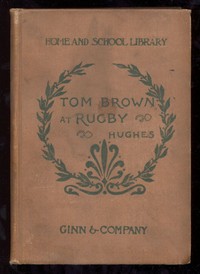
Tom Brown at Rugby — A Closer Reading
Edition facts
Before opening Tom Brown at Rugby — A Closer Reading, the edition data offers a quick orientation: 121,014 words, 8 hr 47 min estimated reading time, and 19 detected text sections.
The text analysis averages about 21.9 words per sentence, while the detected sections provide another way to judge how the source is divided.
Project Gutenberg metadata also associates the work with “Schools -- Fiction,” connecting these edition facts with the source record’s subject description.
Calculated from edition completeness, EPUB availability, text structure and catalogue metadata. Not a user rating.
How this score is calculated
- Description quality20 pts
- Title & short description10 pts
- Source metadata20 pts
- Text length15 pts
- Chapters / structure15 pts
- EPUB file integrity20 pts
Total of 100 points, scaled to a 2.5-5.0 range. Editions with an empty description or a missing EPUB file are not scored.
Read the Text
CHAPTER I. THE BROWN FAMILY 1
CHAPTER II. THE "VEAST" 24
CHAPTER III. SUNDRY WARS AND ALLIANCES 49
CHAPTER IV. THE STAGE COACH 73
CHAPTER V. RUGBY AND FOOT-BALL 92
CHAPTER VI. AFTER THE MATCH 118
CHAPTER VII. SETTLING TO THE COLLAR 139
CHAPTER VIII. THE WAR OF INDEPENDENCE 163
CHAPTER IX. A CHAPTER OF ACCIDENTS 189
CHAPTER I. HOW THE TIDE TURNED 215
CHAPTER II. THE NEW BOY 230
CHAPTER III. ARTHUR MAKES A FRIEND 246
CHAPTER IV. THE BIRD-FANCIERS 264
CHAPTER V. THE FIGHT 281
CHAPTER VI. FEVER IN THE SCHOOL 303
CHAPTER VII. HARRY EAST'S DILEMMAS AND DELIVERANCES 324
CHAPTER VIII. TOM BROWN'S LAST MATCH 343
CHAPTER IX. FINIS 370
Thomas Hughes is a native of the royal county of Berkshire, England. From the nursery windows of the old farmhouse in Uffington, where he was born, in 1823, he delighted in looking out on that famous White Horse Hill which he describes in the opening chapters of "Tom Brown's School Days."
His father was such an English squire as he represents Tom's father to be, and his grandfather was vicar of the parish, and therefore a man of a good deal of local influence. When a child, young Hughes must have become familiar with the old parish church, which dates almost from the time of William the Conqueror, and which has within it some Roman brickwork which carries one back to the days when Agricola's legions were building walled towns in Britain.
Thus the lad's earliest recollections would naturally be of these two landmarks--the ivy-grown church, with its twenty and more generations buried round it, and the great chalk hill whose rudely carved White Horse can be seen gleaming in the sunshine full ten miles away, just as it did when Alfred the Great cut it to commemorate his victory over the Northmen a thousand years ago.
Thomas had a brother George, who was a little older than he, and who was his opposite in many respects. From him he learned many lessons which helped to shape his after life. George was quick to turn his hand to anything, and a lover of all out-door sports; if they had a spice of danger in them, so much the better. Thomas, on the other hand, was naturally both awkward and timid; the sound of a gun frightened him; and a pet pony soon found that, while George was his master, he was Thomas's, and meant to keep so. Thomas was ashamed of what he called his two left hands, with which he never seemed to get the right hold of anything the first time. He was still more ashamed of his timidity. That feeling of fear he could not prevent. Eventually, however, he did better; he so mastered it that he could bravely face what he feared, so making duty stand him in the stead of that mere physical courage, which is often but another name for insensibility to danger.
When he reached the age of seven he went to Twyford to school. Here he found how easy it is to get a nickname, and how hard it is to get rid of it. One of his first lessons related to Greek literature and to the history of Cadmus, who was said to have "first carried letters from Asia to Greece." Instead of asking the question in the book, the master demanded, "What was Cadmus?" This new way of questioning disconcerted the class, who were prepared to tell who Cadmus was, but not what he was. But young Hughes, remembering the letter-carrier at Uffington, suddenly jumped up and shouted out, "I can tell! Cadmus was a postman, sir!" From that day the boy was christened "Cadmus" by his companions, a name which, for convenience' sake, was soon shortened to "Cad,"--a particularly aggravating abbreviation, since in England a "cad" is the exact opposite of a gentleman. Then all sorts of ingenious and mischievous changes were rung on it until poor "Cadmus" was in a fair way of being driven wild with torment. Wherever he went the walls echoed with the jeering cry. But luckily for him his brother George happened to hear a big fellow teasing the lad, and rushing up with clenched fist and blazing eyes, thrashed the bully so soundly that after that Thomas enjoyed entire immunity from the objectionable title.
After about three years at Twyford, the two brothers were sent to the school at Rugby, then under the mastership of Doctor Arnold, who proved himself to be the ablest teacher in England; not because he taught his boys more than any other educator, but because more than any other he awakened in them the true spirit of manhood. "Tom Brown's School Days" is a record of the eight happy years that the lads spent under the Doctor's influence. From Rugby they went to Oxford, where Thomas Hughes graduated at Oriel College in 1845. The timid "Cadmus" of Twyford not only passed through Rugby with credit to himself in foot-ball, in Greek verses, and in the manly art of self-defence, but he got a "Double First" at Oxford--that is, the highest honors in the mathematics and the classics--and was elected captain of the 'Varsity Crew and captain of the University Eleven at cricket as well.
It was while young Hughes was at Oriel that the corn law agitation reached its height. A heavy duty on all imported grain had made bread so dear that thousands of English workmen, with their families, were brought to the verge of starvation. John Bright earnestly espoused their cause and urged Parliament to repeal a tax that enriched a few at the expense of a suffering multitude. Elliott, the "Corn Law Rhymer," stirred the feelings of the masses with his impassioned appeals in verse, so that all over the country hollow-cheeked artisans were repeating the lines,--
"England! what for mine and me, What hath bread-tax done for thee?
Cursed thy harvest, cursed thy land, Hunger-stung thy skill'd right hand."
Thomas Hughes became a convert to the Liberal movement, which shortly after succeeded in repealing a tariff that had been the cause of such wide-spread misery. From that day his sympathies have always been with those classes who are called to earn the least and endure the most; and when in 1848 he was admitted to the bar at Lincoln's Inn, London, he had got the name of being a radical and a reformer in politics--a name, then, rather more dreadful to steady-going, conservative English country gentlemen of the "Squire Brown" type than that of mad dog.
But long before this the young man had got over his dread of opprobrious names, and his fear of those who have nothing harder to hurl.
With a few other resolute spirits he set himself to work to organize those joint-stock industries and business enterprises which have since developed into the colossal co-operative stores of London and the cotton mills of Oldham, representing many millions of capital, the combined savings of thrifty artisans and other persons of small means.
In all this, Mr. Hughes's avowed object has been "to make England the best place for workingmen to live in that the sun ever shone upon." Whether that can be done or not in this age of the world is certainly open to question, but it is equally certain that there can be no possible harm in making the attempt. That the workingmen have appreciated the effort is evident from the fact that they elected Mr. Hughes to Parliament in 1865. It is said that ordinarily the expense of getting into the House of Commons--an unpaid body--averages about $75,000, which the candidate or his friends must be prepared to spend. But in Lambeth, a district of London, inhabited almost wholly by poor men, two hundred of Mr. Hughes's admirers came forward and worked night and day without receiving a single shilling of any man's money, solely with the determination of seeing their candidate succeed.
Since then, the writer of "Tom Brown's School Days" would certainly have broken down from overwork if he had not been, as he says, an "Angular Saxon" and a muscular Christian as well. During his nine years' pull in the political harness he earned the double honor of helping forward the cause of the people and at the same time he so won the regard of the Crown that he received the appointment of Queen's Counsel. While member of Parliament Mr. Hughes was likewise carrying on a large and lucrative law practice, acting as president of the Workingmen's College, which he was instrumental in founding; serving as referee in disputes between manufacturers and their employees in such a way as to get the respect and good-will of both; serving also as director in co-operative banks, coal mines, cotton mills, machine shops, grocery stores, land and building associations; besides being chief manager of the Crystal Palace company, and colonel in a volunteer rifle corps.
Yet well known as Mr. Hughes is for his manifold political and philanthropic services, he is still better known by his books. Though with him literature has been rather a recreation than a vocation, yet his fame seems destined to rest on it, and especially on his "Tom Brown," which has been pronounced "the best description of public school life that ever has been, or is ever likely to be, written." This famous work, published in 1858, was followed the next year by "The Scouring of the White Horse," a story of his favorite White Horse Hill. Three years later came "Tom Brown at Oxford," then "The Life of Alfred the Great," and lastly his "Memoirs of a Brother" and his "Manliness of Christ," besides scores, if not hundreds, of magazine and review articles and letters to London and American papers.
In 1870 Mr. Hughes made the tour of this country, receiving such a welcome from his many friends as "Tom Brown" was sure to get from both old and young. Ten years afterward he undertook to establish an English colony in the Cumberland Mountains of East Tennessee. It was called Rugby, and it was founded in the hope that it might be useful to many educated young men of good families who could find no opening worthy of their powers at home. As he said, "Of the many sad sights in England there is none sadder than this, of first-rate human material going helplessly to waste, and in too many cases beginning to sour and taint, instead of strengthening the national life." A hundred years before, Franklin had expressed the same conviction in his pithy maxim, "'Tis hard for an empty bag to stand upright." It was to fill these vacant lives with honest work and its rewards that Thomas Hughes started his emigration to the wilds of Tennessee. There, co-operation was to be tried in farming, cattle-raising, lumbering, and trade, thus saving the community of workers from that "infinite terror of not making money," which Carlyle declared was the only thing that now stirred deep fear in the souls of his countrymen. Many an ardent young man fresh from the old Rugby of "Tom Brown" fame fondly hoped that the new, western Rugby might enable him to say with Tennyson's "Northern Farmer," as he listened to the music of his horse's hoofs on the road home from market,--
"Proputty, proputty, proputty,--that's what I 'ears 'em saaey";
but, unfortunately, the "proputty" will not always come even at the bidding of hard work and active brains. The Tennessee enterprise has not commanded success, though doubtless, as Addison would say, it has done better--it has deserved it.
Since the inauguration of the movement Mr. Hughes has been appointed county judge of Cheshire, and now makes his home in the quaint old town of Chester, the county seat. He is verging on the limit of that threescore and ten which the Psalmist allotted as the measure of human life. Few men in our day can look back over a busier or more fruitful career. The awkward and timid boy has shown the world what rare force of self-conquest, of persevering growth, of grappling with difficulties, and of successful achievement was to come out of that unpromising beginning. Because of this, we are all debtors to the author of "Tom Brown"; not only for his books, but still more because we see that these books are the frank expression of a brave, earnest, and untiring spirit.
TOM BROWN'S SCHOOL DAYS.
"I'm the Poet of White Horse Vale, sir, With liberal notions under my cap."--_Ballad._
The Browns have become illustrious by the pen of Thackeray and the pencil of Doyle,[1] within the memory of the young gentlemen who are now matriculating[2] at the universities. Notwithstanding the well-merited but late fame which has now fallen upon them, any one at all acquainted with the family must feel that much has yet to be written and said before the British nation will be properly sensible of how much of its greatness it owes to the Browns. For centuries, in their quiet, dogged, homespun way, they have been subduing the earth in most English counties, and leaving their mark in American forests and Australian uplands. Wherever the fleets and armies of England have won renown, there stalwart sons of the Browns have done yeomen's[3] work. With the yew bow and cloth-yard shaft[4] at Cressy and Agincourt[5]--with the brown bill[6] and pike under the brave Lord Willoughby--with culverin and demi-culverin[7] against Spaniards and Dutchmen--with hand-grenade[8] and sabre, and musket and bayonet, under Rodney[9] and St. Vincent, Wolfe and Moore, Nelson and Wellington, they have carried their lives in their hands; getting hard knocks and hard work in plenty, which was, on the whole, what they looked for, and the best thing for them; and little praise or pudding, which indeed they, and most of us, are better without. Talbots[10] and Stanleys, St. Maurs, and such-like folk have led armies and made laws time out of mind; but those noble families would be somewhat astounded--if the accounts ever came to be fairly taken--to find how small their work for England has been by the side of that of the Browns.
[1] #Doyle#: an English artist noted for his humorous and satirical designs.
[2] #Matriculating#: entering.
[3] #Yeomen#: small independent farmers. They have generally constituted the best part of the English army.
[4] #Cloth-yard shaft#: an arrow a yard in length.
[5] #Cressy and Agincourt#: English victories over the French in 1346 and 1415.
[6] #Bill#: a combined spear and battle-axe.
[7] #Culverin and demi-culverin#: ancient forms of cannon.
[8] #Hand-grenade#: a kind of bomb or shell thrown by hand.
[9] #Rodney#, etc.: famous English naval and military commanders.
[10] #Talbots#, etc.: noted family names of the English nobility.
These latter, indeed, have until the present generation rarely been sung by poet, or chronicled by sage. They have wanted their "sacer vates,"[11] having been too solid to rise to the top by themselves, and not having been largely gifted with the talent of catching hold of, and holding on tight to, whatever good things happened to be going--the foundation of the fortunes of so many noble families. But the world goes on its way, and the wheel turns, and the wrongs of the Browns, like other wrongs, seem in a fair way to get righted. And this present writer, having for many years of his life been a devout Brown-worshipper, and moreover having the honor of being nearly connected with an eminently respectable branch of the great Brown family, is anxious, so far as in him lies, to help the wheel over, and throw his stone[12] on to the pile.
[11] #"Sacer vates"#: inspired bard or poet.
[12] #Throw his stone#, etc.: help to build their cairn or monument.
However, gentle reader, or simple reader, whichever you may be, lest you should be led to waste your precious time upon these pages, I make so bold as at once to tell you the sort of folk you'll have to meet and put up with, if you and I are to jog on comfortably together. You shall hear at once what sort of folk the Browns are, at least my branch of them; and then if you don't like the sort, why cut the concern at once, and let you and I cry quits before either of us can grumble at the other. In the first place, the Browns are a fighting family. One may question their wisdom, or wit, or beauty, but about their fight there can be no question. Wherever hard knocks of any kind, visible or invisible, are going, there the Brown who is nearest must shove in his carcass. And these carcasses for the most part answer very well to the characteristic propensity; they are a square-headed and snake-necked generation, broad in the shoulder, deep in the chest, and thin in the flank, carrying no lumber. Then for clanship,[13] they are as bad as Highlanders; it is amazing the belief they have in one another. With them there is nothing like the Browns, to the third and fourth generation. "Blood is thicker than water," is one of their pet sayings. They can't be happy unless they are always meeting one another. Never was such people for family gatherings, which, were you a stranger, or sensitive, you might think had better not have been gathered together. For during the whole time of their being together they luxuriate in telling one another their minds on whatever subject turns up; and their minds are wonderfully antagonistic, and all their opinions are downright beliefs. Till you've been among them some time and understand them, you can't think but that they are quarrelling. Not a bit of it; they love and respect one another ten times the more after a good set family arguing bout,[14] and go back, one to his curacy,[15] another to his chambers,[16] and another to his regiment, freshened for work, and more than ever convinced that the Browns are the height of company.
[13] #Clanship#: here, the holding together of a class, tribe, or family.
[14] #Bout#: contest.
[15] #Curacy#: parish.
[16] #Chambers#: law offices.
This family training, too, combined with their turn for combativeness, makes them eminently quixotic.[17] They can't let anything alone which they think going wrong. They must speak their mind about it, annoying all easy-going folk; and spend their time and money in having a tinker at it, however hopeless the job. It is an impossibility to a Brown to leave the most disreputable lame dog on the other side of a stile. Most other folk get tired of such work. The old Browns, with red faces, white whiskers, and bald heads, go on believing and fighting to a green old age. They have always a crotchet[18] going, till the old man with a scythe[19] reaps and garners them away for troublesome old boys as they are.
And the most provoking thing is, that no failures knock them up, or make them hold their hands, or think you, or me, or other sane people in the right. Failures slide off them like July rain off a duck's back feathers. Jem and his whole family turn out bad, and cheat them one week, and the next they are doing the same thing for Jack; and when he goes to the treadmill,[20] and his wife and children to the workhouse, they will be on the look-out for Bill to take his place.
[17] #Quixotic#: romantic or visionary
[18] #Crotchet#: whim, notion, "hobby."
[19] #Old man with a scythe#: Father Time.
[20] #Treadmill#: a wheel on which prisoners were formerly compelled to work.
TOM BROWN'S BIRTHPLACE.
However, it is time for us to get from the general to the particular; so, leaving the great army of Browns, who are scattered over the whole empire on which the sun never sets, and whose general diffusion I take to be the chief cause of that empire's stability, let us at once fix our attention upon the small nest of Browns in which our hero was hatched, and which dwelt in that portion of the Royal County of Berks,[21] which is called the Vale of White Horse.
[21] #Berks#: Berkshire, a county west of London. It is called "Royal" because it is the seat of Windsor Castle. The Vale of the White Horse gets its name from the gigantic image of a horse cut through the turf in the side of a chalk hill. Tradition says it was done over a thousand year ago, to commemorate a great victory over the Danes by Alfred.
Thomas Hughes's Tom Brown at Rugby moves through a series of tightly framed school episodes, each pivoting on a contest of wills—between boys, between rules and rebellion, and between physical force and moral resolve. The narrative rhythm alternates between collective rituals (football matches, lotteries, suppers) and private confrontations (flashman's bullying, Diggs's blow, Tom's promise to Morgan). This editorial note traces three structural patterns: the staging of rule-breaking as a form of adventure, the recurrence of physical objects (bats, cricket balls, study pictures) as markers of loyalty, and the way Hughes uses the school's architecture—passages, Hall, studies—to map social hierarchy.
Rule-Breaking as Adventure
Hughes frames the boys' infractions not as delinquency but as a species of sport. The narrator observes that Tom and East, after losing their 'character for steadiness,' began 'doing things which were forbidden, as a matter of adventure'—comparing their motives to those of smugglers. The rule against fags being in the Hall after supper becomes a 'daily pleasure' to break, and the threat of a præpostor's visit is likened to 'the shadow of a hawk over a chicken-yard.' This language transforms school discipline into a game of evasion, where the thrill lies in the chase rather than the transgression itself. The pattern recurs: Flashman's brutality is met with a blow that is not returned, and Tom's silence about the roasting incident earns him gratitude but also a promise he fails to keep. Each episode reinforces a code where physical courage and loyalty outweigh obedience.
Objects as Social Currency
Throughout the excerpts, material goods carry symbolic weight. Tom wins 'thirty shillings' in the lottery and, with East, spends it on 'pictures for their study, two new bats and a cricket-ball, all the best that could be got, and a supper of sausages, kidneys, and beef-steak pies to all the rebels.' The items are not mere purchases; they cement alliances and mark the boys as part of a faction. The study itself becomes a contested space—its decoration a badge of identity. Earlier, the lottery ticket is a token of risk and reward. Hughes uses these objects to externalize internal conflicts: a new bat stands for solidarity, a picture for taste, a shared meal for truce. The narrator's aside—'Light come, light go; they wouldn't have been comfortable with money in their pockets'—underscores how possessions in this world are meant to be spent in the service of friendship or rebellion.
Architecture of Hierarchy
The school's physical layout mirrors its social order. The 'Hall' and 'passages' are liminal zones where fags risk punishment; the 'fifth-form room' is where sixth-formers gather, and the 'library' is a space of shared learning. Hughes maps power through movement: a præpostor's 'tour of the passages and Hall, and the fags' studies' is an act of surveillance, while the boys' nightly 'stole out into the Hall' is a territorial claim. The description of a raid—'the first kick at the door and ominous "Open here"'—turns a study into a fortress under siege, with boys diving 'under the sofa, another under the table.' This choreography of hiding and discovery recurs, most notably when Tom is 'roasted' and later returns to find 'matters much changed for the better.' The school is a stage where every doorway and corridor can become a scene of confrontation or escape.
Moral Earnestness and Its Limits
The editor's introduction emphasizes Dr. Arnold's success in developing 'honest, steadfast, and manly' character, and the narrative does reflect a moral framework—Tom's promise to Morgan, his refusal to inform on the roasters, the condemnation of Flashman's cowardice. Yet the excerpts also reveal a gap between stated ideals and actual behavior. The boys break rules 'as a matter of adventure,' and the narrator admits they 'never occurred to them to consider why such and such rules were laid down.' The moral earnestness is filtered through a lens of pragmatism: Tom keeps Harkaway 'all to himself' and spends his winnings on pleasure. Hughes does not preach; he shows boys acting according to a code that values pluck over principle. The result is a portrait of school life where virtue is tested not in sermons but in the scrum of daily choices—whether to strike back, to confess, or to share a pie.
Readers attentive to structure will notice how Hughes builds each chapter around a single, contained incident—the lottery, the fight, the fever—and then moves briskly to the next. The book rewards those who watch for recurring props (bats, pictures, suppers) and the shifting geography of the school. The editor's cuts, noted in the introduction, may affect continuity; the original text is longer. Approach this edition as a curated selection of episodes, each a vignette of boyhood ethics in action.
Reading about Tom’s rule-breaking as something tender reminded me of old school friendships—those quiet rebellions that felt like freedom. There’s a similar warmth in The King of Arcadia — Themes and Context, where earnestness lingers like morning light on a chapel wall. I keep thinking how little we change, only the fields do.
Grace King
1 month agoBenjamin Sanchez
2 weeks agoMila Adams
2 weeks agoCarter Thomas
1 week agoHow did this book work for you?
Your answers remain private and are stored only in this browser.
Camila Taylor
3 weeks ago