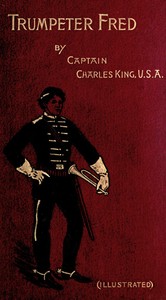
Trumpeter Fred: A Story of the Plains — Context and Discussion

(0 User reviews)   80
King, Charles, 1844-1933 Project Gutenberg 2011
Western stories; Conduct of life -- Juvenile fiction; Friendship -- Juvenile fiction; Indians of North America -- Juvenile fiction; Youth -- Conduct of life -- Juvenile fiction; Soldiers -- Juvenile fiction; Courage -- Juvenile fiction; Traitors -- Juvenile fiction; Prisoners -- Juvenile fiction; United States. Army -- Military life -- Juvenile fiction; West (U.S.) -- Description and travel -- Juvenile fiction; Courts-martial and courts of inquiry -- Juvenile fiction; Trumpet players -- Juvenile fiction Readers of public-domain and historical texts
Project Gutenberg digital edition en

Edition facts

Words 23,736
Reading time 104 min
Text sections 4

Before opening Trumpeter Fred: A Story of the Plains — Context and Discussion, the edition data offers a quick orientation: 23,736 words, 1 hr 44 min estimated reading time, and 4 detected text sections.

The text analysis averages about 21.5 words per sentence, while the detected sections provide another way to judge how the source is divided.

Project Gutenberg metadata also associates the work with “Western stories,” connecting these edition facts with the source record’s subject description.

King's diction and dialogue reveal a frontier military world through the eyes of a young trumpeter, with precise observations of rank, duty, and the tension between experience and authority.
Share
Editorial Edition Score 4.6/5

Calculated from edition completeness, EPUB availability, text structure and catalogue metadata. Not a user rating.

How this score is calculated
  • Description quality20 pts
  • Title & short description10 pts
  • Source metadata20 pts
  • Text length15 pts
  • Chapters / structure15 pts
  • EPUB file integrity20 pts

Total of 100 points, scaled to a 2.5-5.0 range. Editions with an empty description or a missing EPUB file are not scored.

Edition quality

Read the Text

There were only thirty in all that night when the troop reached the Niobrara and unsaddled along the grassy banks. Rather slim numbers for the duty to be performed, and with the captain away, too. Not that the men had lack of confidence in Lieutenant Blunt, but it was practically his first summer at Indian campaigning, and, however well a young soldier may have studied strategy and grand tactics at West Point, it is something very different that is needed in fighting these wild warriors of our prairies and mountains. Blunt was brave and spirited, they all knew that; but in point of experience even Trumpeter Fred was his superior. All along the dusty trail, for an hour before they reached the ford, the tracks of the Indian ponies had been thickly scattered. A war party of at least fifty had evidently gone trotting down stream not six hours before the soldiers rode in to water their tired and thirsty steeds. No comrades were known to be nearer at hand than the garrison at Fort Laramie, fifty long miles away, or those guarding the post of Fort Robinson, right in the heart of the Indian country, and in the very midst of the treacherous tribes along White River. And yet, under its second lieutenant and with only twenty-nine "rank and file," here was "B" Troop ordered to bivouac at the Niobrara crossing, and despite the fact that all the country was alive with war parties of the Sioux, to wait there for further orders.

"Only twenty-nine men all told and a small boy," said Sergeant Dawson, who was forever trying to plague that little trumpeter. It was by no means fair to Fred Waller, either, for while he was somewhat undersized for his fifteen years, his carbine and his Colt's revolver were just as big and just as effective as those of any man in the troop, and he knew how to use them, no matter how hard the "Springfield" kicked. He rode one of the tallest horses, too, and sat him well and firmly, notwithstanding all his furious plunging and "buckings," the day that Dawson slipped the thorny sprig of a wild rosebush under the saddle blanket.

From the first sergeant down to the newest recruit, all the men had grown fond of little Fred in that year of rough scouting and campaigning around old Red Cloud's reservation--all of them, that is to say, with the possible exception of Dawson, who annoyed him in many ways when the officers or first sergeant did not happen to be near, and who sometimes spoke sneeringly of him to such of the troopers as would listen, but these were very few in number.

Fred was the only son of brave old Sergeant Waller, who had served with the regiment all over the plains before the great war of the rebellion, and who had been its standard-bearer in many a sharp fight and stirring charge in Virginia. Now he carried two bullet wounds, and on his bronzed cheek a long white seam, a saber scar, as mementoes of Beverly Ford, Winchester, and Five Forks, and through the efforts of his war commanders a comfortable berth as ordnance sergeant had been secured for him at one of the big frontier posts along the railway. Fred was the pride of the old soldier's heart, and nothing would do but that he, too, must be a trooper. The boy was born far out across the plains in sight of the Chihuahua Mountains, had followed the regiment in his mother's arms up the valley of the Rio Grande to the Albuquerque, then eastward along the Indian-haunted Smoky Hill route to Leavenworth. When the great war burst upon the nation little Fred was just beginning to toddle about the whitewashed walls of the laundresses' quarters--his father was Corporal Waller then--and his baby eyes were big as saucers when he was carried aboard of a big steamship and paddled down the muddy Missouri and around by Cairo and up the winding Ohio to Cincinnati. He was even more astonished at the railway cars that bore the soldiers and a few women and children eastward and finally landed them at Carlisle. There at the old cavalry barracks the little fellow grew to lusty boyhood, while his father was bearing the blue and gold standard through battle after battle on the Virginia soil. And when the war was over and the regiment was hurried out to "the plains," and again to protect the settlers, the emigrants, and the railway builders from the ceaseless assaults of the painted Indians, little Fred went along, and his soldier education was fairly begun.

Old Waller was now first sergeant of "B" troop. The regimental commander and most of the officers were greatly interested in the laughing, sun-tanned, blue-eyed boy, who rode day after day on his wiry Indian pony along the flanks of the column, scorning, though barely seven years old, to stay in the wagons with the women and children. Everybody had a jolly word of greeting for Fred, and kind-hearted Captain Blaine set his "company tailor" to work, and presently there was made for the boy a natty little cavalry jacket and a tiny pair of yellow chevrons. "Corporal Fred" they called him then, and, though he strove hard not to show it, grim old Sergeant Waller was evidently as proud and pleased as the child. He taught the little man to "stand attention" and bring up his chubby brown hand in salute whenever an officer passed by, and most scrupulously was that salute returned. He early placed the boy under the instruction of the veteran chief trumpeter, and made him practice with the musicians as soon as he was "big enough to blow," as he expressed it. And then, too (for there were no army schools, or schoolmasters in those days), regularly as the day came round and the sergeant's morning duties were done, he had his boy at his knee, book or slate in hand, patiently teaching him the little that he knew himself, and wistfully looking for some better instructor.

THE OATH OF ENLISTMENT.

It was while stationed at old Fort Sanders that Waller's enthusiastic devotion to his new captain and his captain's family began. The former troop commander was ordered to the retired list, broken down by wounds, and the senior lieutenant stepped into his place. Waller bade farewell to his old captain with tear-dimmed eyes--they had served together for over fifteen years--and with much inward misgiving, but not the faintest outward show thereof, saluted the new arrival, a young officer but a soldier through and through; it was not a week before the sergeant had fully satisfied himself as to that. Presently the new captain's family reached the fort and took up their abode; a fair-haired, blue-eyed young mother with two children, a boy and a girl, the eldest being three years younger than Fred; and then began another and strong interest.

That very winter scarlet fever devastated the fort. Few children escaped the scourge. There were a dozen little graves in the cemetery out on the prairie when the long winter came to an end. There were two or three larger graves, and one of these held all that was mortal of Fred's loving mother; he and his stern, sad-faced father were now alone in the world.

And Captain Charlton's little household had not been spared. It was among the officers' quarters that the pestilence had first appeared. Frank and Florence Charlton were among the children earliest stricken. The servants fled the house, as frontier servants will, and their place was promptly supplied by Mrs. Waller. She and her husband would listen to no remonstrance, and Mrs. Charlton, overwhelmed with care and dread, was only too glad to have the strong, cheery army woman's help. Over the little brown cottage the shadow of death hovered for days before it was lifted and borne away, and when at last all danger was over and all was again all hope and peace the sergeant's wife went back to her own humble roof across the parade, and there suddenly sickened and died. When the scourge was finally swept from the garrison and the soft winds began to blow from the South, the stricken old soldier was glad of the chance to go with his troop into the field-service, and was almost happy in one thing. Mrs. Charlton had taken his boy as one of her own, and each day she was teaching him faithfully and well. When the troop rode away from Sanders Fred was left behind to occupy a little room under the captain's roof. "Remember, sir, you are sergeant of the guard, and that house and that household are your special charge for all summer long," were Waller's parting words to his boy.

Regularly as the mail reached the troop during its summer scouting Captain Charlton's home missives had their messages for Sergeant Waller; and soon, to his unspeakable joy, letters all his own, addressed in a round boyish hand that grew firmer every week, began to come as his share of the welcome package. Never would he presume to ask for news, yet the captain was not slow to notice how old Waller was sure to be busy close at hand when the home letters came, and prompt to answer, and with soldierly salute to stand erect before his young commander and strive not to show the pride and delight that tingled in every vein at the glowing words in which Mrs. Charlton told of his boy's rapid progress and his devotion to her and the children. His lip would quiver uncontrollably and his eyes fill; his hand might tremble as it touched the brim of his scouting hat, but the salute was precise as ever.

"I thank the captain, and beg to thank the captain's kind lady," was his invariable formula on such occasions. "I hope the boy will always do his duty."

And then he would face about and stride away with his head very high in the air and his eyes blinking hard, and almost immediately his voice would be heard sternly berating some trooper whose horse had tangled himself in his lariat, or whose "kit" was not stowed in proper shape about the saddle. It was his way of striving to hide the joy those messages brought him, and the men were quick to see through it all, and little "Reddy" Mulligan, reprimanded for the third time within a fort-night, started a laugh all through the bivouac by his whimsical protest:

"It's more good news you've been getting from Fred, sergeant, dear; isn't it now? Faith, I wish he'd play ye a thrick wanst in a while, like other byes. Maybe thin I'd be mintioned to the captain for a corporalship." And for once the veteran turned his back on the laughing troop conscious of defeat.

In '74 old Waller changed the yellow stripes and diamond of the first sergeantcy for the crimson and the star of the ordnance, and the troopers, one and all, said good-by to him with infinite regret. Perhaps Dawson, who was next in rank, may be excepted. He confidently expected to be promoted in Waller's place. But though a dashing soldier and a smart non-commissioned officer, he was not the stanch, reliable man the captain needed, and proved it by celebrating Waller's promotion in a very boisterous and unseemly manner. It was plain that he had been drinking heavily, and though Captain Charlton saved him from arrest and court-martial he would not promote him, and plainly, though privately, told him why. The troop knew it was for this reason, but Dawson swore it was all on account of Waller's influence against him when Sergeant Graham was named in regimental orders as the old veteran's successor.

That same summer, with firm hand and glistening eyes, Waller signed his consent to the enlistment of his son as trumpeter in the old troop. How he watched the boy's glowing face as the oath of enlistment, so often lightly spoken, was solemnly repeated, and Fred was bound to the service of his country. How he trembled from head to foot when, but a few weeks afterward and in the dead of night, Charlton and his men hurried forth to intercept a band of Indians who had swooped down upon the herders south of Laramie Peak. Waller could hardly buckle the cantle-straps of Fred's saddle as the little fellow, all eagerness, was bustling about his horse in the dim light of the stable lanterns. Yet when the captain and Lieutenant Rayburn came trotting briskly down the roadway and the men were silently "leading into line," it was the old sergeant's hand that grasped the boy's left foot and swung him lightly into his seat.

"Whatever happens, sir, mind you keep close to the captain," was his parting injunction to his boy. Then his heels came together with the old cavalry "click" and his twitching fingers were stiffened as they went suddenly up in salute to Mr. Rayburn, who bent down from his saddle to say that they would try and take good care of Fred. But Waller answered:

"I thank the lieutenant. The boy is a soldier now, sir. He must take his chances with the rest." Then with one lingering clasp of the trumpeter's hand, "Join your captain," he ordered, and turned away into the darkness.

But the sentry on No. 6 bore witness to the fact that the ordnance sergeant never went to bed again all that night, and the men sent to unload and store the ammunition that came next day from Rock Island Arsenal declared that old Waller was gruffer than ever. All the next night too, he was awake, waiting, watching for tidings from the North. Nothing came until sunset of the second day, just as the whole command was turning out for retreat parade, and then Corporal Rock rode in with dispatches and trotted straight to where the commanding officer was standing in front of the adjutant's office. All eyes were upon him as he threw himself from the saddle and handed the packet to the colonel. Half a dozen officers hastened to join their commander as he tore it open. The piazzas of the officers' quarters were quickly alive with ladies and children, breathlessly eager to hear the news. The colonel's orderly was seen hastening to the surgeon's house--that looked ominous--then Rock remounted; trotted to Captain Charlton's gate, where Mrs. Charlton was tremblingly awaiting him. "It's all right, ma'am," he hastened to say. "Leastwise the captain's safe, but Mulligan is shot--and Ryan and Sergeant Frazer." She hurried in the house with the precious letter he placed in her hands, and while several ladies hastened to join her, the messenger returned to the office.

All this while Sergeant Waller had stood like a statue under the tall white flag-staff where the non-commissioned staff assembled at retreat, watching every move with dry, aching eyes, and a face gray as his mustache.

The trumpet played the retreat, the sunset gun thundered its good-night to the god of day; the adjutant hurried over and received the reports of the companies, the staff, and band, and then a messenger came running to them: "Mrs. Charlton wants you, Sergeant Waller. Fred's all safe, but they had a sharp fight."

The old man could not trust himself to speak. "Listen to this, sergeant," exclaimed Mrs. Charlton, as she hurried through the little group of ladies at her doorway, and looked up in his face with tear-dimmed eyes:

"Tell Waller that in a running fight of four miles Fred rode close at my heels and no man could have shown more spirit or less fear. I am sure it was a shot from his carbine that tumbled one war pony into the Laramie; and every call he had to sound rang out clear as a bell. I'm proud of the boy."

Waller's face was twitching and working; he cleared his throat and tried to speak; he dashed his hand across his eyes and ground his heels into the gravel of the walk; he heard the kind and gentle voices of the ladies joining in the chorus of congratulation, but he could not see their faces; a mist had risen before his eyes. Even the old formula, "I thank the captain's lady," had deserted him. He mumbled some inarticulate words, and then, in dread of disastrous breakdown, turned suddenly away and strode across the drive. More than one woman was in tears. There was not a ripple of faintest laughter when it was seen that in his blindness the old sergeant had collided with the tree box at the edge of the acequia. Straight to his humble quarters he went; but they were beautiful to him, radiant with the light of joy, pride, gratitude, and love that beamed and burnt in his honest heart.

And now, a year later, all the cavalry was in the field. Gold had tempted explorers and miners innumerable to the Black Hills of Dakota--Indian land by solemn treaty. The Government warned the invaders back, but to no purpose. The Indians swarmed from the agencies and massacred all whom they could overpower. Charlton's troop had early been hurried up to Red Cloud, and now with others was engaged in the perilous work of patrolling the trails around the Indian haunts.

Two months of hard and most exciting work had they had, and still the troubles were not over; and then just after the paymaster with his iron safe and bristling escort had paid the outlying posts a visit, and Captain Charlton had been ordered in with him to attend a court-martial at Fort Laramie, there came a week that no man in "B" troop ever forgot.

Mr. Rayburn had been wounded and was in the hospital at Fort Robinson. Twenty of the men were away on escort duty, and so it happened that only young Lieutenant Blunt and about thirty troopers were left at the camp just west of the Agency. Fearful that the money, "burning" as it always does in the soldiers' pockets, would tempt his men to gamble or drink and get into mischief around the crowded post, Charlton had ordered that the troop should march at once to the Niobrara and wait there for his return. It was known, of course, that many Indian bands were out, and it promised to be adventurous. It was Mr. Blunt's first independent command, too, and he felt a trifle nervous. All went well, however, until the morning of the second day, when Sergeant Graham excitedly called his young commander, his face clouded with dismay.

"Lieutenant," he cried, "Sergeant Dawson and several men were robbed last night. The money's clean gone!"

Blunt was out of his blanket in an instant. "How much is missing?" he asked.

"I can't tell yet, sir--a good deal. But that is not the worst of it."

"What on earth could be worse?"

"Trumpeter Waller's gone, sir--deserted; taken his horse, arms, and everything!"

SUSPICIOUS CIRCUMSTANCES.

From the opening paragraph, Charles King establishes a world defined by numbers and ranks: only thirty troopers, a captain away, a second lieutenant untested in Indian campaigning. The narrative voice moves between the soldiers' collective unease and the specific, teasing tone of Sergeant Dawson, who calls Fred Waller 'a small boy' despite the boy's proven skill with carbine and revolver. King's dialogue and description work together to create a setting where every detail—the tracks of Indian ponies, the distance to Fort Laramie, the 'buckings' of Fred's horse—carries weight. The author's own military experience (he was a U.S. Army captain) informs the precise rendering of camp life, from mess chests to 'boots and saddles' calls, grounding the story in authentic army procedure.

Rank, Experience, and the Young Soldier

King repeatedly contrasts formal rank with practical experience. Lieutenant Blunt has studied 'strategy and grand tactics at West Point,' but the men know that fighting 'wild warriors' requires something different. Trumpeter Fred, at fifteen, is 'his superior' in experience. This tension is not merely stated but dramatized through dialogue: Sergeant Dawson's teasing carries an edge of resentment, while Fred's silent competence is shown through action—riding a tall horse, handling its 'furious plunging and buckings' after Dawson's prank. The narrative voice aligns with the men's perspective, noting that even the captain is always 'the old man' to his troops, a colloquialism that signals insider knowledge.

The Weight of Small Details

King builds suspense through precise, almost mundane observations. The war party's tracks are 'thickly scattered' along the trail; the troop reaches the Niobrara at night with only twenty-nine men 'all told and a small boy.' Later, the morning scene at the post is described with quiet specificity: bugles sounding mess call, smoke curling from Indian tepees, 'urchins in picturesque but dirty tatters' watching ponies. These details are not decorative—they establish a fragile peace that the reader knows will break. The author's eye for the routine of camp life—the feeding of oats, the card games, the 'subdued chat' about Fred's disappearance—makes the sudden intrusion of danger more jarring.

Dialogue as Character and Conflict

King uses dialogue to reveal character and advance conflict without heavy exposition. Sergeant Dawson and Private Donovan's request to go to the post is relayed through Sergeant Graham, and Captain Charlton's cool nod—'Very well'—carries an undercurrent of strategy that the men do not grasp. The men's later conversation, overheard through Corporal Wright, shows their shifting perceptions: 'I would have bet any amount' that the captain would 'ride over Sergeant Dawson roughshod,' but instead he 'talked to him just like a Dutch uncle.' The colloquial phrasing ('roughshod,' 'Dutch uncle') roots the dialogue in the soldiers' vernacular, while the captain's unexplained leniency hints at a larger plan the reader must infer.

Narrative Perspective and the Unseen Threat

In Chapter XI, King shifts perspective abruptly. After describing the camp's 'subdued chat,' the narrator interjects: 'Shall we look and see?' The following paragraph pulls back to a panoramic view—'far to the south, far beyond the bold bluffs'—where 'swarms of naked, brilliantly painted red warriors' are gathering. This sudden expansion of scope, from the intimate camp to the distant war party, mirrors the soldiers' own limited knowledge. The reader is given a vantage point the characters lack, creating dramatic irony. King's use of the French name for the Niobrara—'L'Eau qui Court'—adds a layer of historical texture, reminding the reader that this landscape has been traversed and named by many before the cavalry arrived.

King's prose rewards attention to what is left unsaid: the captain's unexplained decisions, the men's half-voiced suspicions, the gaps between orders and understanding. Readers will find that the story's tension derives less from action than from the careful accumulation of detail and dialogue that reveals a community under pressure. The author's own service as a cavalry officer lends authenticity to the depiction of military hierarchy and frontier life, making the silences as telling as the spoken words.

Sitting with Trumpeter Fred, I kept thinking about the quiet weight of a young man’s first real glimpses of duty—how rank shapes a voice before it finds itself. That same ache lingers in The Wild Man of the West: A Tale of the Rocky Mountains — Background and Themes, where the wilderness asks its own questions about who commands and who merely follows. Both feel like old photographs left in a drawer.

There are no reviews for this eBook.

0
0 out of 5 (0 User reviews )

Add a Review

Your Rating *
There are no comments for this eBook.

Reader reflection

How will you remember this book?

Save your reaction, strongest insight, and memorable passage.

Your progress 0 / 10
1

Where are you in your reading?

2

How much did you enjoy the reading experience?

3

Would you pass this book on to a friend?

4

What was the reading difficulty like?

Related eBooks