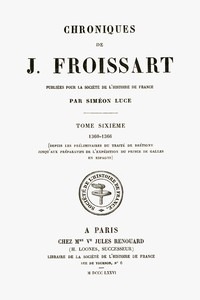
Chroniques de J. Froissart, tome 06/13 : 1360-1366 (Depuis les préliminaires…

(15 User reviews)   3615
By Ashley Gutierrez Posted on Dec 11, 2025
In Category - Wildlife
Froissart, Jean, 1338?-1410? Froissart, Jean, 1338?-1410?
French
If you think modern politics is messy, wait until you read this. Froissart's sixth volume drops us into the 1360s—a time when the Hundred Years' War hits pause with a shaky peace treaty, and everyone immediately starts scheming for the next round. Kings sign papers with one hand and sharpen swords with the other. Knights, suddenly unemployed, turn into roaming bands of mercenaries causing chaos across France. It's like watching a tense ceasefire where you know the real fight is just simmering under the surface. Froissart doesn't just give us dates and battles; he shows us the human cost—the villages burned, the deals broken, the ordinary people caught in the middle. This isn't dry history; it's a raw, boots-on-the-ground account of what happens when war 'ends' but nobody really stops fighting.
Share

Read "Chroniques de J. Froissart, tome 06/13 : 1360-1366 (Depuis les préliminaires…" Online

This book is available in the public domain. Start reading the digital edition below.

START READING FULL BOOK
Instant Access    Mobile Friendly

Book Preview

A short preview of the book’s content is shown below to give you an idea of its style and themes.

personnes les plus capables d’en préparer et d’en suivre la publication. Il nomme, pour chaque ouvrage à publier, un Commissaire responsable chargé d’en surveiller l’exécution. Le nom de l’Éditeur sera placé en tête de chaque volume. Aucun volume ne pourra paraître sous le nom de la Société sans l’autorisation du Conseil, et s’il n’est accompagné d’une déclaration du Commissaire responsable, portant que le travail lui a paru mériter d’être publié. _Le Commissaire responsable soussigné déclare que le tome VI de l’Édition des_ CHRONIQUES DE J. FROISSART, _préparée par_ M. SIMÉON LUCE, _lui a paru digne d’être publié par la_ SOCIÉTÉ DE L’HISTOIRE DE FRANCE. _Fait à Paris, le 1er décembre 1876._ _Signé_ L. DELISLE. _Certifié_, Le Secrétaire de la Société de l’Histoire de France, J. DESNOYERS. SOMMAIRE. CHAPITRE LXXXIV. 1360. TRAITÉ DE BRÉTIGNY (§§ 474 à 490). Édouard III et son armée sont toujours campés à Montlhéry[1]. Charles, duc de Normandie, régent du royaume, et les principaux de son Conseil, les ducs d’Anjou et de Berry ses frères, Gilles Aycelin de Montagu, évêque de Thérouanne, chancelier de France, se décident à faire des ouvertures de paix au roi d’Angleterre. Androuin de la Roche, abbé de Cluny, Simon de Langres, maître des Frères Prêcheurs, Hugues de Genève, seigneur d’Anthon[2], sont chargés de ces négociations[3]. Édouard III, indigné au plus haut point de la descente des Français à Winchelsea[4] dont il vient d’être informé, repousse d’abord, malgré les avis du duc de Lancastre, toutes les propositions d’accommodement. Il ne veut à aucun prix renoncer au titre de roi de France, et son projet est, après être allé se rafraîchir deux ou trois mois en Normandie et en Bretagne, de revenir devant Paris au moment de la moisson et des vendanges. Il lève donc son camp de Montlhéry[5] et se dirige vers le pays chartrain, pendant que les trois envoyés du régent, duc de Normandie, reviennent sans cesse à la charge pour le presser de conclure la paix. Au moment où le monarque anglais et ses gens passent à Gallardon, un orage effroyable éclate tout à coup accompagné d’éclairs, de tonnerre, d’une trombe de vent, de grêle et de pierres d’une grosseur énorme, qui terrifie les Anglais et leur tue hommes et chevaux[6]. Édouard y voit un signe de la volonté de Dieu en faveur de la paix; en même temps, le regard fixé sur l’église Notre-Dame de Chartres[7] qu’il aperçoit dans le lointain, il fait un vœu et se consacre à la Sainte Vierge. Après avoir campé la nuit suivante sur le bord de la rivière de Gallardon[8], il n’en continue pas moins le lendemain sa route vers Bonneval[9] et la marche de Vendôme. Toutefois, il finit par céder aux supplications de l’abbé de Cluny, et des négociations[10] s’engagent à Brétigny[11] près de Chartres entre ses délégués et ceux du régent: les pourparlers durent plusieurs jours et aboutissent à la conclusion d’un traité de paix. P. 1 à 5, 237 à 241. [1] Édouard III fut logé en l’hôtel de Chanteloup (aujourd’hui château de Saint-Germain-lez-Arpajon), entre Montlhéry et Châtres (Arpajon), du mardi 11 mars au lundi 6 avril 1360. _Grandes Chroniques_, VI, 169 et Rymer, III, 480. [2] Isère, arr. Vienne, c. Meyzieu. Hugues de Genève, troisième fils d’Amédée, IIe du nom, comte de Genève, et d’Agnès de Chalon, était le vassal, du chef de sa seigneurie d’Anthon, de Charles, dauphin de Viennois. [3] Ces négociations infructueuses s’ouvrirent à la maladrerie de Longjumeau le vendredi saint 3 avril. Froissart omet de dire que les trois négociateurs qu’il nomme étaient des légats du Saint-Siége qu’Innocent VI avait envoyés en France, par une bulle...

This is a limited preview. Download the book to read the full content.

This volume picks up right after the Treaty of Brétigny in 1360, which was supposed to end the first major phase of the Hundred Years' War. On paper, England's Edward III gets a huge chunk of France, and French King John II goes home from captivity. Peace, right? Not even close.

The Story

Froissart shows us the messy aftermath. The treaty creates a fragile calm, but it's full of loopholes and bad feelings. While kings and nobles negotiate, the real story happens off the battlefield. Thousands of soldiers, now out of a job, form roaming bands called the 'Free Companies.' They pillage the French countryside, creating a whole new wave of suffering. We follow power struggles, like the rise of the Black Prince in Aquitaine, and watch as old grudges and royal egos make the peace feel like a temporary timeout. The central question isn't who wins a war, but whether peace itself can even survive human ambition.

Why You Should Read It

What makes Froissart special is his focus on people, not just politics. He finds the stories within the big events. You feel the frustration of a king trying to control his restless nobles, and the desperation of peasants whose lives are ruined by mercenaries their own king can't stop. It's history with the gloves off—less about grand strategy and more about the gritty, often selfish, choices people make when the rules break down. Reading this is like having a front-row seat to the chaos that follows a 'victory.'

Final Verdict

Perfect for anyone who loves real political drama and complex characters. If you enjoy shows like Game of Thrones for its power games, you'll find the original, real-world version here. It's also great for readers who want to understand history beyond the famous battles, seeing the consequences that shaped everyday life. A bit of patience with the older writing style pays off with a incredibly vivid and human picture of the 14th century.


🔖 Legacy Content

Legal analysis indicates this work is in the public domain. It is now common property for all to enjoy.

Christopher Johnson
1 year ago

Recommended.

Elizabeth Sanchez
8 months ago

I have to admit, the clarity of the writing makes this accessible. Thanks for sharing this review.

Lisa Lewis
1 year ago

Helped me clear up some confusion on the topic.

Emma Lee
1 year ago

As someone who reads a lot, the pacing is just right, keeping you engaged. I will read more from this author.

Donald Rodriguez
1 year ago

Surprisingly enough, the narrative structure is incredibly compelling. I would gladly recommend this title.

5
5 out of 5 (15 User reviews )

Add a Review

Your Rating *
There are no comments for this eBook.
You must log in to post a comment.
Log in


Related eBooks