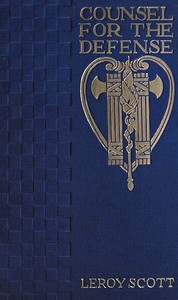
Counsel for the Defense — Edition Insights
Edition facts
For Counsel for the Defense — Edition Insights, the stored edition analysis reports 94,402 words, 6 hr 51 min estimated reading time, and 10 detected text sections.
The text analysis averages about 13.4 words per sentence, while the detected sections provide another way to judge how the source is divided.
Project Gutenberg metadata also associates the work with “Love stories,” connecting these edition facts with the source record’s subject description.
Calculated from edition completeness, EPUB availability, text structure and catalogue metadata. Not a user rating.
How this score is calculated
- Description quality20 pts
- Title & short description10 pts
- Source metadata20 pts
- Text length15 pts
- Chapters / structure15 pts
- EPUB file integrity20 pts
Total of 100 points, scaled to a 2.5-5.0 range. Editions with an empty description or a missing EPUB file are not scored.
Read the Text
Bruce looked at his watch.
"Two hours till press time; I guess it can wait." And taking the story back from the boy he tossed it upon his desk.
He stepped out into the local room, which showed the same kindly tolerance of dirt as did his private office. At a long table two young men sat before typewriters, and in a corner a third young man was taking the clicking dictation of a telegraph sounder.
"Remember, boys, keep everything but the celebration down to bones!" Bruce called out. And with that he passed out of the office and down the stairway to the street.
THE BUBBLE REPUTATION
Despite its thirty thousand population--"Forty thousand, and growing, sir!" loyally declared those disinterested citizens engaged in the sale of remote fields of ragweed as building lots--Westville was still but half-evolved from its earlier state of an overgrown country town. It was as yet semi-pastoral, semi-urban. Automobiles and farm wagons locked hubs in brotherly embrace upon its highways; cowhide boots and patent leather shared its sidewalks. There was a stockbroker's office that was thoroughly metropolitan in the facilities it afforded the elite for relieving themselves of the tribulation of riches; and adjoining it was Simpson Brothers & Company, wherein hick'ry-shirted gentlemen bartered for threshing machines, hayrakes, axle grease, and such like baubles of Arcadian pastime.
There were three topics on which one could always start an argument in Westville--politics, religion, and the editor of the _Express_. A year before Arnold Bruce, who had left Westville at eighteen and whom the town had vaguely heard of as a newspaper man in Chicago and New York but whom it had not seen since, had returned home and taken charge of the _Express_, which had been willed him by the late editor, his uncle. The _Express_, which had been a slippered, dozing, senile sheet under old Jimmie Bruce, burst suddenly into a volcanic youth. The new editor used huge, vociferous headlines instead of the mere whispering, timorous types of his uncle; he wrote a rousing, rough-and-ready English; occasionally he placed an important editorial, set up in heavy-faced type and enclosed in a black border, in the very centre of his first page; and from the very start he had had the hardihood to attack the "established order" at several points and to preach unorthodox political doctrines. The wealthiest citizens were outraged, and hotly denounced Bruce as a "yellow journalist" and a "red-mouthed demagogue." It was commonly held by the better element that his ultra-democracy was merely a mask, a pose, an advertising scheme, to gather in the gullible subscriber and to force himself sensationally into the public eye.
But despite all hostile criticism of the paper, people read the _Express_--many staid ones surreptitiously--for it had a snap, a go, a tang, that at times almost took the breath. And despite the estimate of its editor as a charlatan, the people had yielded to that aggressive personage a rank of high importance in their midst.
Bruce stepped forth from his stairway, crossed Main Street, and strode up the shady Court House walk. On the left side of the walk, a-tiptoe in an arid fountain, was poised a gracious nymph of cast-iron, so chastely garbed as to bring to the cheek of elderly innocence no faintest flush. On the walk's right side stood a rigid statue, suggesting tetanus in the model, of the city's founder, Col. Davy West, wearing a coonskin cap and leaning with conscious dignity upon a long deer rifle.
Bruce entered the dingy Court House, mounted a foot-worn wooden stairway, browned with the ambrosial extract of two generations of tobacco-chewing litigants, and passed into a damp and gloomy chamber. This room was the office of the prosecuting attorney of Calloway County. That the incumbent might not become too depressed by his environment, the walls were cheered up by a steel engraving of Daniel Webster, frowning with multitudinous thought, and by a crackled map of Indiana--the latter dotted by industrious flies with myriad nameless cities.
Three men arose from about the flat-topped desk in the centre of the room, the prosecutor, the Reverend Doctor Sherman, and a rather smartly dressed man whom Bruce remembered to have seen once or twice but whom he did not know. With the first two the editor shook hands, and the third was introduced to him as Mr. Marcy, the agent of the Acme Filter Company, which had installed the filtering plant of the new water-works.
Bruce turned in his brusque manner to the prosecuting attorney.
"What's the matter?" he asked.
"Suppose we all sit down first," suggested the prosecutor.
They did so, and Kennedy regarded Bruce with a solemn, weighty stare. He was a lank, lantern-jawed, frock-coated gentleman of thirty-five, with an upward rolling forelock and an Adam's-apple that throbbed in his throat like a petrified pulse. He was climbing the political ladder, and he was carefully schooling himself into that dignity and poise and appearance of importance which should distinguish the deportment of the public man.
"Well, what is it?" demanded Bruce shortly. "About the water-works?"
"Yes," responded Kennedy. "The water-works, Mr. Bruce, is, I hardly need say, a source of pride to us all. To you especially it has had a large significance. You have made it a theme for a continuous agitation in your paper. You have argued and urged that, since the city's new water-works promised to be such a great success, Westville should not halt with this one municipal enterprise, but should refuse the new franchise the street railway company is going to apply for, take over the railway, run it as a municipal----"
"Yes, yes," interrupted Bruce impatiently. "But who's dead? Who wants the line of march changed to go by his grocery store?"
"What I was saying was merely to recall how very important the water-works has been to us," the prosecutor returned, with increased solemnity. He paused, and having gained that heightened stage effect of a well-managed silence, he continued: "Mr. Bruce, something very serious has occurred."
For all its ostentation the prosecutor's manner was genuinely impressive. Bruce looked quickly at the other two men. The agent was ill at ease, the minister pale and agitated.
"Come," cried Bruce, "out with what you've got to tell me!"
"It is a matter of the very first importance," returned the prosecutor, who was posing for a prominent place in the _Express's_ account of this affair--for however much the public men of Westville affected to look down upon the _Express_, they secretly preferred its superior presentment of their doings. "Doctor Sherman, in his capacity of president of the Voters' Union, has just brought before me some most distressing, most astounding evidence. It is evidence upon which I must act both as a public official and as a member of the Arrangements Committee, and evidence which concerns you both as a committeeman and as an editor. It is painful to me to break----"
"Let's have it from first hands," interrupted Bruce, irritated by the verbal excelsior which the prosecutor so deliberately unwrapped from about his fact.
He turned to the minister, a slender man of hardly more than thirty, with a high brow, the wide, sensitive mouth of the born orator, fervently bright eyes, and the pallor of the devoted student--a face that instantly explained why, though so young, he was Westville's most popular divine.
"What's it about, Doctor Sherman?" the editor asked. "Who's the man?"
There was no posing here for Bruce's typewriter. The minister's concern was deep and sincere.
"About the water-works, as Mr. Kennedy has said," he answered in a voice that trembled with agitation. "There has been some--some crooked work."
"Crooked work?" ejaculated the editor, staring at the minister. "Crooked work?"
"You are certain of what you say?"
"Then you have evidence?"
"I am sorry--but--but I have."
The editor was leaning forward, his nostrils dilated, his eyes gleaming sharply behind their thick glasses.
"Who's mixed up in it? Who's the man?"
The minister's hands were tightly interlocked. For an instant he seemed unable to speak.
"Who's the man?" repeated Bruce.
The minister swallowed.
"Doctor West," he said.
"Doctor West?" he cried. "The superintendent of the water-works?"
If the editor's concern for the city's welfare was merely a political and business pose, if he was merely an actor, at least he acted his part well. "My God!" he breathed, and stood with eyes fixed upon the young minister. Then suddenly he sat down again, his thick brows drew together, and his heavy jaws set.
"Let's have the whole story," he snapped out. "From the very beginning."
"I cannot tell you how distressed I am by what I have just been forced to do," began the young clergyman. "I have always esteemed Doctor West most highly, and my wife and his daughter have been the closest friends since girlhood. To make my part in this affair clear, I must recall to you that of late the chief attention of the Voters' Union has naturally been devoted to the water-works. I never imagined that anything was wrong. But, speaking frankly, after the event, I must say that Doctor West's position was such as made it a simple matter for him to defraud the city should he so desire."
"You mean because the council invested him with so much authority?" demanded Bruce.
"Yes. As I have said, I regarded Doctor West above all suspicion. But a short time ago some matters--I need not detail them--aroused in me the fear that Doctor West was using his office for--for----"
"For graft?" supplied Bruce.
The minister inclined his head.
"Later, only a few weeks ago, a more definite fear came to me," he continued in his low, pained voice. "It happens that I have known Mr. Marcy here for years; we were friends in college, though we had lost track of one another till his business brought him here. A few small circumstances--my suspicion was already on the alert--made me guess that Mr. Marcy was about to give Doctor West a bribe for having awarded the filter contract to his company. I got Mr. Marcy alone--taxed him with his intention--worked upon his conscience----"
"Mr. Marcy has stated," the prosecutor interrupted to explain, "that Doctor Sherman always had great influence over him."
Mr. Marcy corroborated this with a nod.
"At length Mr. Marcy confessed," Doctor Sherman went on. "He had arranged to give Doctor West a certain sum of money immediately after the filtering plant had been approved and payment had been made to the company. After this confession I hesitated long upon what I should do. On the one hand, I shrank from disgracing Doctor West. On the other, I had a duty to the city. After a long struggle I decided that my responsibility to the people of Westville should overbalance any feeling I might have for any single individual."
"That was the only decision," said Bruce. "Go on!"
"But at the same time, to protect Doctor West's reputation, I decided to take no one into my plan; should his integrity reassert itself at the last moment and cause him to refuse the bribe, the whole matter would then remain locked up in my heart. I arranged with Mr. Marcy that he should carry out his agreement with Doctor West. Day before yesterday, as you know, the council, on Doctor West's recommendation, formally approved the filtering plant, and yesterday a draft was sent to the company. Mr. Marcy was to call at Doctor West's home this morning to conclude their secret bargain. Just before the appointed hour I dropped in on Doctor West, and was there when Mr. Marcy called. I said I would wait to finish my talk with Doctor West till they were through their business, took a book, and went into an adjoining room. I could see the two men through the partly opened door. After some talk, Mr. Marcy drew an envelope from his pocket and handed it to Doctor West, saying in a low voice, 'Here is that money we spoke about.'"
"And he took it?" Bruce interrupted.
"Doctor West slipped the envelope unopened into his pocket, and replied, 'Thank you very much; it will come in very handy just now.'"
"My God!" breathed the editor.
"Though I had suspected Doctor West, I sat there stunned," the minister continued. "But after a minute or two I slipped out by another door. I returned with a policeman, and found Doctor West still with Mr. Marcy. The policeman arrested Doctor West, and found the envelope upon his person. In it was two thousand dollars."
"Now, what do you think of that?" Kennedy demanded of the editor. "Won't the town be thunderstruck!"
Bruce turned to the agent, who had sat through the recital, a mere corroborative presence.
"And this is all true?"
"That is exactly the way it happened," replied Mr. Marcy.
Bruce looked back at the minister.
"But didn't he have anything to say for himself?"
"I can answer that," put in Kennedy. "I had him in here before I sent him over to the jail. He admits practically every point that Doctor Sherman has made. The only thing he says for himself is that he never thought the money Mr. Marcy gave him was intended for a bribe."
Bruce stood up, his face hard and glowering, and his fist crashed explosively down upon the table.
"Of all the damned flimsy defenses that ever a man made, that's the limit!"
"It certainly won't go down with the people of Westville," commented the prosecutor. "And I can see the smile of the jury when he produces that defense in court."
"I should say they would smile!" cried Bruce. "But what was his motive?"
"That's plain enough," answered the prosecutor. "We both know, Mr. Bruce, that he has earned hardly anything from the practice of medicine since we were boys. His salary as superintendent of the water-works was much less than he has been spending. His property is mortgaged practically to its full value. Everything has gone on those experiments of his. It's simply a case of a man being in a tight fix for money."
Bruce was striding up and down the room, scowling and staring fiercely at the worn linoleum that carpeted the prosecutor's office.
"I thought you'd take it rather hard," said Kennedy, a little slyly. "It sort of puts a spoke in that general municipal ownership scheme of yours--eh?"
Bruce paused belligerently before the prosecutor.
"See here, Kennedy," he snapped out. "Because a man you've banked on is a crook, does that prove a principle is wrong?"
"Oh, I guess not," Kennedy had to admit.
"Well, suppose you cut out that kind of talk then. But what are you going to do about the doctor?"
"The grand jury is in session. I'm going straight before it with the evidence. An hour from now and Doctor West will be indicted."
"And what about to-morrow's show?"
"What do you think we ought to do?"
"What ought we to do!" Again the editor's fist crashed upon the desk. "The celebration was half in Doctor West's honour. Do we want to meet and hurrah for the man that sold us out? As for the water-works, it looks as if, for all we know, he might have bought us a lot of old junk. Do we want to hold a jubilee over a junk pile? You ask what we ought to do. God, man, there's only one thing to do, and that's to call the whole damned performance off!"
"That's my opinion," said the prosecutor. "What do you think, Doctor Sherman?"
The young minister wiped his pale face.
"It's a most miserable affair. I'm sick because of the part I've been forced to play--I'm sorry for Doctor West--and I'm particularly sorry for his daughter--but I do not see that any other course would be possible."
"I suppose we ought to consult Mr. Blake," said Kennedy.
"He's not in town," returned Bruce. "And we don't need to consult him. We three are a majority of the committee. The matter has to be settled at once. And it's settled all right!"
The editor jerked out his watch, glanced at it, then reached for his hat.
"I'll have this on the street in an hour--and if this town doesn't go wild, then I don't know Westville!"
He was making for the door, when the newspaper man in him recalled a new detail of his story. He turned back.
"How about this daughter of Doctor West?" he asked.
The prosecutor looked at the minister.
"Was she coming home for the celebration, do you know?"
"Yes. She wrote Mrs. Sherman she was leaving New York this morning and would get in here to-morrow on the Limited."
"What's she like?" asked Bruce.
"Haven't you seen her?" asked Kennedy.
"She hasn't been home since I came back to Westville. When I left here she was a tomboy--mostly legs and freckles."
The prosecutor's lean face crinkled with a smile.
"I guess you'll find she's grown right smart since then. She went to one of those colleges back East; Vassar, I think it was. She got hold of some of those new-fangled ideas the women in the East are crazy over now--about going out in the world for themselves, and----"
"Idiots--all of them!" snapped Bruce.
"After she graduated, she studied law. When she was back home two years ago she asked me what chance a woman would have to practise law in Westville. A woman lawyer in Westville--oh, Lord!"
The prosecutor leaned back and laughed at the excruciating humour of the idea.
"Oh, I know the kind!" Bruce's lips curled with contempt. "Loud-voiced--aggressive--bony--perfect frights."
"Let me suggest," put in Doctor Sherman, "that Miss West does not belong in that classification."
"Yes, I guess you're a little wrong about Katherine West," smiled Kennedy.
Bruce waved his hand peremptorily. "They're all the same! But what's she doing in New York? Practising law?"
"No. She's working for an organization something like Doctor Sherman's--The Municipal League, I think she called it."
"Huh!" grunted Bruce. "Well, whatever she's like, it's a pretty mess she's coming back into!"
With that the editor pulled his hat tightly down upon his forehead and strode out of the Court House and past the speakers' stand, across whose front twin flags were being leisurely festooned. Back in his own office he picked up the story he had finished an hour before. With a sneer he tore it across and trampled it under foot. Then, jerking a chair forward to his typewriter, his brow dark, his jaw set, he began to thump fiercely upon the keys.
Next morning when the Limited slowed down beside the old frame station--a new one of brick was rising across the tracks--a young woman descended from a Pullman at the front of the train. She was lithe and graceful, rather tall and slender, and was dressed with effective simplicity in a blue tailored suit and a tan straw hat with a single blue quill. Her face was flushed, and there glowed an expectant brightness in her brown eyes, as though happiness and affection were upon the point of bubbling over.
Standing beside her suit-case, she eagerly scanned the figures about the station. Three or four swagger young drummers had scrambled off the smoker, and these ambassadors of fashion as many hotel bus drivers were inviting with importunate hospitality to honour their respective board and bed. There was the shirt-sleeved figure of Jim Ludlow, ticket agent and tenor of the Presbyterian choir. And leaning cross-legged beneath the station eaves, giving the effect of supporting the low roof, were half a dozen slowly masticating, soberly contemplative gentlemen--loose-jointed caryatides, whose lank sculpture forms the sole and invariable ornamentation of the facades of all Western stations. But nowhere did the young woman's expectant eyes alight upon the person whom they sought.
The joyous response to welcome, which had plainly trembled at the tips of her being, subsided, and in disappointment she picked up her bag and was starting for a street car, when up the long, broad platform there came hurrying a short-legged little man, with a bloodshot, watery eye. He paused hesitant at a couple of yards, smiled tentatively, and the remnant of an old glove fumbled the brim of a rumpled, semi-bald object that in its distant youth had probably been a silk hat.
The young woman smiled back and held out her hand.
"How do you do, Mr. Huggins."
"How de do, Miss Katherine," he stammered.
"Have you seen father anywhere?" she asked anxiously.
"No. Your aunt just sent me word I was to meet you and fetch you home. She couldn't leave Doctor West."
"Is father ill?" she cried.
The old cabman fumbled his ancient headgear.
"No--he ain't--he ain't exactly sick. He's just porely. I guess it's only--only a bad headache."
The novel opens not with its heroine but with a dust-choked newspaper office, its broken chair mended by an atlas and its floor greasy beyond remedy—a room, the narrator remarks, "hopelessly unfit for human habitation." This setting introduces the story's preoccupation with decay beneath surface respectability, a theme that extends from furniture to politics. Leroy Scott's 1912 novel follows Katherine West, a young woman who returns to Westville, Indiana, to practice law and defend her father, a doctor ensnared in a corruption scheme. The excerpts show her conducting methodical surveillance: she notes speedometer readings, watches the Blake automobile slip out at night, and calculates distances to a possible rendezvous at a deserted cabin called The Sycamores. Scott renders her vigilance in concrete detail—the summer-house stakeout, the bedroom window vigil, the roosters' dawn chorus—rather than abstract determination.
Surveillance as Plot Engine
Katherine West does not wait for evidence to arrive; she hunts it. The excerpts show her building a case through patient observation: she befriends the Blake family's chauffeur to read the speedometer, logs mileage before and after midnight trips, and deduces a possible meeting place by halving the distance traveled. Scott describes her reasoning in a chain of conditional clauses—"if anything were in this conjecture," "perhaps there was no confederate"—that mirrors the tentative, iterative nature of detective work. The narrative lingers on the physical details of her watch: the rustic summer-house, the rain driving down in gusts, the thunder threatening a nearer cannonading. These are not atmospheric flourishes but markers of time and risk. The methodical quality of Katherine's investigation—"one detail of her all-embracing vigilance"—distinguishes her from the intuitive amateur sleuth common in period fiction.
The Editor's Office as Moral Barometer
The novel's first chapter describes a newspaper office in terms of neglect: dust, cobwebs, a "literary junk heap" of forgotten novels, a desk in helter-skelter disorder. This is the workspace of Arnold Bruce, editor of the Express, who later becomes Katherine's ally and romantic interest. The room's condition—"hopelessly unfit for human habitation"—carries a judgment not just on Bruce's habits but on the state of local journalism. Scott uses the office as a shorthand for compromised integrity: a successful newspaper run from a squalid room suggests that commercial viability and moral clarity may be at odds. Bruce himself appears as a "bare-armed, solitary man" with abundant bone and muscle, a physical description that aligns him with labor rather than polish. The contrast between the editor's grimy workspace and the political power he challenges sets up a tension between appearance and substance that runs through the excerpts.
Small-Town Geography as Strategy
Westville is not merely a setting but a chessboard. Katherine's surveillance depends on the town's physical layout: the adjacent garage and stable, the alley that connects them, the back streets that Blake's automobile uses for its furtive departures. Scott specifies distances—twenty-two miles round trip, eleven miles to The Sycamores—and maps the possible meeting places within an automobile's radius: Indianapolis, Louisville, Cincinnati, Chicago. The cabin at The Sycamores, "deserted at this season of the year," becomes a plausible rendezvous precisely because it is both remote and known. Katherine's reasoning moves from general possibility to specific location through elimination: "almost instantly she thought of The Sycamores." The novel treats geography as a system of constraints and opportunities, where every back street and speedometer reading is a piece of evidence. This spatial intelligence gives the story a procedural texture that rewards attentive reading.
Readers should attend to the novel's handling of time: the narrative moves between Katherine's long nights of watching and the public events of speeches and trials, creating a rhythm of patience and crisis. Scott's prose favors concrete nouns—roosters, speedometers, summer-houses—over abstract commentary, grounding the story in the material world of 1912 Indiana. The excerpts offer no resolution to the corruption plot, but they establish a heroine who works through method rather than impulse.
There’s something about Lucy and her quiet fight in that 1912 courtroom that lingers. It makes me think of another old story, one where a strange, twisting bill pulls a young man along its own stubborn path. Both feel like small-town Americana filtered through a keyhole. I found myself remembering that one fondly, too. The Girl and the Bill An American Story of Mystery, Romance and Adventure — Text and Context sits nearby on the shelf, and I keep thinking how they’d talk over coffee.
Luke White
2 weeks agoHow did this book work for you?
Your answers remain private and are stored only in this browser.

Noah Gonzalez
3 weeks ago