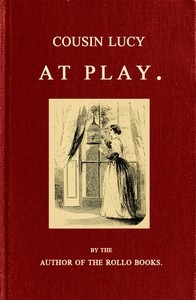
Cousin Lucy at Play by Jacob Abbott

(15 User reviews)   4866
By Ashley Gutierrez Posted on Dec 11, 2025
In Category - Ecology
Abbott, Jacob, 1803-1879 Abbott, Jacob, 1803-1879
English
Ever wondered what childhood was like in 19th-century America? 'Cousin Lucy at Play' gives you a front-row seat. This isn't a grand adventure with pirates or treasure. Instead, it follows a bright, curious little girl named Lucy through her everyday world of simple games, gentle lessons, and small discoveries. The real charm lies in watching how she learns about kindness, responsibility, and the world around her through play. It's a quiet, sweet window into a different time, perfect if you enjoy character-driven stories or have an interest in historical family life. Think of it as a calming, nostalgic visit with a very charming child from the past.
Share

Read "Cousin Lucy at Play by Jacob Abbott" Online

This book is available in the public domain. Start reading the digital edition below.

START READING FULL BOOK
Instant Access    Mobile Friendly

Book Preview

A short preview of the book’s content is shown below to give you an idea of its style and themes.

In the Clerk’s Office of the District Court of Massachusetts. PREFACE. Two volumes of a series of little books, corresponding, in their general style and characteristics, with the Rollo Books for boys, but designed more particularly for the other sex, have already been published, under the names of COUSIN LUCY’S CONVERSATIONS, and COUSIN LUCY’S STORIES. This, and its companion, COUSIN LUCY AT STUDY, are now offered to the public, in the hope that the little readers, into whose hands they may fall, may be interested, and, in some degree at least, profited, by the perusal of them. CONTENTS. Page. CHAPTER I. THE MARBLE BOX, 9 CHAPTER II. METAPHYSICS, 26 CHAPTER III. STORIES, 42 CHAPTER IV. THE RIDE TO TOWN, 56 CHAPTER V. THE GYPSY PARTY, 72 CHAPTER VI. THE MOROCCO BOOK--THE LONELY SLEIGH-RIDE, 90 CHAPTER VII. MARY JAY’S SUNDAY SCHOOL, 108 CHAPTER VIII. THE PRESENT, 126 CHAPTER IX. A FRIGHT, 138 CHAPTER X. ROYAL A PROTECTOR, 156 CHAPTER XI. THE DICTIONARY, 172 LUCY AT PLAY. CHAPTER I. THE MARBLE BOX. There was a box, or chest, of a somewhat singular character, in the house where Lucy lived; it was called the _marble box_. It was not really made of marble; it was made of wood; but then it was painted marble color, and that was the reason why it was called the marble box. The marble box had books and playthings in it. It was pretty large, and so it would hold a considerable number. There was a handle at each end, and when Lucy took hold of one handle, and Royal, her brother, of the other, the box was just about as much as they could conveniently carry. The place where the marble box was usually kept, was under a table in the back chamber entry, not far from the head of the stairs. There was a lock to the marble box, and Lucy’s mother kept the key. She tied a piece of blue ribbon to the key to mark it, and she kept it hung up under the mantel shelf in her room. The rule of the marble box was this--that it never was to be opened except when the children were sick,--or, rather, when they were convalescent. When children are attacked with sickness, they do not generally, for a time, wish for any playthings. But, then, when the disease is once subdued, and the pain, or the unpleasant feelings, whatever they may be, have disappeared,--then there is a period, while the patient is recovering his health and strength, which is called the period of _convalescence_. Now, during convalescence, children are more in need of playthings to interest and occupy their minds than at any other time. There are various reasons why this is so. In the first place, they cannot usually be allowed to go out of doors; for, after such an attack of sickness, it generally takes some time for the system to become restored to its usual state, so as to bear safely the ordinary exposures. Thus, by being confined to the house, the child is cut off from some of his sources of enjoyment, which makes it more necessary that he should have agreeable books and playthings. Then, besides, during convalescence, the mind is not generally in a proper state to engage in study, or in any of the usual duties of life. This is peculiarly the case if the sickness has been severe. We feel weak, and are easily fatigued, and exhausted with exertion, either of mind or body. Consequently the ordinary duties of life are usually suspended during convalescence, and this leaves...

This is a limited preview. Download the book to read the full content.

Jacob Abbott's Cousin Lucy at Play is a gentle, episodic look at a young girl's daily life in the 1800s. We follow Lucy as she navigates her world, which revolves around home, family, and her own imagination.

The Story

The book doesn't have a single, driving plot. Instead, it's a series of small moments. Lucy learns to sew, cares for her garden, plays games with other children, and listens to stories from the adults around her. Each chapter presents a simple situation—like sharing toys, telling the truth, or being patient—and through these experiences, Lucy (and the reader) picks up little lessons about growing up. The conflict is never dramatic; it's the quiet struggle of a child learning to be good and understand her place in the family.

Why You Should Read It

This book is a fascinating slice of life. Abbott captures the rhythms and values of a 19th-century childhood with genuine affection. Lucy feels real—sometimes stubborn, often sweet, always curious. Reading it feels less like following a story and more like peeking into a family album. You get a real sense of how parents taught children back then, emphasizing moral character through everyday actions. It's surprisingly soothing.

Final Verdict

Perfect for readers who love historical detail and gentle, character-focused narratives. If you're a fan of books like Little Women for their domestic scenes, or if you're interested in the history of childhood and education, you'll find Lucy's world captivating. It's also a great, calm read for a lazy afternoon. Just don't go in expecting high drama—the joy here is in the quiet, ordinary moments.


🔖 Public Domain Notice

This text is dedicated to the public domain. Preserving history for future generations.

Mary Gonzalez
1 year ago

Thanks for the recommendation.

Patricia Johnson
1 year ago

Amazing book.

Mary Jones
1 year ago

Fast paced, good book.

Thomas Lee
1 year ago

Just what I was looking for.

John Lopez
1 year ago

After finishing this book, the pacing is just right, keeping you engaged. A true masterpiece.

5
5 out of 5 (15 User reviews )

Add a Review

Your Rating *
There are no comments for this eBook.
You must log in to post a comment.
Log in


Related eBooks