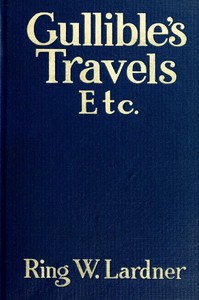
Gullible's Travels, Etc. — Background and Themes

(1 User reviews)   209
Lardner, Ring, 1885-1933, Preston, May Wilson, 1873-1949 [Illustrator] Project Gutenberg 2011
Humorous stories, American; Courtship -- Fiction; Chicago (Ill.) -- Fiction; Opera -- Fiction; Bridge players -- Fiction; Voyages and travels -- Fiction; Husband and wife -- Fiction; Sisters-in-law -- Fiction Readers of public-domain and historical texts
Project Gutenberg digital edition en

Edition facts

Words 46,686
Reading time 203 min
Text sections 5

For Gullible's Travels, Etc. — Background and Themes, the stored edition analysis reports 46,686 words, 3 hr 23 min estimated reading time, and 5 detected text sections.

The text analysis averages about 13.1 words per sentence, while the detected sections provide another way to judge how the source is divided.

Project Gutenberg metadata also associates the work with “Humorous stories, American,” connecting these edition facts with the source record’s subject description.

Ring Lardner's 1917 collection uses a first-person narrator with a distinct vernacular voice to recount misadventures in courtship, travel, and card games. The excerpts reveal a sharp comic style focused on marital dynamics and social pretensions, often through dialogue and ironic understatement.
Share
Editorial Edition Score 4.7/5

Calculated from edition completeness, EPUB availability, text structure and catalogue metadata. Not a user rating.

How this score is calculated
  • Description quality20 pts
  • Title & short description10 pts
  • Source metadata20 pts
  • Text length15 pts
  • Chapters / structure15 pts
  • EPUB file integrity20 pts

Total of 100 points, scaled to a 2.5-5.0 range. Editions with an empty description or a missing EPUB file are not scored.

Edition quality

Read the Text

Hatch had it all framed that the Hatches was goin' to take us to a show, and the next thing was what show would it be. So Hatch found the afternoon paper, that somebody'd left on the street-car, and read us off a list o' the shows that was in town. I spoke for the Columbia, but the Missus give me the sign to stay out; so they argued back and forth and finally Mrs. Hatch says:

"Let's see that paper a minute."

"What for?" says Hatch. "I didn't hold nothin' out on you."

But he give her the paper and she run through the list herself, and then she says:

"You did, too, hold out on us. You didn't say nothin' about the Auditorium."

"What could I say about it?" says Hatch. "I never was inside."

"It's time you was then," says Mrs. Hatch.

"What's playin' there?" I says.

"Grand op'ra," says Mrs. Hatch.

"Oh!" says my Missus. "Wouldn't that be wonderful?"

"What do you say?" says Mrs. Hatch to me.

"I think it'd be grand for you girls," I says. "I and Jim could leave you there and go down on Madison and see Charley Chaplin, and then come back after you."

"Nothin' doin'!" says Mrs. Hatch. "We'll pick a show that everybody wants to see."

Well, if I hadn't of looked at my Missus then we'd of been O. K. But my eyes happened to light on where she was settin' and she was chewin' her lips so's she wouldn't cry. That finished me. "I was just kiddin'," I says to Mrs. Hatch. "They ain't nothin' I'd like better than grand op'ra."

"Nothin' except gettin' trimmed in a rummy game," says Hatch, but he didn't get no rise.

Well, the Missus let loose of her lips so's she could smile and her and Mrs. Hatch got all excited, and I and Hatch pretended like we was excited too. So Hatch ast what night could we go, and Mrs. Hatch says that depended on what did we want to hear, because they changed the bill every day. So her and the Missus looked at the paper again and found out where Friday night was goin' to be a big special night and the bill was a musical show called _Carmen_, and all the stars was goin' to sing, includin' Mooratory and Alda and Genevieve Farr'r, that was in the movies a w'ile till they found out she could sing, and some fella they called Daddy, but I don't know his real name. So the girls both says Friday night was the best, but Hatch says he would have to go to lodge that evenin'.

"Lodge!" says Mrs. Hatch. "What do you care about lodge when you got a chance to see Genevieve Farr'r in _Carmen_?"

"Chance!" says Hatch. "If that's what you call a chance, I got a chance to buy a thousand shares o' Bethlehem Steel. Who's goin' to pay for my chance?"

"All right," says Mrs. Hatch, "go to your old lodge and spoil everything!"

So this time it was her that choked up and made like she was goin' to blubber. So Hatch changed his mind all of a sudden and decided to disappoint the brother Owls. So all of us was satisfied except fifty per cent., and I and the Missus beat it home, and on the way she says how nice Mrs. Hatch was to give us this treat.

"Yes," I says, "but if you hadn't of had a regular epidemic o' discardin' deuces and treys Hatch would of treated us to groceries for a week." I says: "I always thought they was only twelve pitcher cards in the deck till I seen them hands you saved up to-night."

"You lose as much as I did," she says.

"Yes," I says, "and I always will as long as you forget to fetch your purse along."

So they wasn't no come-back to that, so we went on home without no more dialogue.

Well, Mrs. Hatch called up the next night and says Jim had the tickets boughten and we was to be sure and be ready at seven o'clock Friday night because the show started at eight. So when I was down-town Friday the Missus sent my evenin' dress suit over to Katzes' and had it pressed up and when I come home it was laid out on the bed like a corpse.

"What's that for?" I says.

"For the op'ra," she says. "Everybody wears them to the op'ra."

"Did you ask the Hatches what was they goin' to wear?" I says.

"No," says she. "They know what to wear without me tellin' them. They ain't goin' to the Auditorium in their nightgown."

So I clumb into the soup and fish, and the Missus spent about a hour puttin' on a dress that she could have left off without nobody knowin' the difference, and she didn't have time for no supper at all, and I just managed to surround a piece o' steak as big as your eye and spill some gravy on my clo'es when the bell rung and there was the Hatches.

Well, Hatch didn't have no more evenin' dress suit on than a kewpie. I could see his pants under his overcoat and they was the same old bay pants he'd wore the day he got mad at his kid and christened him Kenneth. And his shoes was a last year's edition o' the kind that's supposed to give your feet a chance, and if his feet had of been the kind that takes chances they was two or three places where they could of got away without much trouble.

I could tell from the expression on Mrs. Hatch's face when she seen our make-up that we'd crossed her. She looked about as comf'table as a Belgium.

"Oh!" she says. "I didn't think you'd dress up."

"We thought you would," says my Frau.

"We!" I says. "Where do you get that 'we'?"

"If it ain't too late we'll run in and change," says my Missus.

"Not me," I says. "I didn't go to all this trouble and expense for a splash o' gravy. When this here uniform retires it'll be to make room for pyjamas."

"Come on!" says Hatch. "What's the difference? You can pretend like you ain't with us."

"It don't really make no difference," says Mrs. Hatch.

And maybe it didn't. But we all stood within whisperin' distance of each other on the car goin' in, and if you had a dollar for every word that was talked among us you couldn't mail a postcard from Hammond to Gary. When we got off at Congress my Missus tried to thaw out the party.

"The prices is awful high, aren't they?" she says.

"Outrageous," says Mrs. Hatch.

Well, even if the prices was awful high, they didn't have nothin' on our seats. If I was in trainin' to be a steeple jack I'd go to grand op'ra every night and leave Hatch buy my ticket. And where he took us I'd of been more at home in overalls and a sport shirt.

"How do you like Denver?" says I to the Missus, but she'd sank for the third time.

"We're safe here," I says to Hatch. "Them French guns can't never reach us. We'd ought to brought more bumbs."

"What did the seats cost?" I says to Hatch.

"One-fifty," he says.

"Very reasonable," says I. "One o' them aviators wouldn't take you more than half this height for a five-spot."

The Hatches had their overcoats off by this time and I got a look at their full costume. Hatch had went without his vest durin' the hot months and when it was alongside his coat and pants it looked like two different families. He had a pink shirt with prune-colored horizontal bars, and a tie to match his neck, and a collar that would of took care of him and I both, and them shoes I told you about, and burlap hosiery. They wasn't nothin' the matter with Mrs. Hatch except she must of thought that, instead o' dressin' for the op'ra, she was gettin' ready for Kenneth's bath.

And there was my Missus, just within the law, and me all spicked and spanned with my soup and fish and gravy!

Well, we all set there and tried to get the focus till about a half-hour after the show was billed to commence, and finally a Lilliputhian with a match in his hand come out and started up the orchestry and they played a few o' the hits and then the lights was turned out and up went the curtain.

Well, sir, you'd be surprised at how good we could hear and see after we got used to it. But the hearin' didn't do us no good--that is, the words part of it. All the actors had been smuggled in from Europe and they wasn't none o' them that could talk English. So all their songs was gave in different languages and I wouldn't of never knew what was goin' on only for Hatch havin' all the nerve in the world.

After the first act a lady that was settin' in front of us dropped somethin' and Hatch stooped over and picked it up, and it was one o' these here books they call a liberetto, and it's got all the words they're singin' on the stage wrote out in English.

So the lady begin lookin' all over for it and Hatch was goin' to give it back because he thought it was a shoe catalogue, but he happened to see at the top of it where it says "Price 25 Cents," so he tossed it in his lap and stuck his hat over it. And the lady kept lookin' and lookin' and finally she turned round and looked Hatch right in the eye, but he dropped down inside his collar and left her wear herself out. So when she'd gave up I says somethin' about I'd like to have a drink.

"Let's go," says Hatch.

"No," I says. "I don't want it bad enough to go back to town after it. I thought maybe we could get it sent up to the room."

"I'm goin' alone then," says Hatch.

"You're liable to miss the second act," I says.

"I'd never miss it," says Hatch.

"All right," says I. "I hope you have good weather."

So he slipped me the book to keep for him and beat it. So I seen the lady had forgot us, and I opened up the book and that's how I come to find out what the show was about. I read her all through, the part that was in English, before the curtain went up again, so when the second act begin I knowed what had came off and what was comin' off, and Hatch and Mrs. Hatch hadn't no idear if the show was comical or dry. My Missus hadn't, neither, till we got home and I told her the plot.

_Carmen_ ain't no regular musical show where a couple o' Yids comes out and pulls a few lines o' dialogue and then a girl and a he-flirt sings a song that ain't got nothin' to do with it. _Carmen's_ a regular play, only instead o' them sayin' the lines, they sing them, and in for'n languages so's the actors can pick up some loose change offen the sale o' the liberettos. The music was wrote by George S. Busy, and it must of kept him that way about two mont's. The words was either throwed together by the stage carpenter or else took down by a stenographer outdoors durin' a drizzle. Anyway, they ain't nobody claims them. Every oncet in three or four pages they forget themself and rhyme. You got to read each verse over two or three times before you learn what they're hintin' at, but the management gives you plenty o' time to do it between acts and still sneak a couple o' hours' sleep.

The first act opens up somewheres in Spain, about the corner o' Chicago Avenue and Wells. On one side o' the stage they's a pill mill where the employees is all girls, or was girls a few years ago. On the other side they's a soldiers' garage where they keep the militia in case of a strike. In the back o' the stage they's a bridge, but it ain't over no water or no railroad tracks or nothin'. It's prob'ly somethin' the cat dragged in.

Well, the soldiers stands out in front o' the garage hittin' up some barber shops, and pretty soon a girl blows in from the hero's home town, Janesville or somewheres. She runs a few steps every little w'ile and then stops, like the rails was slippery. The soldiers sings at her and she tells them she's came to look for Don Joss that run the chop-suey dump up to Janesville, but when they shet down on him servin' beer he quit and joined the army. So the soldiers never heard o' the bird, but they all ask her if they won't do just as good, but she says nothin' doin' and skids off the stage. She ain't no sooner gone when the Chinaman from Janesville and some more soldiers and some alley rats comes in to help out the singin'. The book says that this new gang o' soldiers was sent on to relieve the others, but if anything happened to wear out the first ones it must of took place at rehearsal. Well, one o' the boys tells Joss about the girl askin' for him and he says: "Oh, yes; that must be the little Michaels girl from up in Wisconsin."

So pretty soon the whistle blows for noon and the girls comes out o' the pill mill smokin' up the mornin' receipts and a crowd o' the unemployed comes in to shoot the snipes. So the soldiers notices that Genevieve Farr'r ain't on yet, so they ask where she's at, and that's her cue. She puts on a song number and a Spanish dance, and then she slips her bouquet to the Chink, though he ain't sang a note since the whistle blowed. But now it's one o'clock and Genevieve and the rest o' the girls beats it back to the coffin factory and the vags chases down to the Loop to get the last home edition and look at the want ads to see if they's any jobs open with fair pay and nothin' to do. And the soldiers mosey into the garage for a well-earned rest and that leaves Don all alone on the stage.

But he ain't no more than started on his next song when back comes the Michaels girl. It oozes out here that she's in love with the Joss party, but she stalls and pretends like his mother'd sent her to get the receipt for makin' eggs _fo yung_. And she says his mother ast her to kiss him and she slips him a dime, so he leaves her kiss him on the scalp and he asks her if she can stay in town that evenin' and see a nickel show, but they's a important meetin' o' the Maccabees at Janesville that night, so away she goes to catch the two-ten and Don starts in on another song number, but the rest o' the company don't like his stuff and he ain't hardly past the vamp when they's a riot.

It seems like Genevieve and one o' the chorus girls has quarreled over a second-hand stick o' gum and the chorus girl got the gum, but Genevieve relieved her of part of a earlobe, so they pinch Genevieve and leave Joss to watch her till the wagon comes, but the wagon's went out to the night desk sergeant's house with a case o' quarts and before it gets round to pick up Genevieve she's bunked the Chink into settin' her free. So she makes a getaway, tellin' Don to meet her later on at Lily and Pat's place acrost the Indiana line. So that winds up the first act.

Well, the next act's out to Lily and Pat's, and it ain't no Y.M.C.A. headquarters, but it's a hang-out for dips and policemans. They's a cabaret and Genevieve's one o' the performers, but she forgets the words to her first song and winds up with tra-la-la, and she could of forgot the whole song as far as I'm concerned, because it wasn't nothin' you'd want to buy and take along home.

Finally Pat comes in and says it's one o'clock and he's got to close up, but they won't none o' them make a move, and pretty soon they's a live one blows into the joint and he's Eskimo Bill, one o' the butchers out to the Yards. He's got paid that day and he ain't never goin' home. He sings a song and it's the hit o' the show. Then he buys a drink and starts flirtin' with Genevieve, but Pat chases everybody but the performers and a couple o' dips that ain't got nowheres else to sleep. The dips or stick-up guys, or whatever they are, tries to get Genevieve to go along with them in the car w'ile they pull off somethin', but she's still expectin' the Chinaman. So they pass her up and blow, and along comes Don and she lets him in, and it seems like he'd been in jail for two mont's, or ever since the end o' the first act. So he asks her how everything has been goin' down to the pill mill and she tells him that she's quit and became a entertainer. So he says, "What can you do?" And she beats time with a pair o' chopsticks and dances the Chinese Blues.

After a w'ile they's a bugle call somewhere outdoors and Don says that means he's got to go back to the garage. So she gets sore and tries to bean him with a Spanish onion. Then he reaches inside his coat and pulls out the bouquet she give him in Atto First to show her he ain't changed his clo'es, and then the sheriff comes in and tries to coax him with a razor to go back to his job. They fight like it was the first time either o' them ever tried it and the sheriff's leadin' on points when Genevieve hollers for the dips, who dashes in with their gats pulled and it's good night, Mister Sheriff! They put him in moth balls and they ask Joss to join their tong. He says all right and they're all pretty well lit by this time and they've reached the singin' stage, and Pat can't get them to go home and he's scared some o' the Hammond people'll put in a complaint, so he has the curtain rang down.

Then they's a relapse of it don't say how long, and Don and Genevieve and the yeggs and their lady friends is all out in the country somewheres attendin' a Bohunk Sokol Verein picnic and Don starts whinin' about his old lady that he'd left up to Janesville.

"I wisht I was back there," he says.

"You got nothin' on me," says Genevieve. "Only Janesville ain't far enough. I wisht you was back in Hongkong."

So w'ile they're flatterin' each other back and forth, a couple o' the girls is monkeyin' with the pasteboards and tellin' their fortunes, and one o' them turns up a two-spot and that's a sign they're goin' to sing a duet. So it comes true and then Genevieve horns into the game and they play three-handed rummy, singin' all the w'ile to bother each other, but finally the fellas that's runnin' the picnic says it's time for the fat man's one-legged race and everybody goes offen the stage. So the Michaels girl comes on and is gettin' by pretty good with a song when she's scared by the noise o' the gun that's fired to start the race for the bay-window championship. So she trips back to her dressin'-room and then Don and Eskimo Bill put on a little slap-stick stuff.

When they first meet they're pals, but as soon as they get wise that the both o' them's bugs over the same girl their relations to'rds each other becomes strange. Here's the talk they spill:

"Where do you tend bar?" says Don.

"You got me guessed wrong," says Bill. "I work out to the Yards."

"Got anything on the hip?" says Don.

"You took the words out o' my mouth," says Bill. "I'm drier than St. Petersgrad."

"Stick round a w'ile and maybe we can scare up somethin'," says Don.

"I'll stick all right," says Bill. "They's a Jane in your party that's knocked me dead."

"What's her name?" says Don.

Ring Lardner's narrator in Gullible's Travels, Etc. speaks in a dense, colloquial idiolect that immediately sets the tone: "We was playin' rummy over to Hatch's, and Hatch must of fell in a bed of four-leaf clovers." The voice is consistent across the excerpts—grammatically nonstandard, rhythmically precise, and laced with deadpan humor. The stories orbit domestic and social friction: card games, shows, vacations, and the small negotiations of married life. Lardner builds comedy through situational irony and the narrator's unwitting self-exposure, as when he describes his wife's beach hair as "spinach with French dressin'." The catalog subjects list "Courtship -- Fiction" and "Husband and wife -- Fiction," and the excerpts bear this out, though the courtship is more often a sparring match than a romance.

Vernacular Voice and Comic Timing

The narrator's language is the engine of the humor. He consistently drops auxiliary verbs ("We was playin'"), uses double negatives, and invents compound words ("flivver'd"). His similes are deliberately incongruous: comparing a lucky opponent to someone who "fell in a bed of four-leaf clovers," or describing a wave's force as akin to "State and Madison at the noon hour." Lardner controls pacing through dialogue interruptions and parenthetical asides. In the card-game scene, the narrator's retorts—"Not without a gun," "Jim's pretty husky"—land as punchlines because the reader hears the flat, unimpressed delivery. The voice is not merely decorative; it reveals character. The narrator thinks himself clever but is often outmaneuvered, as when his wife and Mrs. Hatch arrange the evening without consulting the men. Lardner never breaks character to editorialize; the comedy emerges from the gap between what the narrator says and what the reader infers.

Marital Skirmishes and Social Performance

The excerpts center on the narrator and his wife as a couple navigating social obligations and leisure activities. Their relationship is a series of small contests: who pays, who dances, who decides when to leave the beach. The wife's voice is heard only through the narrator's report, but she is no passive figure—she negotiates the treat from Mrs. Hatch, insists on dancing, and "didn't resist none when I drug her in to shore." The Palm Beach episode is particularly rich in social observation. The narrator mocks the fashionable guests—their "concrete bosom" shirts, a woman dressed like "the Fourth o' July"—while his wife admires the gowns. He undercuts her enthusiasm: "you could have one just like 'em if you'd take the shade offen the piano lamp." The humor is barbed but affectionate; the couple bickers but stays together. Lardner uses the vacation setting to expose the gap between aspirational leisure and its messy reality—expensive drinks, bruising waves, and rented rooms.

Structure and the Unreliable Narrator

The collection's title story, "Gullible's Travels," signals a parody of travel narrative, but the excerpts suggest a structure built around episodic misadventure rather than a linear journey. The narrator's unreliability is subtle: he presents himself as the sensible one, yet his decisions (quitting the beach rooms without a refund) are impulsive. His observations are sharp but self-serving. Lardner embeds details that undercut the narrator's authority—for instance, the clerk's non-response to the refund request. The stories move from card game to show to vacation, each scene a self-contained comic set piece. The catalog subject "Voyages and travels -- Fiction" fits, but the travel is less about discovery than about the narrator's attempts to maintain dignity while being battered by waves and social codes. The excerpts do not reveal the full arc of any story, but the pattern is clear: the narrator enters a situation, asserts his wit, and exits slightly worse off, leaving the reader to enjoy the wreckage.

Readers should attend to Lardner's use of dialect as a deliberate literary choice, not mere transcription. The narrator's voice carries the weight of character and theme; every dropped "g" and misplaced verb is a clue to his worldview. The excerpts offer no resolution to the stories, but the humor depends on recognizing the narrator's blind spots. Approach these pieces as comic monologues where the real joke is on the speaker.

Reading Lardner’s sharp, stumbling narrators, I remembered my grandfather’s own tall tales—always slightly off, always heartfelt. That same awkward honesty lives in The Mission Of Mr. Eustace Greyne 1905 — Reading Notes, where the bumbling hero fumbles toward affection, and I felt that familiar ache of rooting for someone so poorly equipped and so earnest all at once.

James Harris
3 weeks ago

5
5 out of 5 (1 User reviews )

Add a Review

Your Rating *
There are no comments for this eBook.

Reader reflection

What did you think of this book?

Answer a few questions and save a private reflection on this device.

Your progress 0 / 10
1

What is your current status with this title?

2

How much did you enjoy the reading experience?

3

How likely are you to recommend this book?

4

How easy was the book to follow?

Related eBooks