
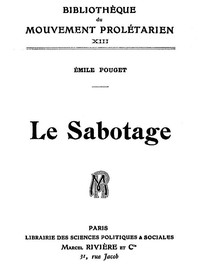
Le Sabotage by Emile Pouget
Read "Le Sabotage by Emile Pouget" Online
This book is available in the public domain. Start reading the digital edition below.
START READING FULL BOOKBook Preview
A short preview of the book’s content is shown below to give you an idea of its style and themes.
Let's be clear from the start: 'Le Sabotage' is not a storybook. You won't find a traditional plot with a hero's journey. Instead, think of it as a document, a manifesto, and a collection of tactics all rolled into one. Written by Emile Pouget, a major figure in the French anarchist and syndicalist movements, this book is his direct, unfiltered argument for a specific kind of worker resistance.
The Story
The 'story' here is the conflict itself. Pouget sets the scene of brutal industrial capitalism at the turn of the 20th century. Workers have few rights, unions are weak, and strikes often end in violence and hunger. In this context, he introduces sabotage not as mindless destruction, but as a calculated strategy. He defines it broadly: it's the conscious withdrawal of efficiency. This could mean literally throwing a wooden shoe (a 'sabot') into machinery, but more often, it's about organized, deliberate slowdowns, 'working to rule' (following every petty regulation to a T to grind things to a halt), and creative acts of 'misunderstanding' instructions. He fills the pages with real examples, painting a picture of a silent, grinding war happening inside every factory where management holds all the obvious power.
Why You Should Read It
I picked this up out of historical curiosity, but it stuck with me for its raw, pragmatic energy. Pouget's writing isn't dry theory; it's urgent and persuasive. He's making a case to desperate people. What fascinated me most was the psychology of resistance he describes. When you can't win a fair fight, you change the rules of the game. The idea of collective, subtle action as a weapon is incredibly powerful. It makes you look at everyday acts of workplace friction in a whole new light. This book is a window into a mindset—one of defiance and ingenious non-compliance. It's less about whether you agree with his methods and more about understanding the desperate logic that creates them.
Final Verdict
This is a niche but gripping read. It's perfect for anyone interested in labor history, social movements, or radical political thought. If you've ever enjoyed books about protest strategy or wondered how powerless people organize, this is a foundational text. It's also shockingly short and accessible. Fair warning: it will challenge you. Pouget doesn't apologize for his militant stance. You won't find a balanced debate here; you're getting one side's playbook, straight from the source. Approach it not as a prescription for today, but as a historical artifact that captures the anger, creativity, and fierce spirit of a struggling working class over a century ago. It's a reminder that the fight for dignity takes many, often unexpected, forms.
This publication is available for unrestricted use. Access is open to everyone around the world.
Thomas Lewis
1 year agoFrom the very first page, the author's voice is distinct and makes complex topics easy to digest. Worth every second.
Noah Brown
4 months agoAfter finishing this book, it manages to explain difficult concepts in plain English. Absolutely essential reading.
Lucas Jackson
1 year agoSurprisingly enough, the arguments are well-supported by credible references. Definitely a 5-star read.
Melissa Young
1 year agoJust what I was looking for.








Aiden Hernandez
1 year agoLoved it.