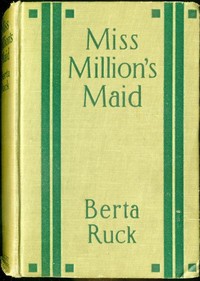
Miss Million's Maid: A Romance of Love and Fortune — Background and Themes

(0 User reviews)   38
Ruck, Berta, 1878-1978 Project Gutenberg 2010
Inheritance and succession -- Fiction; Young women -- Fiction; Love stories; Lady's maids -- Fiction; England -- Social life and customs -- 20th century -- Fiction Readers of public-domain and historical texts
Project Gutenberg digital edition en

Edition facts

Words 103,859
Reading time 452 min
Text sections 10

Before opening Miss Million's Maid: A Romance of Love and Fortune — Background and Themes, the edition data offers a quick orientation: 103,859 words, 7 hr 32 min estimated reading time, and 10 detected text sections.

The text analysis averages about 13.5 words per sentence, while the detected sections provide another way to judge how the source is divided.

Project Gutenberg metadata also associates the work with “Inheritance and succession -- Fiction,” connecting these edition facts with the source record’s subject description.

Beatrice Lovelace, a young woman living a subdued life with her aunt in suburban Putney, becomes lady's maid to the newly wealthy Miss Million. The novel traces her shift from a constrained household to the giddy world of new money, where cars, country inns, and unexpected encounters test her loyalties.
Share
Editorial Edition Score 4.8/5

Calculated from edition completeness, EPUB availability, text structure and catalogue metadata. Not a user rating.

How this score is calculated
  • Description quality20 pts
  • Title & short description10 pts
  • Source metadata20 pts
  • Text length15 pts
  • Chapters / structure15 pts
  • EPUB file integrity20 pts

Total of 100 points, scaled to a 2.5-5.0 range. Editions with an empty description or a missing EPUB file are not scored.

Edition quality

Read the Text

This was the background to the figure of my Aunt Anastasia, who stood, holding herself as stiff as a poker (she is very nearly as slim, even though she's fifty-three) in her three-year-old grey alpaca gown with the little eightpence-three-farthings white collar fastened by her pearl brooch with granny's hair in it.

Her face told me what to expect. A heated flush, and no lips. One of Auntie's worst tempers!

"Beatrice!" she exclaimed in a low, agitated tone. "I am ashamed of you. I am ashamed of you." She could not have said it more fervently if I'd been found forging cheques. "After all my care! To see you hobnobbing like a housemaid with these people!"

Aunt Anastasia always mentions the people here as who should say "the worms in the flower-beds" or "the blight upon the rambler-roses."

"I wasn't hobnobbing, Auntie," I defended myself. "Er--he only offered me the hose to----"

"The thinnest of excuses," put in my aunt, curling what was left visible of her lips. "You need not have taken the hose."

"He put it right into my hand."

"Insufferable young bounder," exclaimed Aunt Anastasia, still more bitterly.

I felt myself flushing hotly.

"Auntie, why do you always call everybody that who is not ourselves?" I ventured. "'Honour bright,' the young man didn't do it in a bounder-y way at all. I'm sure he only meant to be nice and neighbourly and----"

"That will do, Beatrice. That will do," said my Aunt majestically. "I am extremely displeased with you. After all that I have said to you on the subject of having nothing to do with the class of person among which we are compelled to live, you choose to forget yourself over--over a garden wall, and a hose, forsooth.

"For the future, kindly remember that you are my niece"-- (impressively)--"that you are your poor father's child"--(more impressively)--"and that you are Lady Anastasia's great-granddaughter" --(this most impressively of all, with a stately gesture towards the Gainsborough portrait hanging over the most rickety of bamboo tables). "Our circumstances may be straitened now. We may be banished to an odious little hovel in the suburbs among people whom we cannot possibly know, even if the walls are so thin that we can hear them cleaning their teeth next door. There is no disgrace in being poor, Beatrice. The disgrace lies in behaving as if you did not still belong to our family!"

Aunt Anastasia always pronounces these last two words as if they were written in capital letters, and as if she were uttering them in church.

"I am going to the library now to change my books," she concluded with much dignity. "During my absence you will occupy yourself by making the salad for supper."

"Yes, Auntie," I said in the resigned tone that so often covers seething rebellion. Then a sudden thought struck me, and I suggested: "Hadn't I--hadn't I better return that hose? It is simply pouring itself out all over the lawn still----"

"I will return the hose," said my aunt, in the tragic tones of Mrs. Siddons playing Lady Macbeth and saying "Give me the dagger!"

She stepped towards the back window.

I didn't feel equal to seeing the encounter between Aunt Anastasia in her most icily formal mood and the young man with the nice voice, of whom I caught white-and-gold glimpses hovering about on the other side of the green trellis.

I knew she'd be rude to him, as only "our families" can be rude to those whom they consider "bounders." He's nothing to me. I've never spoken to him before this evening. I oughtn't to mind what he thinks about those weird people who live at No. 45. I oughtn't to wonder what it was he was just going to say to me.

So I fled out of the bamboo and heirloom furnished drawing-room, down the narrow little oil-clothed passage, and into the kitchen with its heartening smell of hot gooseberry tart and the cheerful society of Million, our little maid-of-all-work. It's the custom of our family to call the maid by her surname.

(At the same time I couldn't help wondering what that young man had been going to say.)

TWO GIRLS IN A KITCHEN

LITTLE Million, looking very cheery and trim in her black gown and her white apron, and the neat little cap perched upon her glossy black hair, smiled welcomingly upon me as I came into the kitchen.

I like Million's nice smile and her Cockney chatter about the Soldiers' Orphanage where she was brought up and trained for domestic service, and about her places before she came here. Aunt Anastasia considers that it is so demoralising to gossip with the lower orders. But Millions is the only girl of my own age in London with whom I have the chance of gossiping!

She likes me, too. She considers that Miss Beatrice treats her as if she were a human being instead of a machine. She tossed the paper-covered Celandine Novelette that she had been reading into the drawer of the kitchen-table among the lead spoons and the skewers and the cooking-forks, and then she spread the table with a clean tea-cloth, and brought out the colander with the lettuce and the cucumber and the cress that I was going to cut up into salad; doing everything as if she liked helping me.

"There, now! What a mercy I left the kitchen window open. Now I haven't seen the new moon through the glass!" she exclaimed, as she put all ready before me--the hard-boiled egg, the mustard, sugar, pepper, salt, oil, and vinegar--for me to make the salad-dressing. "Miss Beatrice, look at it through the open window--there, just to the right of that little pink cloud--turn your money, and you'll get a wish."

I peeped out of the window, and caught sight of that slender festoon of silver swung in the sky above the roses of the garden trellis.

"I've no money to turn," I smiled ruefully, "never have."

"Turn some o' mine, Miss," said Million. "I've got four-and-six here that I'm going to put into the Post Office Savings Bank to-morrow." Million is extraordinarily thrifty. "There you are. Wished your wish, Miss Beatrice?"

"Oh, yes, I've wished it," I said. "Always the same wish with me, you know, Million. Always a perfectly hopeless one. It's always, always that some millionaire may leave me a fortune one day, and that I shall be very rich, rolling in money."

"D'you think so much of money, then, Miss Beatrice?" said Million, bustling over the black-and-white chequered linoleum to the range, and setting the lid on to her saucepan full of potatoes. "Rich people aren't always happy----"

"That's their own fault for not knowing how to spend the money!"

"Ah, but I was readin' a sweetly pretty tale all about that just now. 'Love or Money,' that was the name of it," said Million, nodding at the kitchen-table drawer in which she keeps her novelettes, "and it said these very words: 'Money doesn't buy everythin'.'"

"H'm! It would buy most of the things I want!" I declared as I sliced away at my cucumber. "The lovely country house where I'd have crowds of people, all kinds of paralysingly interesting people to stay with me! The heavenly times in London, going everywhere and seeing everything! The motors! And, oh, Million"--I heard my voice shake with yearning as I pronounced the magic name of what every woman thinks of when she thinks of having money--"oh, Million, the clothes I'd get! If I had decent clothes I'd be decent-looking. I know I should."

"Why, Miss Beatrice, I've always thought you was a very nice-looking young lady, anyhow," said our little maid staunchly. "And to-night you're really pretty; I was just passing the remark to myself when you came in. Look at yourself in my little glass----"

I looked at myself in the mirror from the sixpence-ha'penny bazaar. I saw a small, pink, heart-shaped face with large brown eyes, eyes set wide apart and full of impatience and eagerness for life. I saw a quantity of bright chestnut hair, done rather "anyhow." I saw a long, slender, white throat--just the throat of Lady Anastasia--sloping down into shoulders that are really rather shapely. Only how can anything on earth look shapely under the sort of blouse that Aunt Anastasia gets for me? Or the sort of serge skirt? Or the shoes?

I glanced down at those four-and-elevenpenny canvas abominations that were still sopping from the gardening hose, and I said with fervour: "If I had money, I'd have three pairs of new shoes for every day in the week. And each pair should cost as much as all my clothes have cost this year!"

"Fancy that, now. That's not the kind of thing as I'd care for myself. Extravagant--that's a thing I couldn't be," declared Million, in her cheerful, matter-of-fact little voice, sweeping up the hearth as she spoke. "Legacies and rolling in money--and a maid to myself, and bein' called 'Miss Million,' and all that. That 'ud never be my wish!"

"What was your wish, then?" I asked, beginning to tear up the crisp leaves of the lettuce into the glass salad-bowl. "I've told you mine, Million. Tell me yours."

"Sure, you won't let on to any one if I do?" returned our little maid, putting her black, white-capped head on one side like a little bird. "Sure you won't go and make game of me afterwards to your Aunt Nasturtium--oh, lor'. Hark at me, now!--to Miss Lovelace, I mean? If there's one thing that does make me feel queer it's thinking folks are making game of me."

"I promise I won't. Tell me the wish!"

Million laughed again, coloured, twiddled her apron. Then, leaning over the deal table towards me, she murmured unexpectedly and bashfully: "I always wish that I could marry a gentleman!"

"A gentleman?" I echoed, rather taken aback.

"Of course, I know," explained Million, "that a young girl in my walk of life has plenty of chances of getting married. Not like a young lady in yours, Miss. Without a young lady like you has plenty of money there's a very poor choice of husbands!"

"There is, indeed," I sighed.

The little maid went on: "So I could have some sort of young man any day, Miss Beatrice. There's the postman here--very inclined to be friendly--not to mention the policeman. And the young man who used to come round to attend to the gas at the Orphanage when I was there. He writes to me still."

"And do you write back to him?"

"Picture postcards of Richmond Park. That's all he's ever had from me. He's not the sort of young man I'd like. You see, Miss, I've seen other sorts," said Million. "Where I was before I came here there was three sons of the house, and seein' so much of them gave me a sort of cri--terion, like. One was in the Navy. Oh, Miss, he was nice. Oh, the way he talked. It was better than 'The Flag Lieutenant.' It's a fact, I'd rather listen to his voice than any one's on the stage, d'you know.

"The two others were at Oxford College. And oh, their lovely ties, and the jolly, laughing sort of ways they had, and how they used to open the door for their mother, and to sing in the bathroom of a morning. Well! I dunno what it was, quite. Different," said little Million vaguely, with her wistfully ambitious grey eyes straying out of the kitchen window again. "I did like it. And that's the sort of gentleman I'd like to marry."

She turned to the oven again, and moved the gooseberry tart to the high shelf.

I said, smiling at her: "Million, any 'gentleman' ought to be glad to marry you for your pastry alone."

"Oh, lor', Miss, I'm not building on it," said Million brightly. "A sergeant's daughter? A girl in service? Why, what toff would ever think of her? 'Tisn't as if I was on the stage, where it doesn't seem to matter what you've been. Or as if I was 'a lovely mill-hand,' like in those tales where they always marry the son of the owner of the works. So what's the good of me thinking? Not but what I make up dreams in my head, sometimes," admitted Million, "of what I'd do and say--if 'He' did and said!"

"All girls have those dreams, Million," I told her, "whether they're maids or mistresses."

"Think so, Miss Beatrice?" said our little maid. "Well, I suppose I'm as likely to get my wish of marrying a gentleman as you are of coming in for a fortune. Talking of gentlemen, have you noticed the tall, fair one who's come to live at No. 44? Him that plays the pianoler of an evening? In a City office he is, their girl told me. Wanted to get into the Army, but there wasn't enough money. Well, he's one of the sort I'd a-liked. A real gentleman, I call him."

And Auntie calls him an insufferable young bounder!

Funny, funny world where people give such different names to the same thing!

I can see it's going to take Aunt Anastasia a week before she forgives me the incident of the young man next door!

Supper this evening was deathly silent; except for the scrunching over my salad, just like footsteps on the gravel. After supper we sat speechless in the drawing-room. I darned my holey tan cashmere stockings.

Auntie read her last book from the library, "Rambles in Japan." She's always reading books of travel--"Our Trip to Turkey," "A Cycle in Cathay," "Round the World in a Motor-boat," and so on. Poor dear! She would so adore travelling! And she'll never get the chance except in print. Once I begged her to sell the Gainsborough portrait of Lady Anastasia, and take out the money in having a few really ripping tours. I thought she would have withered me with her look.

She'll never do anything so desperately disrespectful to our family. She'll never do anything, in fact. Nothing will ever happen. Life will just go on and on, and we shall go on too, getting older, and shabbier, and more "select," and duller. They say that fortune knocks once in a lifetime at every one's door. But I'm sure there'll never be a knock at the door of No. 45 Laburnum Grove, except----

Ah! the postman. Then Million's quick step into the hall. Then nothing further. No letters for us? The letter must have been for our little maid. Perhaps from the young man who attended to the Orphanage gas? Happy Million, to have even an unwanted young man to write to her!

OH! to think that fortune should have given its knock at the door of No. 45 after all! To think that this is how it should have happened! Of all the unexpected thunderbolts! And after that irresponsible talk about money and legacies and wishes this evening in the kitchen, and to think that Destiny had even then shuffled the cards that she has just dealt!

It was ten minutes after the postman had been that we heard a flurried tap on the drawing-room door, and Million positively burst into the room. She was wide-eyed, scarlet with excitement. She held a letter out towards us with a gesture as if she were afraid it might explode in her hand.

"What is this, Million?" demanded my aunt, severely, over the top of her "Rambles."

"Oh, Miss Lovelace!" gasped our little maid. "Oh, Miss Beatrice! I don't rightly know if I'm standing on my head or my heels. I don't know if I've got the right hang of this at all. Will you--will you please read it for me?"

I read it through without taking any of it in, as so often happens when something startling meets one's eyes.

Million's little fluttered voice queried, "What do you make of that, Miss?"

"I don't know. Wait a minute. I must read it over again," I gasped in turn. "May I read it aloud?"

Million, clutching her starched white apron, nodded.

I read it aloud, this letter of Destiny.

It bore the address of a lawyer's office in Chancery Lane, and it began:

"_To_ MISS NELLIE MILLION.

"Dear Madam:--I am instructed to inform you that under the will of your late uncle, Mr. Samuel Million, of Chicago, U.S.A., you have been appointed heiress to his fortune of one million dollars.

"I shall be pleased to call upon you and to await your instructions, if you will kindly acquaint me with your present address----"

"That was sent to the Orphanage," whispered Million.

"or I should be very pleased to meet you if you would make it convenient to come and call upon me here at my offices at any time which may suit you. I am, Madam,

"Yours obediently, "JOSIAH CHESTERTON."

There was silence in our drawing-room. Million's little face turned, with a positively scared expression, from Aunt Anastasia to me.

"D'you think it's true, Miss?"

"Have you ever heard of this Mr. Samuel Million before?"

"Only that he was poor dad's brother that quarrelled with him for enlisting. I heard he was in America, gettin' on well----"

"That class," murmured my Aunt Anastasia with concentrated resentment, "always gets on!"

That was horrid of her!

I didn't know how to make it up to Million. I put out both hands and took her little roughened hands.

"Million, I do congratulate you. I believe it's true," I said heartily, finding my voice at last. "You'll have heaps of money now. Everything you want. A millionaire's heiress, that's what you are!"

"Me, miss?" gasped the bewildered-looking Million. "Me, and not you, that wanted money? Me an heiress? Oh, lor'! whatever next?"

The next morning--the morning after that startling avalanche of news had been precipitated into the monotonous landscape of our daily lives--I accompanied Million to the lawyer's office, where she was to hear further particulars of her unexpected, her breath-taking, her epic legacy.

A million dollars! Two hundred thousand pounds! And all for the little grey-eyed, black-haired daughter of a sergeant in a line regiment, brought up in a soldiers' orphanage to domestic service at £20 a year! To think of it!

I could see my Aunt Anastasia thinking of it--with bitterness, with envy.

It was she who ought to have taken Million to that office in Chancery Lane.

But she--the mistress of the house--excused herself by saying it was her morning for doing the silver.

We left her in the kitchen surrounded by what I am irreverent enough to call the relics of our family's grandeur--the Queen Anne tea service, the Early Georgian forks and spoons that have been worn and polished fragile and thin. Indeed, one teaspoon is broken. Aunt Anastasia took to her bed on the day of that accident. And the maid we had before Million scoured my grandfather's Crimean medal so heartily that soon there would have been nothing left to see on it. Since then my aunt has tended the relics with her own hands.

We left her brooding darkly over the injustice that had brought fortune to a wretched little maid-of-all-work and poverty to our family; we hailed the big white motor-'bus at the top of the road by the subscription library, and dashed up the steps to the front seat.

"There! Bit of all right, this, ain't it, Miss Beatrice!" gasped Million ecstatically.

Stars of delight shone in each grey eye as she settled herself down on the tilted seat. I thought that this change of expression was because she had thought over her marvellous good fortune during the night, and because she had begun to realise a little what it would all mean to her. But I was quite wrong. Million, peering down over the side of the 'bus, exclaimed gleefully, "Look at 'em! Look at 'em!"

"At all the girls down our road, there," explained Million, with a wave of her tightly gloved hand.

At almost every house in Laburnum Grove a maid, in pink or lilac print, with pail and floor-cloth, was giving the steps their matutinal wash. One was polishing the knocker, the bell-handles, and the brass plate of the doctor's abode.

"And here am I, as large as life, a-ridin' on a 'bus the first thing in the morning!" enlarged Million, clenching her fists and sitting bolt upright. "At half-past nine o'clock, if you please--first time I've ever done such a thing! I've often wondered what it was like, top of a 'bus on a fine summer's morning! I'll know now!"

"You won't ever have to know again," I laughed as I sat there beside her. "You won't be going in any more 'buses or trams or tubes."

The novel opens not with the heiress but with a row about a young man in a suburban garden. Beatrice Lovelace, the narrator, lives at No. 45 Laburnum Grove, Putney—a street of identical villas where her aunt’s household is conspicuously cheerless. The first chapter establishes a world of precise social codes: the green strips of lawn, the calceolaria and lobelia borders, the tennis-club chatter from neighboring windows. Beatrice observes these with a sharp eye for contrast, noting that while other young people get “heaps of fun,” her own home offers “No laughter and parties.” This opening situates the story firmly in a recognizable lower-middle-class London suburb, where a single domestic quarrel can set a whole chain of events in motion.

From Suburban Stillness to the Open Road

The early chapters trace Beatrice’s movement from the constrained villa to a wider, more unpredictable England. After she becomes Miss Million’s maid, the setting shifts abruptly to a country inn described as “a page out of a Caldecott picture-book,” with whitewashed walls, roses, and a pond of ducks. Yet the inn is also anchored in the twentieth century by the presence of two motorcars: a hired vehicle and a glittering blue two-seater with a silver mascot of the Winged Victory. The contrast between the old-fashioned parlour—with its framed Queen Victoria, stuffed birds, and woollen antimacassars—and the modern automobile outside encapsulates the novel’s interest in collisions between tradition and new money. Beatrice’s narration dwells on these material details, using them to signal shifts in social standing and expectation.

Voices and Accents in a Shifting Social Landscape

Berta Ruck renders dialogue with attention to class and regional markers. The American visitor, Mr. Jessop, speaks in a distinct idiom (“Well, now, if any one had told me…”), while the Irish-accented Honourable Jim Burke adds “the most extraordinary flavour of an American accent tinging his brogue.” These vocal details do more than characterize; they map a social terrain where nationality and class are fluid, performable. Beatrice herself notes the “débonnaire” quality of Burke’s manner, and her internal commentary often weighs the gap between appearance and reality—wondering, for instance, from whom Burke has borrowed the new car. The novel’s dialogue thus becomes a field of social negotiation, where a turn of phrase can signal belonging or imposture.

The Maid’s Perspective on Wealth and Romance

Beatrice’s position as both servant and narrator gives her a unique vantage point on the romance plot. She is not the heiress but her attendant, and her observations are filtered through the practical concerns of a lady’s maid: the shopping, the packing, the management of a new household. When she encounters Burke at the inn, she introduces him to Jessop as “my conspicuous-looking acquaintance,” a phrase that holds him at arm’s length even as the narrative draws him into the story. This double vision—participant and observer—allows the novel to critique the very conventions of romantic fortune it seems to embrace. Beatrice’s voice remains wry and precise, never fully surrendering to the allure of the cars, the country houses, or the charming men who drive them.

Readers attentive to the novel’s material culture will find a layered commentary on Edwardian social mobility. The motorcar, the suburban garden, the inn parlour—each setting carries a weight of class meaning that Beatrice’s narration unpacks without moralizing. The romance plot proceeds alongside a quieter story about work, observation, and the limits of a maid’s freedom. Pay attention to who drives, who pays, and who watches from the window.

There’s something about Beatrice leaving Putney for Miss Million’s whirl that stays with me, that quiet ache of trading one kind of walls for another. It reminds me of the slower unease in Country Lodgings, where rooms hold secrets rather than comforts. I find myself returning to both, the way one revisits a particular afternoon light. Country Lodgings — Text and Context sits beside it on my shelf, a familiar shadow.

There are no reviews for this eBook.

0
0 out of 5 (0 User reviews )

Add a Review

Your Rating *
There are no comments for this eBook.

Reader reflection

Your personal reading reflection

Build a private reading journal entry for this title.

Your progress 0 / 10
1

How far have you progressed with this book?

2

How much did you enjoy the reading experience?

3

Is this a title you would suggest to others?

4

Did the language feel accessible?

Related eBooks