1

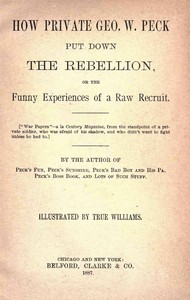
How Private George W. Peck Put Down the Rebellion or, The Funny Experiences of a Raw Recruit - 1887 — Context and Discussion
(0 User reviews)
712
Project Gutenberg
2008
Not confirmed
Humorous stories; Autobiographical fiction; War stories; United States -- History -- Civil War, 1861-1865 -- Fiction; Soldiers -- Fiction
Readers of public-domain and historical texts
Project Gutenberg digital edition
en
Edition facts
Words
101,561
Reading time
442 min
Text sections
11
How Private George W. Peck Put Down the Rebellion or, The Funny Experiences of a Raw Recruit - 1887 — Context and Discussion can be approached with a clearer sense of reading commitment from its source measurements: 101,561 words, 7 hr 22 min estimated reading time, and 11 detected text sections.
The text analysis averages about 27.4 words per sentence, while the detected sections provide another way to judge how the source is divided.
Project Gutenberg metadata also associates the work with “Humorous stories,” connecting these edition facts with the source record’s subject description.
Source:
Project Gutenberg record #25492
A Civil War memoir from a private's perspective, blending humor with gritty details of camp life, horse mishaps, and a female smuggler encounter, challenging official battle narratives.
Read the complete public-domain text at its original source.
Read on Project GutenbergGeorge W. Peck opens his Civil War memoir by taking aim at the grandiloquent battle accounts in the Century magazine, where every general claims his fight was decisive. Peck, a private, proposes to tell the true story from the ranks, and his version is conspicuously short on heroics and long on mishaps. The first chapter alone introduces a raw recruit who cannot mount a horse without a rail fence, a pattern of physical comedy that persists throughout the excerpts. The narrative voice is wry and self-deprecating, treating military life as a series of absurd obstacles rather than glorious engagements.
The Raw Recruit's Physical Comedy
The opening chapters establish a recurring motif of bodily incompetence. Peck describes mounting a horse “from the top of a rail fence,” a feat that requires more ingenuity than the actual riding. Later, he is thrown from the same horse and lands in a mud puddle, his uniform ruined. These episodes are not merely slapstick; they undercut the romantic image of the cavalryman. The narrator’s body is a source of trouble—he is too stiff, too slow, too clumsy. Even his first ride ends with him clinging to the saddle as the horse bolts, a scene that reads more like a vaudeville routine than a military drill. The humor is rooted in the gap between expectation and reality: the recruit expects to be a soldier but can barely stay on the horse.
The Female Smuggler and the Limits of Chivalry
One of the most extended episodes involves the capture of a female smuggler carrying quinine. Peck, acting on orders, searches her on the spot—a violation of the era’s gender norms. The scene is played for comedy, but it also reveals a tension between military duty and social propriety. The woman later reappears in New Orleans, married to a Confederate officer, and embraces Peck warmly. She jokes about her dress being unhooked, a detail that underscores the awkward intimacy of the encounter. The episode complicates the binary of enemy and ally: the smuggler becomes a friend, and her husband, a one-armed veteran, invites Peck to dinner. The war’s divisions dissolve into personal connections, yet the humor never lets the reader forget the underlying violence—the empty sleeve, the contraband, the search.
Undercutting Official History
Peck’s narrative is framed as a corrective to the self-serving accounts of generals. In the first chapter, he notes that “no general has lost a battle on either side” in the magazine articles, and that the war seems “a draw game.” His own story offers no decisive battles, only a series of small, inglorious episodes: a failed arrest, a stolen chicken, a night ride that ends in a ditch. The humor lies in the contrast between the grand claims of official history and the mundane reality of a private’s experience. Peck does not claim to have won the war; the title is ironic. By the end of the excerpts, the rebellion is “put down” only in the sense that the narrator survives, tells his tale, and shares a meal with former enemies. The book thus functions as a comic antidote to the heroic narrative, insisting that the war was also a farce.
Readers should approach this book as a deliberate counterpoint to the solemn war histories of the late nineteenth century. Peck’s humor is not merely entertainment; it is a method of critique. The episodes reward attention to detail—the way a horse throws him, the precise wording of a smuggler’s letter, the awkwardness of a reunion. The narrative voice is consistent, and the comedy builds through repetition and understatement. For those interested in the Civil War’s literary legacy, this work offers a rare enlisted man’s perspective, one that refuses to take itself seriously even as it questions the official record.
Peck’s memoir has a way of lingering, the way old camp stories do—half-laugh, half-ache. I found myself thinking about that same tenderness in The Rejuvenation of Aunt Mary — A Closer Reading, where growing older feels less like surrender and more like a quiet second chance. Both books hold their people gently, even when the world doesn’t.
There are no reviews for this eBook.
There are no comments for this eBook.
Reader reflection
What was your reading experience?
Capture what you thought, learned, and would like to remember.
Your progress
0
/
10
2
What was your overall reaction to the book?
3
How likely are you to recommend this book?
4
What was the reading difficulty like?
5
How clearly were the main ideas presented?
6
How strong was your personal connection to the text?
7
How well did it match your expectations?
8
How valuable was this book for your own interests?
9
What did this book teach you most?
10