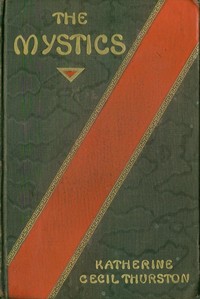
The Mystics: A Novel — Text and Context
Edition facts
The source record for The Mystics: A Novel — Text and Context measures this digital text at 31,385 words, 2 hr 17 min estimated reading time, and 5 detected text sections.
The text analysis averages about 16.8 words per sentence, while the detected sections provide another way to judge how the source is divided.
Project Gutenberg metadata also associates the work with “Inheritance and succession -- Fiction,” connecting these edition facts with the source record’s subject description.
Calculated from edition completeness, EPUB availability, text structure and catalogue metadata. Not a user rating.
How this score is calculated
- Description quality20 pts
- Title & short description10 pts
- Source metadata20 pts
- Text length15 pts
- Chapters / structure15 pts
- EPUB file integrity20 pts
Total of 100 points, scaled to a 2.5-5.0 range. Editions with an empty description or a missing EPUB file are not scored.
Read the Text
Henderson had failed for himself, and he failed equally for others. The years that followed his marriage were but the unwinding of a pitifully old story. Before his boy was ten years old he had run the gamut of humiliation; he had done everything that the pinch of poverty could demand, except apply for aid to his brother Andrew. This even the faithful, patient wife who had stood stanch in all his trials never dared to suggest.
In this atmosphere John learned to look upon life. A naturally high-spirited and courageous child, he gradually fell under that spell of premature understanding that is the portion of a mind forced too soon to realize the significance of ways and means. Day by day his serious eyes grew to comprehend the lines that marked his mother's beloved face; to know the cost at which his own education, his own wants, were supplied by the tired, silent father, who, despite his shabby clothes and prematurely broken air, seemed perpetually to move in the glamour of a past romance; and gradually, steadily, passionately, as these things came home to him, there grew up in his youthful mind a desire to compensate by his own future for the struggle he daily witnessed.
Many were the nights when--his lessons for the next day finished, and his father away at one of the many precarious tasks that kept the household together--he would draw close to his mother, as she sat industriously sewing, and beg her for the hundredth time to recount the story of the grim Scotch home where his father had lost his birthright; of the stern old grandfather who had died inexorably unforgiving; of the unknown uncle of whom rumor told many eccentric stories. And, roused by the recital, his boyish face would flush, his boyish mind leap forward towards the future.
"'Twill all come back, mother!" he would cry. "'Twill all come back! I'll win it back!"
And, with a sobbing laugh, his mother would drop her sewing and draw him to her heart in a sudden yearning of love and pride.
In such surroundings and in such an atmosphere he passed sixteen years; then the first upheaval of his life took place. His father died.
His first recollection--when the terrible necessities of the event were past, and his own grief and consternation had partially subsided--was the remembrance of his mother calling him to her room; of her kissing him, crying over him and telling him of the resolve she had taken to write and make known his existence to his uncle in Scotland.
The confession at first overwhelmed him. His own pride, his sense of loyalty to his father's memory prompted him to cry out against the idea as against a sacrilege. Then slowly his boyish, immature mind grasped something of the nobility that prompted the decision--something of the inexpressible love that counted sentiment and personal dignity as nothing beside his own future; and in a passion of gratitude he flung his arms about his mother, repeating the old childish vows with a new and deeper force.
So the letter to Scotland was despatched; and a time of sharp suspense followed for mother and son. Then, one never-to-be-forgotten day, the answer arrived.
Andrew Henderson wrote unemotionally. He expressed formal regret for his brother's death, but evinced no interest in his sister-in-law's position. He briefly described himself as living an isolated life in a small house on the sea-coast, a dozen miles from the family home which had remained untenanted since his father's death. He admitted that with advancing years the duties of life had begun to weigh upon him, diverting his mind and time from the graver pursuits to which his life was devoted; finally he grudgingly suggested that, should his nephew care to undertake the duties of secretary at a salary of sixty pounds a year, he might find a home with him.
The immediate feeling that followed the reading of the letter was fraught with chilling disappointment. On the moment, pride again asserted itself, urging a swift refusal of the rich man's proposal; then once more the patience that had kept Mrs. Henderson brave and gentle during seventeen years of wearing poverty made itself felt. All thought of personal grievance faded from her mind as she pointed out the urgent necessity of John's being seen and known by this uncle, whose only relation and ostensible heir he was. She talked for long, wisely and kindly--as mothers talk out of the unselfish fulness of their hearts--and with every word the golden castles of her imagination rose tower on tower to form the citadel in which her son was to reign supreme.
So wisely and so lovingly did she talk that she persuaded not only the boy, but herself, into the belief that he had but to reach Scotland to make his inheritance sure; and before the day closed she wrote to Andrew Henderson accepting his offer. A week later the whole light of her life went out, as she watched the train steam out of the station, carrying John northward.
Upon the days that followed his arrival in Scotland there is no need to dwell. He came as a stranger, and as a stranger he was introduced by his uncle to the routine of work expected of him. No mention was made of his recent loss, no suggestion was given that his mother should make her double bereavement easier by visits to her son. Whatever of hope or sentiment he had brought with him, he was left to destroy or smother as best he could.
The first week resolved itself into one round of boyish homesickness and desolation; then gradually, as the marvellous healing properties of youth began to stir, a new feeling awakened in his mind--a sense of curiosity concerning the strange old man whom fate, by a twist of the wheel, had made the arbiter of his life. Even to one so young and inexperienced, it was impossible to know Andrew Henderson and not to feel that some strange peculiarity set him apart from other men. In his ascetic face, in his large, light-blue eyes, in his extraordinary air of abstraction and aloofness from mundane things, there was something that fascinated and repelled; and with a wondering interest the boy studied these things, trying in his unformed way to reconcile them with his narrow experience of human nature.
For many weeks he sought without success for some key to the attitude of this new-found relative. Then one evening--when solution seemed least near--the key, metaphorically speaking, fell at his feet. Returning home from a ramble over the headland, his observant eye was caught by the sight of a narrow foot-track that, crossing the main pathway of the cliff, wound steeply upward and seemingly lost itself in a tangle of gorse and bracken. Stirred by a boyish desire for exploration, he paused, turned into this obscure track, and incontinently began its ascent.
For some hundreds of yards it led upward in a sharp incline; and with its added steepness, the ardor of the explorer warmed. With impetuous haste he climbed the last dozen yards; when, as the anticipated summit was reached, he halted in abrupt, dismayed surprise; for with alarming suddenness the land broke off short, disclosing a deep gap or fissure, carpeted with heather and surrounded by natural protecting walls of rock, in the centre of which was set a miniature chapel built of dark stone.
At sight of the little edifice, he thrilled with adventurous surprise. There was something mysterious, something almost fine in the sight of the small temple, with the setting sun gleaming on its solid walls, its low, massive door and round window of thick stained glass. He leaned out over the shelving rock, staring down upon it with wide, astonished eyes; then the natural instinct of the boy overtopped every other feeling. With a quick-movement of excitement and expectation, he began to descend into the hollow.
But though he walked round the little building a dozen times, shook the heavy door and peered ineffectually into the opaque window, nothing rewarded his curiosity, and after half an hour of diligent endeavor he was compelled to return home no wiser than when he had first stood on the summit of the path and looked down into the rocky cleft.
All that evening, however, the thought of his discovery remained with him. At the eight-o'clock supper of porridge, vegetables, and fruit which he shared with his uncle, he chafed under the silence of his companion and at the air of calm indifference that the whitewashed room with its raftered ceiling seemed to wear; and it was with a sigh of satisfaction that he rose from table and bade his uncle a formal good-night.
With the same suggestion of relief, he watched the old man light his candle and ascend the bare stairs to his own room; then prompted by the impulse he never neglected, he went into the study to write the daily letter that made his mother's existence bearable.
He wrote for nearly an hour, omitting no detail of the evening's discovery. Then, as he closed and sealed the letter, a clock on the mantel-piece struck ten. The sound had an oddly hollow and chilly effect in the bare, carpetless room; and unconsciously he raised his head and glanced about him. His ideas, still stirred by his adventure, were more prone than usual to the suggestion of outward things; and for almost the first time since his arrival, he felt drawn to study his intimate surroundings. With a new curiosity he let his eyes wander from the severe book-shelves to the ugly iron safe that stood in the most prominent position in the room; and from the safe his glance turned to the revolving bookcase by his uncle's favorite chair, in which lay the volumes that were in daily use. Following an impulse he had never previously been conscious of, he crossed the room, and drawing three books, at hap-hazard from the case, studied their titles.
_The Indissoluble Essence_, he read; _The Soul in Relation to the Human Mind_; _The Mystic Influence_.
He stood for a space gazing at the sombre covers, but making no attempt to dip into their pages; then a sudden look of comprehension sprang into his eyes. The oddly built stone chapel took on a new and more personal meaning. With a quick gesture he thrust the books back into their place, extinguished the lamp, and softly left the room. Gaining the hall, he did not turn towards the stairs; but tiptoeing to the table, picked up his cap, crossed the hall noiselessly and opened the outer door.
The warmth of the August day was still heavy on the air as he stepped into the open; a great copper-colored moon hung low over the sea, and a soft, filmy haze lay over both land and water. Without hesitation he turned into the cliff path, and followed it until his quick eyes caught the indistinct foot-track that he had discovered earlier in the evening. With the same decision, the same suggestion of anticipation, he stepped rapidly forward and once more began the sharp ascent.
The impetus of his curiosity carried him forward; he mounted the path in hot haste; then, as he gained the summit, he halted again, but in new surprise. In the hazy, mellow moonlight, the small building stood out sharp and dark as on his previous visit, but from the round, stained-glass window a flood of light--crimson, rose-color, and gold--poured out into the night.
In the first moment of astonishment, John stood motionless, his gaze riveted on the glow of color that poured through the window upon the rocks and heather of the cleft. Then, as he continued to stand with widely opened eyes, another surprise was sprung upon him. The door of the chapel opened and the figure of his uncle--long since supposed to be sleeping tranquilly in his own room--showed tall and angular in the aperture.
From John's position, the open door and the lighted interior of the little edifice were distinctly visible; and in one glance he saw his uncle's silhouetted figure and behind it a bare space some dozen feet square, lined on floor and walls with sections of marble alternately black and white. From the ceiling of this chamber depended an octagonal symbol in polished metal, and close by the door eight wax candles flickered slightly in the faint stir of air. But his astonished and inquisitive eyes had barely become aware of these details when Andrew Henderson turned towards the circular sconce in which the candles were set and began to extinguish them one by one. As the light died, he stepped forward and John drew back sharply; but at his movement a stone, loosened by his heel, went rolling down into the hollow. And a moment later his uncle, glancing up, saw his figure outlined against the luminous sky.
What the outcome of the incident would have been on any other occasion, it is difficult to say. As it was, the moment was propitious. Old Henderson, surprised in an instant of exaltation, was pleased to put his own narrow, superstitious construction on the boy's appearance. Laboring under an abnormal excitement, he showed no resentment at the fact of being spied upon; but calling John to him, ordered him to walk home beside him across the cliff.
Never was walk so strange--never were companions so ill-matched as the two who threaded their way back over the headland. Andrew Henderson walked first, talking all the time in a jargon addressed partly to the boy, partly to himself, in which mysticism was oddly tangled with a confusion of crazy theories and beliefs; behind came John, half fascinated and wholly bewildered by the medley of words that poured out upon the night.
On reaching the house, the old man became suddenly silent again, falling back as if by habit into the morose absorption that marked his daily life; but as he turned to mount the stairs to his own room, he paused and his curious light-blue eyes travelled over his nephew's face.
"Good-night!" he said. "You make a good listener."
And John--still confused and silent--retired to bed, to lie awake for many hours, partly thrilled and partly elated by the awesome thought that there was a madman in the house.
But all that had happened seven years ago, and now Andrew Henderson lay waiting for his end. In those seven years John had passed through the mill of deadly monotony that saps even youth, and lulls every instinct save hope. The first enthusiasm of romance that had wrapped the discovery of his uncle's secret had faded out with time. By slow degrees he had learned--partly from his own observation, partly from the old man's occasional fanatic outbursts--that the strange chapel with its metal symbol and marble floor was not the outcome of a private whim, but the manifestation of a creed that boasted a small but ardent band of followers. He had learned that--to themselves, if not to the world--these devotees were known as the Mystics; that their articles of faith were preserved in a secret book designated the Scitsym, which passed in rotation each year from one to another of the six Arch-Mystics, remaining in the care of each for two months out of the twelve. He had discovered that London was the Centre of this sect; and that its fundamental belief was the anticipation of a mysterious prophet--human, and yet divinely inspired--by whose coming the light was to extend from the small and previously unknown band across the whole benighted world.
He had learned all these things. He had been stirred to a passing awe by the discovery that his uncle was, in his own person, actually one of the profound Six who formed the Council of the sect and to whom alone the secrets of its creed were known; and for three successive years his interest and curiosity had been kindled when Andrew Henderson travelled to England and returned with the Arch-Councillor--an old blind man of seventy--who invariably spent one day and night mysteriously closeted with his host and then left, having deposited the sacred Scitsym with his own hands in the tall iron safe that stood in Henderson's study. But that annual excitement had lessened with time. Even a madman may become monotonous when we live with him, day in, day out, for seven long years; and gradually the attitude of John's mind had changed with the passage of time. The sense of adventure and triumphant enterprise had steadily receded; the knowledge that he was working out a slow, distasteful probation had advanced. Reluctantly and yet definitely he had realized that his position was not to come and conquer, but to watch and wait; and this consciousness of a tacitly expected end had grown with the years--with the growth of his mind and body. It was not that he was hard-natured. The regularity with which he despatched his yearly money to his mother--reserving the merest fraction for himself--precluded that idea. But he was young and human, and he was youthfully and humanly greedy to possess the good things of life for himself and for the one being he passionately loved. It would, indeed, have been an enthusiast in virtue who could have blamed him for counting upon dead men's shoes.
And now the shoes were all but empty! He stood watching his uncle die!
Having stayed almost motionless for several minutes, he glanced at the clock; then moved to the bed, taking a bottle and a medicine spoon from the dressing-table as he passed.
"Time for your medicine, uncle!" he said, in his quiet, level voice.
But the sick man did not seem to hear.
In a slightly louder tone John repeated his remark. This time the vacant expression faded slowly from the large, pale eyes, and Andrew Henderson moved his head weakly.
Seeing the indication of consciousness, John carefully measured out a dose of medicine, and, stooping over the pillows, passed one arm under his uncle's neck.
Andrew Henderson submitted without objection, but as his head was raised and the medicine held to his lips, he seemed suddenly to realize the position, to comprehend that it was his nephew who leaned over him. With a spasmodic movement he turned towards John, his lips twitching with some inward and newly aroused excitement.
"The Book, John!" he said, sharply--"the Book!"
John remained quite composed. With a steady hand he balanced the spoon of medicine that he still held.
"Your medicine first, uncle," he said, quietly. "We'll talk about the Book after."
But the old man's calm had been disturbed. With unexpected strength he raised one thin hand and pushed the spoon aside, spilling the contents on the bed.
"How can I leave it?" he exclaimed. "How can I go and leave the Book unguarded?" Again his lips twitched and a feverish brightness flickered in his eyes as they searched his nephew's face.
"When I go, John," he added, excitedly, "the Book may be in your keeping for hours--perhaps for a whole night. I know the Arch-Councillor will answer my summons immediately; but it is possible he may be delayed. It may be the ordination of the Unknown that I should Pass before he arrives. If this is so, I want you to guard the Book--but also I want you to guard my dead body. Let no one touch it until he comes. The key of the safe is here--" He fumbled weakly for the thin chain that hung about his neck. "No one must remove it--no one must touch it until he comes--" His voice faltered.
With a calm gesture John forced him back upon the pillows, and quietly wiped up the medicine.
But with a fresh effort the old man lifted himself again.
"John," he cried, suddenly, "do you understand what I am saying? Do you understand that for a whole night you may be alone with the inviolable Scitsym? 'The Hope of the Universe, by whose Light alone the One and Only Prophet shall be made known unto the Watchers!'" He murmured the quotation in a low, rapt voice.
Again the younger man attempted to soothe him.
"Don't distress yourself!" he said, gravely. "I am here. You can trust me. Lie back and rest."
But his uncle's face was still excitedly perturbed; his pale eyes still possessed an unnatural brightness.
"Oh yes!" he said, sharply, "I trust you! I have trusted you. I have left a letter by which you will see that I have trusted you--and that your fidelity has been rewarded. But this is another matter. Can I trust you in this? Can I trust you as myself?" As he put the question a sweat of weakness and excitement broke out over his forehead.
The novel opens with a deathwatch in a gaunt house on the Scottish coast, where John Henderson observes his uncle's final hours. The dying man's hands clasp an object on his chest, and his eyes fix on a distant ceiling point. The storm outside—wind roaring inland, rain lashing windows—mirrors the internal tension, yet both men remain self-engrossed, indifferent to the turmoil. This precise, atmospheric setting establishes a tone of isolation and impending revelation.
Death and the Unseen Object
The opening chapter dwells on the psychological weight of approaching death. The narrator asserts that no sensation is more powerful than knowing death has cast its shadow on a familiar life. John Henderson watches his uncle, whose face is an impenetrable mask, hands clasped over something hanging from his neck. The object is not named, but its presence suggests a secret or talisman. The scene is stark: a whitewashed room, oil lamps, a small iron bedstead. The uncle's cough and slow breaths are the only signs of life. This focus on a single, charged moment—waiting for death—creates a claustrophobic intensity that contrasts with the wild exterior.
The Prophet's Confession
Later, the Prophet confronts Enid in her room. He speaks with deliberate flippancy, undermining his own dignity. He mentions the routine at Hellier Crescent: Arch-Mystics perusing the Scitsym, the Precursor guarding the threshold. The Prophet admits he has come to make a confession, not from belief in unburdening conscience, but because Enid has a right to know. His tone shifts from ironic to grave as he says he is jeopardizing himself utterly. Enid perceives a change in him over seven days—a new, dominant emotion she cannot name. The scene hinges on the tension between his public role and private doubt.
Cult Structure and Symbols
The excerpts reveal a hierarchical cult with specific roles: the Prophet, the Precursor, and six Arch-Mystics. They study a text called the Scitsym, and the Prophet wears a symbolic octagonal figure on his breast, described as a mark of cruel laceration. The setting includes Hellier Crescent, presumably the cult's base. The Prophet's ability to alter prophecies and his ironic remark about a Prophet changing prophecies hint at manipulation. The cult's routine is rigid, but the Prophet breaks it to visit Enid, suggesting internal conflict. These details, though fragmentary, indicate a structured belief system with its own rituals and symbols.
The excerpts offer a glimpse into a story where personal crisis intersects with organized mysticism. Readers should note how the cult's language—'Scitsym,' 'Precursor,' 'Arch-Mystics'—creates a distinct vocabulary, and how the Prophet's confession may unravel the sect's authority. The incomplete text leaves questions about the uncle's object and the cult's true nature, inviting careful attention to the novel's gradual revelations.
Reading the uncle’s quiet death in that cold house, I remembered sitting with my own grandfather’s final breath—how strange the silence felt afterward. Prudence of the Parsonage — A Closer Reading gave me that same ache, the way grief settles into ordinary rooms, unannounced and permanent. Both stories hold that hush, that waiting.
James King
4 weeks agoBenjamin Torres
1 week ago-
Janet Steele - 1 month ago
{'review_type': 'neutral', 'text': 'The Mystics presents an intriguing premise with a focus on spiritual intrigue, and the atmosphere is well crafted. However, the pacing is uneven, and the characters sometimes feel distant. The philosophical digressions, while interesting, slow down the narrative. A decent read for those who enjoy thoughtful, slow-burn mysteries.'} -
Kimberly Parker - 4 weeks ago
{'review_type': 'negative', 'text': "The novel disappoints with its vague, banal mysticism and shallow characters. The plot meanders without a clear direction, and the resolution is lacking. The writing, while occasionally elegant, is bogged down by excessive philosophizing that adds little to the story. It's a tedious read that fails to deliver on its intriguing setup."} -
Nicole Anderson - 4 weeks ago
{'review_type': 'positive', 'text': 'A thought-provoking novel that delves into the mysterious world of mysticism with a gripping main character and an intricate plot. The narrative is richly layered, exploring themes of faith, doubt, and the supernatural with a modern sensibility. The prose is elegant, and the suspense builds steadily. A satisfying and cerebral read for fans of literary fiction and quiet thrillers.'}
How will you remember this book?
Save your reaction, strongest insight, and memorable passage.
Matthew Martinez
1 month ago