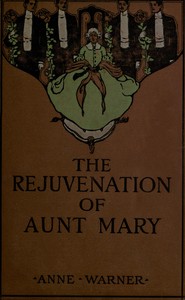
The Rejuvenation of Aunt Mary — A Closer Reading
Edition facts
This digital edition of The Rejuvenation of Aunt Mary — A Closer Reading is described by source-level measurements including 73,747 words, 5 hr 21 min estimated reading time, and 26 detected text sections.
The text analysis averages about 15.1 words per sentence, while the detected sections provide another way to judge how the source is divided.
Project Gutenberg metadata also associates the work with “New York (N.Y.) -- Fiction,” connecting these edition facts with the source record’s subject description.
Calculated from edition completeness, EPUB availability, text structure and catalogue metadata. Not a user rating.
How this score is calculated
- Description quality20 pts
- Title & short description10 pts
- Source metadata20 pts
- Text length15 pts
- Chapters / structure15 pts
- EPUB file integrity20 pts
Total of 100 points, scaled to a 2.5-5.0 range. Editions with an empty description or a missing EPUB file are not scored.
Read the Text
o the stern old great-aunt who never had paid any attention to her niece since she had chosen to elope with the doctor’s reprobate son. Now the father and mother were dead and buried, the brothers and sisters reinstated in their rights and had all grown up and become great credits to the old lady, whose heart had suddenly melted at the arrival of five orphans all at once. And there was only Jack to continue to worry about.
Jack was not anything particularly remarkable; he was just one of those lovable good-for-nothings that seem born to get better people into trouble all their lives long. He had been spoiled originally by being ten years younger than the next youngest in the family; and then, when the children had been shipped on to Aunt Mary’s tender mercies, Jack had won her heart immediately because she accidentally discovered that he had never been baptized, and so felt fully justified in re-naming him after her own father and having the name branded into him for keeps by her own religious apparatus. It followed naturally that John Watkins, Jr., Denham, for so her father’s daughter had insisted that her youngest nephew should be called, was the favorite nephew of his aunt.
And it was lucky for him that he was the favorite, for Aunt Mary, who was highly spiced at fifty, became peppery at sixty, and almost biting at seventy. And yet for Jack she would sign checks almost without a murmur. Mr. Stebbins was much more censorious and impatient with the young man than she ever was; and to all the rest of the world Mr. Stebbins was an urbane and agreeable gentleman, whereas to all the rest of the world Aunt Mary was a problem or a terror. But Mr. Stebbins needed to be a man of tact and management, for he was the real manager of that fortune of which “Mary, only surviving child of John Watkins, merchant and ship owner,” was the legal possessor; and so tactful was Mr. Stebbins that he and his powerful client had never yet clashed, and they had been in close business relations for almost as many years as Lucinda had been established on the hearthstone of the Watkins home. Perhaps one reason why Mr. Stebbins endured so well was that he had a real talent for compromising, and that he had skillfully transformed Aunt Mary’s inherited taste for driving a bargain into an acquired pleasure in what is really a polite form of the same action.
So, when it came to the matter of Jack’s difficulties, Mr. Stebbins could always find a half-way measure that saved the situation; and when he received the letter as to the cook and her claim he hied himself to the city at once, and wrote back that the claim could be settled for three hundred dollars.
“And enough, I must say,” Aunt Mary remarked to Lucinda upon receipt of the statement; “three hundred dollars for one cat—for, after all, Jack blames the whole on the cat, an’ he didn’t hit it, even then.”
Lucinda did not answer.
“But if the boy settles down now I shan’t mind payin’ the three—Where are you goin’?”
For Lucinda was walking out of the room.
“I’m goin’ to the door,” said she raspingly. “The bell’s ringin’.”
After a minute or two she came back.
“Telegram!” she announced, handing the yellow envelope over.
Aunt Mary put on her glasses, opened it, and read:
Cook has blood poison. Sues for a thousand. Probable amputation.
Aunt Mary dropped the paper with a gasp.
Lucinda looked at her with interest.
“It’s that same arm again,” said Aunt Mary, “just as I thought it was settled for!” Her eyes seemed to fairly crackle with indignation. “Why don’t she put it in a sling an’ have a little patience?”
Lucinda took the telegram and read it.
“’Pears like she can’t,” she commented, in a tone like a buzz saw; “’pears like it’s goin’ to be took off.”
Aunt Mary reached forth her hand for the telegram and after a second reading shook her head in a way that, if her companion had been a globe-trotter, would have brought matadores and Seville to the front in her mind in that instant.
“I declare,” she said, “seems like I had enough on my mind without a cook, too. What’s to be done now? I only know one thing! I ain’t goin’ to pay no thousand dollars this week for no arm that wasn’t worth but three hundred last week. Stands to reason that there ain’t no reason in that. I guess you’d better bring me my desk, Lucinda; I’m goin’ to write to Mr. Stebbins, an’ I’m goin’ to write to Jack, and I’m goin’ to tell ’em both just what I think. I’m goin’ to write Jack that he’d better be lookin’ out, and I’m goin’ to write to Mr. Stebbins that next time he settles things I want him to take a receipt for that arm in full.”
The letters were duly written and Mr. Stebbins, upon the receipt of his, redoubled his efforts, and did succeed in permanently settling with the cook, the arm being eventually saved. Aunt Mary regarded the sum as much higher than necessary, but still pleasantly less than that demanded of her, and so life in general moved quietly on until Easter.
But Easter is always a period of more or less commotion in the time of youth and leads to various hilarious outbreaks. Jack’s Easter took him to town for a “little time,” and the “little time” ended in the station-house at three o’clock on Sunday morning.
Accusation: Producing concussion of the brain on a cab driver.
The news was conveyed to Aunt Mary through private advices from Mr. Stebbins (who had been hastily summoned to the city for purposes of bail); she was very angry indeed, this time—primarily at the indignity done her flesh and blood by arresting it. Then, as she re-read the lawyer’s letter, other reflections crowded to the fore in her mind.
“Funny! Whatever could have made the boy get up and go downtown at three in the morning, anyway?” she said. “Seems kind of queer, don’t you think, Arethusa? Do you suppose he was ill and huntin’ for a drug store?”
Arethusa had been sent for the second day previous because Lucinda’s youngest sister’s youngest child had come down with scarlet fever, and the family wanted Lucinda to enliven the quarantine. Arethusa had sent invitations out for a dinner party, but she had recalled them and hastened to obey the summons. It was an evil hour for her, for she loved her brother and was mightily distressed at the bad news.
“I don’t believe he can have been ill,” she said, at the top of her voice; “if he’d been ill he wouldn’t have had the strength to hit the cab driver so hard.”
“I don’t blame him for hittin’ the cab driver,” said Aunt Mary warmly. “As near as I can recollect, I’ve often wanted to do that myself. But I can’t make out where he got the man to hit, or why he was there to hit him. I can’t make rhyme or reason out of it. I wish we knew more. Well, I presume we will, later.”
Her surmise was correct. They knew much more later. They knew more from Mr. Stebbins, and they knew profusely more from the evening papers.
“I think our boy’d better have come home for his Easter,” Aunt Mary remarked, with a species of angry undertow threading the current of her speech. “There’s no sayin’ what this will cost before we’re done with it.”
Arethusa choked; it was all so very terrible to her.
“What is it that the cabman wants, anyhow?” her aunt demanded presently.
“He doesn’t want anything,” yelled the unhappy sister. “He’s going to die.”
“Well, who is going to sue me, then?”
“It’s his wife; she wants five thousand dollars damages.”
Aunt Mary’s lips tightened.
“Five thousand dollars!” she said, with a bitter patience. “I can see that this is goin’ to be an awful business. Five thousand dollars! Dear, dear! I must say that that wife sets a pretty high price on her husband—at least, a’cordin’ to my order of thinkin’, she does. From what I’ve seen of cabmen, I’d undertake to get her another just as good for a tenth of the money, any day.”
Arethusa was silent, staring thoughtfully at the newspaper cuts of a great Tammany leader and a noted pugilist, which had been labeled as the principals in the family tragedy.
Aunt Mary turned over another of the many papers received, and scanned its sensational columns afresh.
“Arethusa,” she exclaimed suddenly, “do you know, I bet anythin’ I know what this editor means to insinuate? It just strikes me that he’s tryin’ to give the impression that our boy’s been drinkin’.”
“Perhaps so,” Arethusa screamed.
“Well, I don’t believe it,” said Aunt Mary firmly, “and I ain’t goin’ to believe it. And I ain’t goin’ to pay no five thousand dollars for no cabman’s brains, neither. You write to Mr. Stebbins to compromise on two or maybe three.”
She stopped and bit her lips and shook her head. “I don’t see why Jack grows up so hard,” she murmured, half in anger and half in sorrow. “Edward and Henry never had such times. Oh, well,” she sighed, “boys will be boys, I suppose; an’ if this all results in the boy’s settlin’ down it’ll be money well spent in the end, after all. Maybe—probably—most likely.”
The days that followed were anxious days, but at last the cabman rallied and concluded not to die, and Jack went off yachting with a light heart and a choice collection of good advice from Mr. Stebbins and Aunt Mary.
Nothing happened to mar his holiday. He ran a borrowed steam launch on to some rocks with rather heavy consequences to his aunt’s exchequer, and returned from the West Indies so late that she never had a visit from him at all that summer; but, barring these slightly unwelcome incidents, he did remarkably well, and when he returned to college in the fall he was regarded as having become, at last, a stable proposition.
“I wonder whether our boy’s comin’ home for Christmas?” Aunt Mary asked her niece, Mary, as that happy period of family reunions drew near. Mary had come up to stay with her aunt while Lucinda went away to bury a second cousin. Mary was very different from Arethusa, having a voice that, when raised, was something between an icicle and a steam whistle, and a temperament so much on the order of her aunt’s that neither could abide the other an hour longer than was absolutely necessary. But Arethusa had a sprained ankle, so there was no help for existing circumstances.
“No, he isn’t,” said Mary, who had no patience at all with her brother, and showed it. “He’s going West with the glee club.”
“With the she club!” cried poor Aunt Mary, in affright.
“I don’t like the idea,” said the old lady, shaking her head. “Somethin’ will be sure to happen. I can feel it runnin’ up and down my bones this minute.”
“Oh, if he can get into trouble, of course, Jack will,” said Mary cheerfully.
Aunt Mary didn’t hear her, because she didn’t raise her voice particularly. Besides, the old lady was absorbed for the nonce in the most dismal sort of prognostications.
And they all came true, too. Something unfortunate beyond all expectations came to pass during the glee club’s visit to Chicago, and the result was that, before the new year was well out of its incubator Jack had papers in a breach-of-promise suit served on him. He wrote Mr. Stebbins that it was all a joke, and had merely been a portion of that foam which a train of youthful spirits are apt to leave in their wake; but the girl stood solid for her rights, and, as she had never heard from her fiancé since the night of the dance, her family—who were rural, but sharp—thought it would take at least fifteen thousand dollars to patch the crack in her heart. If the news could have been kept from Aunt Mary until after Mr. Stebbins had looked into the matter, everything might have resulted differently. But the Chicago lawyer who had the case took good care that the wealthy aunt knew all as quickly as possible, and it seemed as if this was the final straw under which the camel must succumb.
And Aunt Mary did appear to waver.
“Fifteen thousand dollars!” she cried, aghast. “Heaven help us! What next?”
It was Lucinda who was seated calmly opposite at this crisis.
“Do you suppose he really did it?” the aunt continued, after a minute of appalled consideration.
“It’s about the only thing he ain’t never done,” the tried and true servant answered, her tone more gratingly penetrative than ever.
Aunt Mary eyed her sharply, not to say furiously.
“I wish you’d give a plain answer when I ask you a plain question, Lucinda,” she said coldly. “If you’d ever got a breach-of-promise suit in the early mail you’d know how I feel. Perhaps—probably.”
“I ain’t a doubt but what he done it,” Lucinda screamed out; “an’ if I was her an’ he wouldn’t marry me after sayin’ he would I’d sue him for a hundred thousand, an’ think I let him off cheap then.”
Aunt Mary deigned to smile faintly over the subtlety of this speech; but the next minute she was frowning blacker than ever.
“A girl from Kalamazoo, too, just up in Chicago for a week—just up in Chicago long enough to come down on me for fifteen thousand dollars.”
“Maybe she’ll take five thousand instead,” Lucinda remarked.
“Maybe!” ejaculated her mistress, in fine scorn. “Maybe! Well, if you don’t talk as if money was sweet peas an’ would dry up if it wasn’t picked!”
Lucinda screwed up her face.
Aunt Mary gave her one awful look.
“You get me some paper an’ my desk, Lucinda,” she said. “I think it’s about time I was takin’ a hand in it myself. I’ve been pretty patient, an’ I don’t see as it’s helped matters any. Now I’m goin’ to write that boy a letter that’ll settle him an’ his cats, an’ his cooks, an’ his cabmen, an’ his Kalamazoo, just once for all. I guess I can do what I set out to do. Pretty generally—most always.”
Lucinda brought the desk, and Aunt Mary frowned fearfully and began to write the letter.
It developed very strongly. As her pen sized up the situation in black and white, the old lady seemed to realize the iniquities of the case more and more plainly; and as the letter grew her wrath grew also. The whole came, in the end, to a threat—made in good earnest—to take a very serious step indeed if any more “foolishness” developed.
Aunt Mary prided herself on her granite-like will. She had full faith in her ability to slay her nearest and dearest if it seemed right and best to do so.
She sealed her letter tight, stuck the stamp on square and hard, and bid Lucinda convey it to Joshua and tell him never to quit it until he saw it safe on to the evening train.
“She’s awful mad at him for sure, this time,” said Lucinda after she had delivered her message, and while Joshua was considering the front and back of the letter with a deliberateness born of long servitude.
“I sh’d think she would be,” he said.
As nearly all of Jack’s private difficulties were printed in every newspaper in America, Joshua naturally was on the inside of all their history.
“She scrinched up her face just awful over that letter,” Lucinda continued. “I’m sure I wish he’d ’a’ been by to ’a’ taken warnin’.”
“He ain’t got nothin’ to really fret over,” said Joshua serenely; “he knows it, ’n’ I know it, ’n’ you know it, too.”
“You don’t know nothin’ of the sort,” said Lucinda. “She’s madder’n usual this time. She’s good an’ mad. You mark my words, if he goes off on a ’nother spree this spring he’ll get cut out o’ her will.”
“You mark my words!” rasped Lucinda, shaking her finger in witchlike warning.
Joshua laughed again.
“Them laughs best what laughs last,” said Aunt Mary’s handmaiden. She turned away, and then returned to give Joshua a look that proved that the peppery mistress had inculcated some cayenne into the souls of those about her. “You mark my words—them laughs best what laughs last, an’ there’ll be little grinnin’ for him if he ain’t a chalk-walker for one while now.”
But, as a matter of fact, Jack’s situation was suddenly become extremely precarious.
“There ain’t no sense in it,” said Aunt Mary to herself, with an emphasis that screwed her face up until she looked quite like Lucinda; “that life those young men lead on their little vacations is to blame for everything. Cities are wells of iniquity; they’re full of all kinds of doin’s that respectable people wouldn’t be seen at, and I’m proud to say that I haven’t been in one myself for twenty-five years. I’m a great believer in keepin’ out of trouble, an’ if Jack’d just stuck to college an’ let towns go, he’d never have met the cabman and the Kalamazoo girl, an’ I’d have overlooked the cook an’ the cat. As it is, my patience is done. If he goes into one more scrape he’ll be done too. I mean what I say. So my young man had better take warnin’. Probably—most likely—pretty certainly.”
Chapter Three Introducing Jack
It has been previously stated that Aunt Mary’s nephew, Jack, was a scapegrace, and as delightful as scapegraces generally are. It goes without saying that he was good-looking; and of course he must have been jolly and pleasant or he wouldn’t have been so popular. As a matter of fact, Jack was very good-looking, unusually jolly, and uncommonly popular. He was one of the best liked men in each of the colleges which he had attended. There was something so winning about his smile and his eternal good humor that no one ever tried to dislike him; and if anyone ever had tried he or she would not have succeeded for very long. It is probably very unfortunate that the world is so full of this type of young man, but that which should cause us all to have infinite patience with them is the reflection of how much more unfortunate it would be if they were suddenly eliminated from the general scheme of things.
Like all college boys, Jack had a chum. The chum was Robert Burnett, another charming young fellow of one-and-twenty, whose education had been so cosmopolitan in design and so patriotic in practice that he always said “Sacre bleu” and “Donnerwetter” when he thought of it, and “Great Scott” when he didn’t. He and Jack were as congenial a pair as ever existed, and they had just about as much in common as the aunt of the one and the father of the other had had to pay for.
In the February of the year of which I write, Washington, celebrating his birthday as usual, gave all American students their usual chance to celebrate with him. Celebrations were temptations incarnate to Jack, and he was feeling frowningly what a clog Aunt Mary’s latest epistle was upon his joys, when his friend came to the rescue with an invitation to spend the double holiday (it doubled that year—Sunday, you know) at the brand-new ancestral castle which Burnett père had just finished building for his descendants. It may be imagined that Jack accepted the invitation with alacrity, and that his never-very-downcast heart bounded gleefully higher than usual over the prospect of two days of pleasure in the country.
The novel opens with a crisis: Jack is threatened with expulsion from college, and his Aunt Mary is “much surprised and decidedly vexed—mainly at the college.” The narrator immediately establishes Aunt Mary’s deafness and arbitrariness through a chain of family obligations—Lucinda the maid must attend a wedding, so Arethusa is sent to stay with her aunt. This early scene, set in a domestic interior, introduces a pattern of movement between controlled spaces (Aunt Mary’s home) and the chaotic city beyond. The ear trumpet, a recurring prop, becomes a comic device that filters every conversation.
Ear Trumpets and Misheard Commands
The ear trumpet is more than a hearing aid; it is a structural pivot for dialogue. When Aunt Mary says, “I always hear what you say. Always,” the reader knows the opposite is true. The trumpet forces characters to shout, creating a rhythm of raised voices and misinterpretations. In one scene, Janice the maid mutters about clouds, and Aunt Mary mishears “Feel a fly?” This recurring gag underscores the gap between Aunt Mary’s perception and reality. The trumpet also serves as a status symbol: Lucinda, the indispensable maid, sits at the “off-end” of it, controlling what Aunt Mary hears. The device literalizes the theme of selective attention—Aunt Mary hears only what she wants, and the young men exploit this to orchestrate her adventures.
The City as a Series of Set Pieces
The narrative moves through distinct urban locations: a theater, a French café, a roof-garden, a yacht. Each setting is introduced with precise details—the theater lets out “somewhat after eleven,” the café serves supper late into the night. The yacht trip is preceded by a shopping expedition for a blue suit, rubber-soled shoes, and a yachting cap. These items are not mere props; they signal Aunt Mary’s transformation from housebound elder to adventurer. The city itself becomes a stage, with each chapter title marking a new scene: “Aunt Mary En Fête,” “Aunt Mary’s Night About Town.” The movement between interiors (her home, the café) and exteriors (the street, the Sound) creates a rhythm of confinement and release.
Food as a Marker of Experience
Meals punctuate the plot and reveal character. The young men breakfast on “ham and eggs” with uproarious energy, while Mitchell, the more cautious, eats “an old and reliable breakfast food.” Aunt Mary’s first café supper is a milestone—she has never been out so late. The yachting party’s ice cream, “provisioned for provisioning us all,” becomes a running joke about overpreparation. Food also signals discomfort: after the yacht trip, Aunt Mary collapses and declares, “put it down on that memoranda for me never to find no fault with nothing ever again.” The physical effects of new experiences—seasickness, indigestion—are treated with comic gravity, as if each meal and outing is a test of endurance.
The Rhythm of Repetition and Variation
Warner structures scenes around repeated patterns: a young man proposes an outing, Aunt Mary hesitates, then agrees with childlike trust. The phrase “I’m sure I shall have a good time” echoes across chapters. Each adventure follows a similar arc—preparation, journey, mishap, return—but the details vary. The yacht trip, for instance, is preceded by a calm drive and a shopping spree, then disrupted by weather. The narrator’s tone remains consistently ironic, noting Aunt Mary’s “colossal trust” and the young men’s casual manipulation. This repetition-with-variation gives the novel a cumulative comic effect, as Aunt Mary’s world expands incrementally while her essential character—deaf, stubborn, but game—remains unchanged.
Readers will find that the novel’s humor depends less on plot twists than on the friction between Aunt Mary’s limited perspective and the chaotic city around her. Pay attention to how the ear trumpet, the meals, and the repeated phrase “I’m sure I shall have a good time” build a portrait of a woman being gently, sometimes roughly, pushed into a new life. The structure rewards those who notice the small variations in each outing—the same joke told differently, the same trust betrayed anew.
I’ve always loved how Aunt Mary’s ear trumpet finally fell silent, her world opening through motion rather than sound. There’s a similar pulse in More Tish—that same stubborn joy of old bones refusing quiet corners. I find myself shelving them together, these companions in unrepentant liveliness, each whispering to the other across the years. More Tish — Text and Context rests beside her now, and I smile every time.
There are no reviews for this eBook.
Take a moment to reflect on this book
Create a short personal record of your experience with this book.
Eric Laura Santiago - 1 month ago
Nathan Smith - 1 month ago
Diana Judith Mitchell - 4 weeks ago