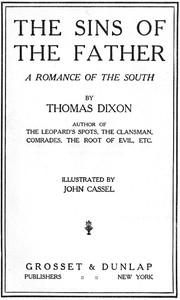
The Sins of the Father: A Romance of the South — Story, Setting & Ideas
Edition facts
For The Sins of the Father: A Romance of the South — Story, Setting & Ideas, the stored edition analysis reports 119,384 words, 8 hr 40 min estimated reading time, and 13 detected text sections.
The text analysis averages about 15.2 words per sentence, while the detected sections provide another way to judge how the source is divided.
Project Gutenberg metadata also associates the work with “Political fiction,” connecting these edition facts with the source record’s subject description.
Calculated from edition completeness, EPUB availability, text structure and catalogue metadata. Not a user rating.
How this score is calculated
- Description quality20 pts
- Title & short description10 pts
- Source metadata20 pts
- Text length15 pts
- Chapters / structure15 pts
- EPUB file integrity20 pts
Total of 100 points, scaled to a 2.5-5.0 range. Editions with an empty description or a missing EPUB file are not scored.
Read the Text
Schlitz had been a teamster's scullion in the Union Army. He was not even an army cook, but a servant of servants. He was now the master of the Legislature of a great Southern state and controlled its black, ignorant members with a snap of his bloated fingers. There was but one man Norton loathed with greater intensity and that was the shrewd little Scalawag Governor, the native traitor who had betrayed his people to win office. A conference of these two cronies was always an ill omen for the state.
He hurried up the winding stairs, pushed his way into a corner of the crowded galleries from which he could see every face and searched in vain for his young workman.
He stood for a moment, looked down on the floor of the House and watched a Black Parliament at work making laws to govern the children of the men who had created the Republic--watched them through fetid smoke, the vapors of stale whiskey and the deafening roar of half-drunken brutes as they voted millions in taxes, their leaders had already stolen.
The red blood rushed to his cheeks and the big veins on his slender swarthy neck stood out for a moment like drawn cords.
He hurried down to the Court House Square, walked with long, leisurely stride through the thinning crowds, and paused before a vacant lot on the opposite side of the street. A dozen or more horses were still tied to the racks provided for the accommodation of countrymen.
"Funny," he muttered, "farmers start home before sundown, and it's dusk--I wonder if it's possible!"
He crossed the street, strolled carelessly among the horses and noted that their saddles had not been removed and the still more significant fact that their saddle blankets were unusually thick. Only an eye trained to observe this fact would have noticed it. He lifted the edge of one of the blankets and saw the white and scarlet edges of a Klan costume. It was true. The young dare-devil who had sent that message to old Peeler had planned an unauthorized raid. Only a crowd of youngsters bent on a night's fun, he knew; and yet the act at this moment meant certain anarchy unless he nipped it in the bud. The Klan was a dangerous institution. Its only salvation lay in the absolute obedience of its members to the orders of an intelligent and patriotic chief. Unless the word of that chief remained the sole law of its life, a reign of terror by irresponsible fools would follow at once. As commander of the Klan in his county he must subdue this lawless element. It must be done with an iron hand and done immediately or it would be too late. His decision to act was instantaneous.
He sent a message to his wife that he couldn't get home for supper, locked his door and in three hours finished his day's work. There was ample time to head these boys off before they reached old Peeler's house. They couldn't start before eleven, yet he would take no chances. He determined to arrive an hour ahead of them.
The night was gloriously beautiful--a clear star-gemmed sky in the full tide of a Southern summer, the first week in August. He paused inside the gate of his home and drank for a moment the perfume of the roses on the lawn. The light from the window of his wife's room poured a mellow flood of welcome through the shadows beside the white, fluted columns. This home of his father's was all the wreck of war had left him and his heart gave a throb of joy to-night that it was his.
Behind the room where the delicate wife lay, a petted invalid, was the nursery. His baby boy was there, nestling in the arms of the black mammy who had nursed him twenty odd years ago. He could hear the soft crooning of her dear old voice singing the child to sleep. The heart of the young father swelled with pride. He loved his frail little wife with a deep, tender passion, but this big rosy-cheeked, laughing boy, which she had given him six months ago, he fairly worshipped.
He stopped again under the nursery window and listened to the music of the cradle. The old lullaby had waked a mocking bird in a magnolia beside the porch and he was answering her plaintive wail with a thrilling love song. By the strange law of contrast, his memory flashed over the fields of death he had trodden in the long war.
"What does it matter after all, these wars and revolutions, if God only brings with each new generation a nobler breed of men!"
He tipped softly past the window lest his footfall disturb the loved ones above, hurried to the stable, saddled his horse and slowly rode through the quiet streets of the town. On clearing the last clump of negro cabins on the outskirts his pace quickened to a gallop.
He stopped in the edge of the woods at the gate which opened from Peeler's farm on the main road. The boys would have to enter here. He would stop them at this spot.
The solemn beauty of the night stirred his soul to visions of the future, and the coming battle which his Klan must fight for the mastery of the state. The chirp of crickets, the song of katydids and the flash of fireflies became the martial music and the flaming torches of triumphant hosts he saw marching to certain victory. But the Klan he was leading was a wild horse that must be broken to the bit or both horse and rider would plunge to ruin.
There would be at least twenty or thirty of these young marauders to-night. If they should unite in defying his authority it would be a serious and dangerous situation. Somebody might be killed. And yet he waited without a fear of the outcome. He had faced odds before. He loved a battle when the enemy outnumbered him two to one. It stirred his blood. He had ridden with Forrest one night at the head of four hundred daring, ragged veterans, surrounded a crack Union regiment at two o'clock in the morning, and forced their commander to surrender 1800 men before he discovered the real strength of the attacking force. It stirred his blood to-night to know that General Forrest was the Commander-in-Chief of his own daring Clansmen.
Half an hour passed without a sign of the youngsters. He grew uneasy. Could they have dared to ride so early that they had reached the house before his arrival? He must know at once. He opened the gate and galloped down the narrow track at a furious pace.
A hundred yards from Peeler's front gate he drew rein and listened. A horse neighed in the woods, and the piercing shriek of a woman left nothing to doubt. They were already in the midst of their dangerous comedy.
He pressed cautiously toward the gate, riding in the shadows of the overhanging trees. They were dragging old Peeler across the yard toward the roadway, followed by the pleading voice of a woman begging for his worthless life.
Realizing that the raid was now an accomplished fact, Norton waited to see what the young fools were going to do. He was not long in doubt. They dragged their panting, perspiring victim into the edge of the woods, tied him to a sapling and bared his back. The leader stepped forward holding a lighted torch whose flickering flames made an unearthly picture of the distorted features and bulging eyes.
"Mr. Peeler," began the solemn muffled voice behind the cloth mask, "for your many sins and blasphemies against God and man the preachers of this county have assembled to-night to call you to repentance----"
The terror-stricken eyes bulged further and the fat neck twisted in an effort to see how many ghastly figures surrounded him, as he gasped:
"Oh, Lord--oh, hell--are you all preachers?"
"All!" was the solemn echo from each sepulchral figure.
"Then I'm a goner--that coffin's too big----"
"Yea, verily, there'll be nothing left when we get through--Selah!" solemnly cried the leader.
"But, say, look here, brethren," Peeler pleaded between shattering teeth, "can't we compromise this thing? I'll repent and join the church. And how'll a contribution of fifty dollars each strike you? Now what do you say to that?"
The coward's voice had melted into a pious whine.
The leader selected a switch from the bundle extended by a shrouded figure and without a word began to lay on. Peeler's screams could be heard a mile.
Norton allowed them to give him a dozen lashes and spurred his horse into the crowd. There was a wild scramble to cover and most of the boys leaped to their saddles. Three white figures resolutely stood their ground.
"What's the meaning of this, sir?" Norton sternly demanded of the man who still held the switch.
"Just a little fun, major," was the sheepish answer.
"A dangerous piece of business."
"For God's sake, save me, Major Norton!" Peeler cried, suddenly waking from the spell of fear. "They've got me, sir--and it's just like I told you, they're all preachers--I'm a goner!"
Norton sprang from his horse and faced the three white figures.
"Who's in command of this crowd?"
"I am, sir!" came the quick answer from a stalwart masquerader who suddenly stepped from the shadows.
Norton recognized the young cabinet-maker's voice, and spoke in low tense tones:
"By whose authority are you using these disguises, to-night?"
"It's none of your business!"
The tall sinewy figure suddenly stiffened, stepped close and peered into the eyes of the speaker's mask:
"Does my word go here to-night or must I call out a division of the Klan?"
A moment's hesitation and the eyes behind the mask fell:
"All right, sir--nothing but a boyish frolic," muttered the leader apologetically.
"Let this be the end of such nonsense," Norton said with a quiet drawl. "If I catch you fellows on a raid like this again I'll hang your leader to the first limb I find--good night."
A whistle blew and the beat of horses' hoofs along the narrow road told their hurried retreat.
Norton loosed the cords and led old Peeler to his house. As the fat, wobbling legs mounted the steps the younger man paused at a sound from behind and before he could turn a girl sprang from the shadows into his arms, and slipped to her knees, sobbing hysterically:
"Save me!--they're going to beat me--they'll beat me to death--don't let them--please--please don't let them!"
By the light from the window he saw that her hair was a deep rich red with the slightest tendency to curl and her wide dilated eyes a soft greenish grey.
He was too astonished to speak for a moment and Peeler hastened to say:
"That's our little gal, Cleo--that is--I--mean--of--course--it's Lucy's gal! She's just home from school and she's scared to death and I don't blame her!"
The girl clung to her rescuer with desperate grip, pressing her trembling form close with each convulsive sob.
The man drew the soft arms down, held them a moment and looked into the dumb frightened face. He was surprised at her unusual beauty. Her skin was a delicate creamy yellow, almost white, and her cheeks were tinged with the brownish red of ripe apple. As he looked in to her eyes he fancied that he saw a young leopardess from an African jungle looking at him through the lithe, graceful form of a Southern woman.
And then something happened in the shadows that stood out forever in his memory of that day as the turning point of his life.
Laughing at her fears, he suddenly lifted his hand and gently stroked the tangled red hair, smoothing it back from her forehead with a movement instinctive, and irresistible as he would have smoothed the fur of a yellow Persian kitten.
Surprised at his act, he turned without a word and left the place.
And all the way home, through the solemn starlit night, he brooded over the strange meeting with this extraordinary girl. He forgot his fight. One thing only stood out with increasing vividness--the curious and irresistible impulse that caused him to stroke her hair. Personally he had always loathed the Southern white man who stooped and crawled through the shadows to meet such women. She was a negress and he knew it, and yet the act was instinctive and irresistible.
He asked himself the question a hundred times, and the longer he faced it the angrier he became at his stupid folly. For hours he lay awake, seeing in the darkness only the face of this girl.
The conference of the carpetbagger with the little Governor proved more ominous than even Norton had feared. The blow struck was so daring, so swift and unexpected it stunned for a moment the entire white race.
When the editor reached his office on the second morning after the raid, his desk was piled with telegrams from every quarter of the state. The Governor had issued a proclamation disarming every white military company and by wire had demanded the immediate surrender of their rifles to the negro Adjutant-General. The same proclamation had created an equal number of negro companies who were to receive these guns and equipments.
The negroid state Government would thus command an armed black guard of fifty thousand men and leave the white race without protection.
Evidently His Excellency was a man of ambitions. It was rumored that he aspired to the Vice-Presidency and meant to win the honor by a campaign of such brilliance that the solid negro-ruled South would back him in the National Convention.
Beyond a doubt, this act was the first step in a daring attempt inspired by the radical fanatics in Congress to destroy the structure of white civilization in the South.
And the Governor's resources were apparently boundless. President Johnson, though a native Southerner, was a puppet now in the hands of his powerful enemies who dominated Congress. These men boldly proclaimed their purpose to make the South negro territory by confiscating the property of the whites and giving it to the negroes. Their bill to do this, House Bill Number Twenty-nine, introduced by the government leader, Thaddeus Stevens, was already in the calendar and Mr. Stevens was pressing for its passage with all the skill of a trained politician inspired by the fiercest hate. The army had been sent back into the prostrate South to enforce the edicts of Congress and the negro state government could command all the Federal troops needed for any scheme concocted.
But the little Governor had a plan up his sleeve by which he proposed to startle even the Black Radical Administration at Washington. He was going to stamp out "Rebellion" without the aid of Federal troops, reserving his right to call them finally as a last resort. That they were ready at his nod gave him the moral support of their actual presence.
That any man born of a Southern mother and reared in the South under the conditions of refinement and culture, of the high ideals and the courage of the old régime, could fall so low as to use this proclamation, struck Norton at first as impossible. He refused to believe it. There must be some misunderstanding. He sent a messenger to the Capitol for a copy of the document before he was fully convinced.
And then he laughed in sheer desperation at the farce-tragedy to which the life of a brave people had been reduced. It was his business as an editor to record the daily history of the times. For a moment in imagination he stood outside his office and looked at his work.
"Future generations simply can't be made to believe it!" he exclaimed. "It's too grotesque to be credible even to-day."
It had never occurred to him that the war was unreasonable. Its passions, its crushing cost, its bloodstained fields, its frightful cruelties were of the great movements of the race from a lower to a higher order of life. Progress could only come through struggle. War was the struggle which had to be when two great moral forces clashed. One must die, the other live. A great issue had to be settled in the Civil War, an issue raised by the creation of the Constitution itself, an issue its creators had not dared to face. And each generation of compromisers and interpreters had put it off and put it off until at last the storm of thundering guns broke from a hundred hills at once.
It had never been decided by the builders of the Republic whether it should be a mighty unified nation or a loose aggregation of smaller sovereignties. Slavery made it necessary to decide this fundamental question on which the progress of America and the future leadership of the world hung.
He could see all this clearly now. He had felt it dimly true throughout every bloody scene of the war itself. And so he had closed the eyes of the lonely dying boy with a reverent smile. It was for his country. He had died for what he believed to be right and it was good. He had stood bareheaded in solemn court martials and sentenced deserters to death, led them out in the gray morning to be shot and ordered them dumped into shallow trenches without a doubt or a moment's hesitation. He had walked over battlefields at night and heard the groans of the wounded, the sighs of the dying, the curses of the living, beneath the silent stars and felt that in the end it must be good. It was war, and war, however cruel, was inevitable--the great High Court of Life and Death for the nations of earth.
But this base betrayal which had followed the honorable surrender of a brave, heroic army--this wanton humiliation of a ruined people by pot-house politicians--this war on the dead, the wounded, the dying, and their defenseless women--this enthronement of Savagery, Superstition, Cowardice and Brutality in high places where Courage and Honor and Chivalry had ruled--these vandals and camp followers and vultures provoking violence and exciting crime, set to rule a brave people who had risked all for a principle and lost--this was a nightmare; it was the reduction of human society to an absurdity!
For a moment he saw the world red. Anger, fierce and cruel, possessed him. The desire to kill gripped and strangled until he could scarcely breathe.
Nor did it occur to this man for a moment that he could separate his individual life from the life of his people. His paper was gaining in circulation daily. It was paying a good dividend now and would give his loved ones the luxuries he had dreamed for them. The greater the turmoil the greater his profits would be. And yet this idea never once flashed through his mind. His people were of his heart's blood. He had no life apart from them. Their joys were his, their sorrows his, their shame his. This proclamation of a traitor to his race struck him in the face as a direct personal insult. The hot shame of it found his soul.
When the first shock of surprise and indignation had spent itself, he hurried to answer his telegrams. His hand wrote now with the eager, sure touch of a master who knew his business. To every one he sent in substance the same message:
"Submit and await orders."
As he sat writing the fierce denunciation of this act of the Chief Executive of the state, he forgot his bitterness in the thrill of life that meant each day a new adventure. He was living in an age whose simple record must remain more incredible than the tales of the Arabian Nights. And the spell of its stirring call was now upon him.
The drama had its comedy moments, too. He could but laugh at the sorry figures the little puppets cut who were strutting for a day in pomp and splendor. Their end was as sure as the sweep of eternal law. Water could not be made to run up hill by the proclamation of a Governor.
He had made up his mind within an hour to give the Scalawag a return blow that would be more swift and surprising than his own. On the little man's reception of that counter stroke would hang the destiny of his administration and the history of the state for the next generation.
On the day the white military companies surrendered their arms to their negro successors something happened that was not on the programme of the Governor.
The novel opens with a striking image: the young editor of The Daily Eagle and Phoenix straightening his tie, a gesture that signals the careful self-presentation required of a public man in the Reconstruction South. Dixon immediately establishes a world where personal composure is a fragile shield against scandal. The dedication to Randolph Shotwell—soldier, editor, Klansman—and the author's note claiming the central figure is drawn from the authentic history of Major Daniel Norton, ground the fiction in specific regional and political soil. The table of contents divides the work into two books, 'Sin' and 'Atonement,' framing the narrative as a moral arc. The first chapter's title, 'The Woman in Yellow,' introduces a figure whose color-coded presence suggests both allure and warning.
The Beast Within: Language of Control and Loathing
In the excerpted confrontation between Norton and Cleo, Dixon deploys a vocabulary of animality and mastery that recurs throughout the text. Norton refers to 'the Beast in him' stirred by Cleo's presence, and later describes her 'sensual thickness of the negroid type'—a phrase that collapses racial and sexual anxiety into a single epithet. His posture during their argument is described with deliberate physicality: 'his hands thrust into his pockets, his feet wide apart, his whole attitude one of cool defiance.' The dialogue is a series of commands and ultimatums: 'I am waiting for you to go,' 'You'll do nothing of the kind,' 'I'm master of this house.' This pattern of assertion and resistance suggests that power in this novel is negotiated through bodily stance and verbal brinkmanship, not merely through social position.
The House as Battleground: Domestic Space and Hidden Knowledge
The domestic interior in these excerpts functions as a theater of surveillance and secrecy. Cleo watches Norton from the window as he leaves, then swiftly enters his vacated room to learn the typewriter. The room is described with 'books and papers scattered loosely over his table' and the typewriter 'left open'—details that emphasize vulnerability and intrusion. The house is also a site of contested authority over servants: Norton insists on keeping Minerva and Andy despite Cleo's demands, asserting 'I'm master of this house.' Yet Cleo's threat to change 'my relations to your servants' hints at a power that operates through domestic channels rather than public ones. The locked room, the watched window, the learned machine—these small actions accumulate into a pattern where the home becomes a space of covert warfare.
The Weight of a Word: Silence as Strategy and Sentence
Throughout the confrontation, silence is wielded as both weapon and vulnerability. Cleo tells Norton, 'I've been silent too many years. It's a habit I'll not easily break,' while Norton acknowledges that 'a word from you and Helen's life is blasted.' The threat of speech—of a secret revealed—hangs over every exchange. Dixon underscores this through Norton's internal state: 'a sickening fear slowly stealing into his heart' after he leaves. The novel's structure, with its two books titled 'Sin' and 'Atonement,' implies that the withheld word is itself a form of sin, and that its eventual utterance will drive the plot toward atonement. The reader is positioned to wait for the word that will break the silence and shatter the precarious order of Norton's life.
Readers attentive to the novel's political context will note that the Ku Klux Klan appears in the catalog subjects, and the dedication to a 'Clansman' signals Dixon's investment in Lost Cause ideology. The excerpts, however, focus on personal rather than institutional conflict. The tension between public reputation and private guilt, between the editor's civic role and his hidden past, may reward attention to how Dixon uses the newspaper office and the home as parallel stages for the drama of concealment.
There’s a heaviness in Dixon’s Carolina—secrets that press down like humidity. It made me think of how Shakespeare’s imagined daughter carries her own quiet burdens, though hers are lighter, more hopeful. There’s a tenderness in both, the way private lives bend under stories not yet told. I keep returning to that thought. Judith Shakespeare: Her love affairs and other adventures — A Closer Reading feels like an echo, but a softer one.
There are no reviews for this eBook.
How will you remember this book?
Save your reaction, strongest insight, and memorable passage.